
Google’s Gemini Small Business Tools: What Owners Can Hand Off and What to Keep

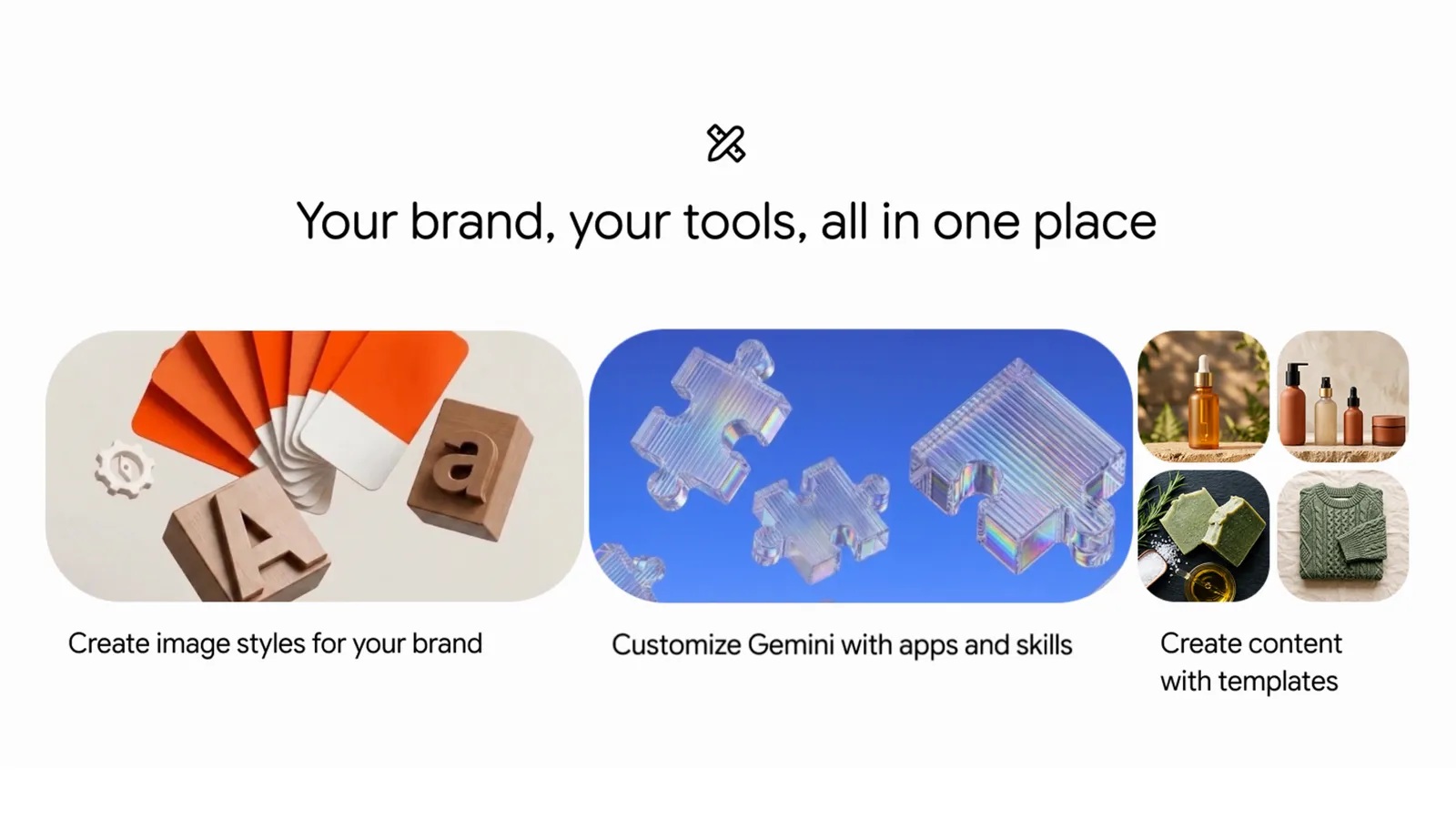
Google on Oct. 20 began rolling out a business hub in Gemini that saves brand guidelines, analyzes financial files and connects to seven third-party apps, including Shopify, Canva and Xero. The launch puts Gemini small business tools in direct competition with Meta, which added business features to its Muse agent three weeks earlier.
Google’s new Gemini small business tools are a dedicated landing page inside the Gemini app. Owners can save brand guidelines once, generate matching marketing visuals, turn spreadsheets and receipts into financial charts, and connect Google Business Profile, Google Ads, Workspace, Shopify, Canva, Xero and other apps. Google says the rollout reaches all Gemini app users globally in the coming days.
For owners, the practical decision is narrower than the launch suggests: which jobs can move to an AI system this quarter, and which still need a person checking every figure.
What Are Google’s New Gemini Small Business Tools?
The tools combine a business landing page with three capabilities: saved brand styles, financial analysis and app connections. From the hub, owners can build brand assets, analyze finances and review customer insights. Gemini now links to Google Business Profile, Google Ads and Google Workspace, alongside Adobe, Canva, Dropbox, Shopify, Wix, Zoho and Xero.
Google says tens of millions of small business owners already use Gemini to brainstorm products, manage customer feedback and analyze performance. Vishnu Sivaji, senior director of the Gemini app, wrote in an Oct. 20 company blog post that the tools are meant to give entrepreneurs “their time back so they can focus on what started it all: their passion.” The company is pitching admin relief, not a new category of software.
Brand Style Memory
Owners can upload a website, brand kit, fonts or color palettes. Gemini then pairs that style with Nano Banana 2.1, Google’s latest image generation model, to produce launch and campaign visuals. The style stays saved, so owners don’t re-upload guidelines for each request. For a one-person shop without a designer, that removes the most repetitive step in producing social graphics.
Financial Analysis
Google says Gemini can turn messy spreadsheets, receipts and purchase records into charts and interactive models within seconds. That claim comes from the company, and Google has not published accuracy figures for the feature. A café owner could drop in a month of supplier receipts and ask which ingredient costs rose fastest. That makes a useful starting point for a supplier conversation. It is not a substitute for reconciled accounts.
What Google’s Customer Stories Do and Do Not Show
Google’s announcement features five owners: a ceramicist in Bordeaux, France; a ginger farmer in Maharashtra, India; a professional organizer in Goiânia, Brazil; a sports venue founder in Jakarta, Indonesia; and a restaurant and butcher shop owner in New Jersey. The Bordeaux ceramicist, who runs Bleu Clémentine, saves two to three hours a day by drafting product descriptions, newsletters and social posts with Gemini, the company said.
The Maharashtra farmer, Santosh Jadhav, used Gemini to evaluate soil suitability, calculate seed requirements and draft an investment budget, according to Google. Those are high-stakes uses. A wrong seed calculation or budget line costs a season, which is why outside verification matters more as tasks move from marketing copy to money.
These stories describe how owners used Gemini before the business hub existed. None reports results from the new landing page, brand memory or finance features, which had not reached users when the post went live. The time savings are self-reported figures published by the vendor. Owners weighing the Gemini business hub should treat them as illustrations rather than benchmarks.
How Does the Gemini Business Hub Compare With Meta Muse for Small Business?
The two products overlap by design, but they differ in reach, connectors and stated controls. Meta’s agent links to Instagram analytics, Facebook Pages and Meta ad accounts, plus Canva, Intuit QuickBooks, Shopify, Slack and Stripe. Meta says Muse publishes, sends or spends nothing without the owner’s approval. Muse is available only in the U.S. and Canada.
Both companies sell the same promise. Meta said in its announcement that small businesses told it they are “short on hours, not ideas.” On cost, Meta says most everyday Muse uses are free, with subscription plans for heavier usage. Google’s Oct. 20 post did not list separate pricing for the business tools and did not describe an approval step for connected apps. Owners should confirm both before linking an ad account or accounting software.
Connector fit matters more than feature lists. Gemini’s launch list names Xero and Zoho but not QuickBooks, while Meta Muse for Small Business names QuickBooks. A bakery running its books in QuickBooks would get finance context from Muse today but would need to export files to use Gemini. Geography settles the rest: an owner in Pune, Jakarta or São Paulo can use the Gemini business hub, while Muse remains closed to them for now.
Are Small Businesses Ready for AI Agents?
Adoption numbers suggest the audience exists. A Small Business & Entrepreneurship Council survey, conducted online by TechnoMetrica from Sept. 11-19 among 516 owners of firms with two to 99 employees, found 58% use AI agents regularly or occasionally. Another 14% are considering or planning to. The survey’s credibility interval is plus or minus 4.4 percentage points, and the SBE Council is a small business advocacy group.
Readiness lags use. A Wakefield Research survey for TD Bank of 200 U.S. owners, conducted Aug. 17-28 among firms with 100 or fewer employees and at least $100,000 in annual revenue, found 99% use AI in some way. Even so, 40% named AI adoption as an area where they feel unprepared, and 43% said the same of technology and operations. Chris Ward, head of small business banking at TD Bank U.S., said in a statement that business owners “are looking for trusted partners who can help them turn confidence into action.”
The pattern holds outside the U.S. A YouGov poll commissioned by Meta of 3,983 owners across nine Asia-Pacific markets, fielded Aug. 6 to Sept. 2, found 84% use AI and 86% want more guidance to benefit from it. Cost was the leading barrier to AI training, cited by 51%. Meta competes directly with Google for these customers, so the findings come from an interested party.
That small business AI adoption gap matters because the hub assumes owners will configure connectors and brand kits themselves. Google’s announcement does not mention onboarding support or training.
When Small Businesses Should Not Rely on Gemini
Accuracy is the strongest case against handing over more work. In a Simply Business online survey of 1,047 U.S. owners, conducted between the fourth quarter of 2025 and the first quarter of 2026, 36% named accuracy as a barrier, 34% data security and 31% the learning curve. Only 10% said they would let AI handle their business insurance. Simply Business is an insurance marketplace, which gives it a stake in that last finding.
Connecting an agent to live business systems adds a second layer of risk. Agent access to business apps raises concerns about incorrect actions and prompt injection, and rework can erode the time saved. Prompt injection means hidden instructions in a document or webpage that redirect what the AI does. A wrong chart costs an afternoon. A wrong action inside an ad account can cost real money.
Three jobs should stay off AI tools for small business for now: filing taxes or payroll, drafting contracts or legal notices, and making final spending decisions. Each carries liability that a solo owner absorbs personally. Use the finance feature to surface questions, then answer them from your actual books or with your accountant.
How to Test Gemini Small Business Tools in 30 Days
A short, structured trial shows whether the hub saves time or simply adds review work.
- Week 1, brand visuals. Upload your brand kit and generate five social graphics. Review each before posting. Mistakes here are visible and cheap to fix.
- Week 2, finance read-out. Give Gemini a copy of last quarter’s sales export, never the live file. Compare its totals with your accounting software line by line.
- Week 3, one connector. Link a single app, such as Google Business Profile, and read the permissions screen before approving.
- Week 4, measurement. Log minutes saved and minutes spent fixing output each day. If fixes eat more than half the saved time, scale back.
- Day 30, decision. Keep the tasks that passed, drop the rest and revisit in a quarter.
What Small Business Owners Should Do Next
Gemini small business tools give owners outside the U.S. and Canada an agent-style option that Meta does not yet offer them. Brand visuals are the safest early use, since errors show up before anything goes public. Finance analysis works for raising questions, not settling them. Pricing and approval controls for connected apps are absent from Google’s announcement, so verify both inside the app before linking any account.
This week, open Gemini, check whether the business landing page has appeared, and run Week 1 of the trial before connecting a single financial account.
Frequently Asked Questions
What is the Gemini business hub?
The Gemini business hub is a landing page inside the Gemini app for small business owners. It gathers brand building, financial analysis and customer insights in one place, saves brand styles for image generation and connects to Google and third-party apps. Google announced it on Oct. 20, 2026.
Is the Gemini business hub free?
Google said the business landing page, marketing and finance skills and new connected apps are rolling out to all Gemini app users. Its announcement did not list separate pricing for the business tools. Owners should check plan limits inside the app before relying on the features for daily work.
Which apps connect to Gemini’s small business tools?
Gemini connects to Google Business Profile, Google Ads and Google Workspace. Google also named seven third-party apps at launch: Adobe, Canva, Dropbox, Shopify, Wix, Zoho and Xero. QuickBooks was not on the launch list, so QuickBooks users may need to export files to analyze them in Gemini.
Is Gemini’s business hub available in India?
Yes. Google said the tools are rolling out globally to all Gemini app users in the days after the Oct. 20 announcement, and its launch examples included a ginger farmer in Maharashtra. Meta’s competing Muse agent, by contrast, is available only in the U.S. and Canada.
How is Gemini different from Meta Muse for Small Business?
Gemini’s hub is global and links to Google tools plus apps such as Xero and Shopify. Muse is limited to the U.S. and Canada, links to Instagram, Facebook and Meta ads, and names QuickBooks and Stripe. Meta says Muse acts only with owner approval; Google’s post did not describe approval controls.
Can Gemini do my small business accounting?
No. Gemini can turn spreadsheets, receipts and purchase records into charts and models, which helps owners spot trends and questions. It does not replace reconciled books, tax filings or payroll. Check any figure it produces against your accounting software or an accountant before acting on it.