

Over Labor Day weekend in 2014, Alex Guirguis and a group of friends drove four cars from Seattle to Crater Lake in Oregon. On the way home, all four were pulled over and ticketed for speeding. Contesting Oregon tickets from Washington meant hiring a lawyer in another state. Someone said there had to be an app for that. There wasn’t. Guirguis, now Co-Founder and CEO of Off The Record, has spent the years since making fighting traffic tickets as easy as paying them.
At the time, Guirguis and co-founder Mark Mikhail were senior software engineers on Fulfillment by Amazon. Off The Record applies the same thinking to traffic court. A driver photographs a ticket, sees an upfront legal fee, and is matched by the company’s SmartMatch system with an independent local attorney who knows that court. The company says it helps hundreds of thousands of drivers a year through more than 1,000 partner law firms in all 50 states, with a 97% rate of favorable outcomes.
Pricing is where the model surprised people. When Off The Record launched in New York, fighting a ticket typically cost around $500. Once firms could see each other’s fees, prices dropped, and today more than one in ten New York cases books for $100 or less. The company never asked a single firm to cut its fees.
In an exclusive interview with Neha Mehra, founder of Entrepreneur Loop, Guirguis explains why paying a ticket is treated as a guilty plea, why winning over attorneys was a trust problem before a tech problem, and how traffic tickets became Off The Record’s version of Amazon’s books.
- [MANDATORY] Could you start by introducing yourself and telling us about your journey that led to founding Off The Record? What sparked your interest in disrupting the traffic court system?
I’m Alex Guirguis, Co-Founder & CEO of Off The Record, a legal technology platform that connects drivers with independent local attorneys to fight their traffic tickets. We help hundreds of thousands of drivers each year, and the whole company rests on one idea: fighting a ticket should be as easy as paying one.
It started with a camping trip. Over Labor Day weekend in 2014, a group of friends and I drove from Seattle down to Crater Lake in Oregon, in four separate cars. On the drive home, all four cars got pulled over in Oregon and ticketed for speeding. Four cars, four tickets. Oregon did very well on that trip.
Then came the hard part: doing something about it. We were Washington drivers with Oregon tickets. Fighting them meant finding a local attorney in a state none of us lived in, making sense of an unfamiliar court’s paperwork, and doing all of it from home. At some point one of us said, “There has to be an app for this.” There wasn’t.
At the time, my co-founder, Mark Mikhail, and I were both senior software engineers at Amazon, on Fulfillment by Amazon, the service that stores and ships products for third-party sellers. Our whole job was hiding complexity: sellers, warehouses, carriers and last-mile delivery, all behind a button that says “Buy Now.” Traffic court had the same kind of complexity and none of that infrastructure. Thousands of courts, tens of millions of cases, and drivers were expected to figure it out on their own.
And this isn’t some niche corner of the legal system. Nearly half of all cases filed in America’s state courts are traffic cases, according to the National Center for State Courts. For most people, a traffic ticket is the legal system. Yet most go through it without guidance, and without realizing that paying is treated as pleading guilty.
That’s the gap Off The Record was built to close. We’re not here to help anyone dodge accountability. We’re here so drivers make that decision knowing what they’re agreeing to, with a local attorney on their side if they want one.
- You mentioned that most people don’t realize they’re interacting with a legal system when they get a ticket. How did you discover this disconnect, and what research or personal experiences shaped your understanding of this problem?
Honestly, I discovered it by being the exception. Before that Oregon trip, I’d fought a few tickets in Seattle, and it was easy: my brother and I had a lawyer friend who handled them for us. So I already knew the fine is rarely the real cost.
Then I started asking friends and coworkers what they did after getting a ticket. Almost everyone gave the same answer: “I just paid it.” Not “I weighed my options and paying made the most sense.” They just paid it.
When I asked why, the answer was always the same. People assumed fighting a ticket meant hiring a lawyer, taking time off work and sitting in a courthouse. Whether or not that’s true, believing it is enough to make paying feel like the easy option.
That’s when it clicked. The difference between me and everyone else wasn’t that I understood traffic law. It was a phone number. I happened to know a lawyer; they didn’t. Drivers weren’t making bad decisions. They were making the only decision anyone made obvious.
That’s why most drivers never contest a ticket, even when they think it was wrong. And what bothered me most was what they didn’t realize they were agreeing to. Paying a ticket is treated as pleading guilty. The conviction goes on your driving record, where insurers can see it, and it can mean points, higher premiums and consequences that follow you for three to five years, depending on the state.
So the real disconnect isn’t only that people don’t know they can fight a ticket. It’s that paying looks like the end of the problem, when it’s often the start of a more expensive one. Off The Record is basically that lawyer friend, for everyone.
- The hidden costs of traffic tickets—turning a $150 ticket into $1,500+ in insurance increases—is a shocking revelation for many drivers. Can you walk us through how you identified this financial chain and decided to build a business around solving it?
The fine is usually the smallest part of what a ticket costs. There are really three layers.
The first is the fine, which is the part everyone sees. The second is the fees and surcharges courts add on top, which can add a lot to what you owe. The third, and usually the most expensive, is insurance.
A single traffic ticket raises premiums 20–30% on average. LendingTree found that one speeding ticket raises the average driver’s premium by about $525 a year, and a 20-year-old’s by about $1,184 a year. More serious violations hit harder: Bankrate found that a DUI nearly doubles the average full-coverage premium.
Drivers do connect those dots, just too late. A jump of $500 a year at renewal gets noticed, so people call their insurer to ask why, and the answer is that recent ticket. The problem is timing. Nobody paying a ticket thinks, “If I pay this, my insurance goes up.” They find out months later, when the higher bill arrives. By then, the ticket is a conviction on their record and there’s usually nothing left to fight. The damage is done.
That’s the gap we built the business around. The only time you can still do something about a ticket is before you pay it, and that’s exactly when nobody tells you what it will really cost.
- Off The Record operates in what you call “the largest and most frequently used court system in the United States” with 40+ million cases annually. How did you approach entering such a massive, established market?
The biggest challenge wasn’t the size of the market. It was that those cases are spread across thousands of courts and jurisdictions. When you tell investors or advisors you’re focused on traffic court, the first question is usually, “If this is such a big opportunity, why hasn’t someone already done it?”
The answer is that the market is massive but incredibly fragmented. Traffic law varies by state, county, city and sometimes by individual court. There’s no national standard and no central system. What works in one jurisdiction may not work in the next, which makes scaling much harder than it looks.
That fragmentation is also what kept the opportunity open. It’s not a problem a big law firm wants, because there’s no single system to plug into. It’s not one most tech companies gravitate toward either, because the surface area is huge and the domain knowledge runs deep. You have to be willing to build the network jurisdiction by jurisdiction before the product works at scale.
So rather than trying to standardize everything, we embraced it. We built a platform that connects drivers with local attorneys who already know their courts, judges and procedures. The expertise already existed. What was missing was a fast, transparent way for drivers to reach it, at a price that made sense.
The other thing we recognized is that with that many cases, even a small change in driver behavior matters. Our position is simple: if a ticket would go on your driving record or raise your insurance, fight it. Our job is to make that easy enough that people actually do it, and to show them their options in minutes, before they pay.
- Building a consumer marketplace that connects drivers with local attorneys is complex. What were the biggest technical and operational challenges you faced in creating this platform?
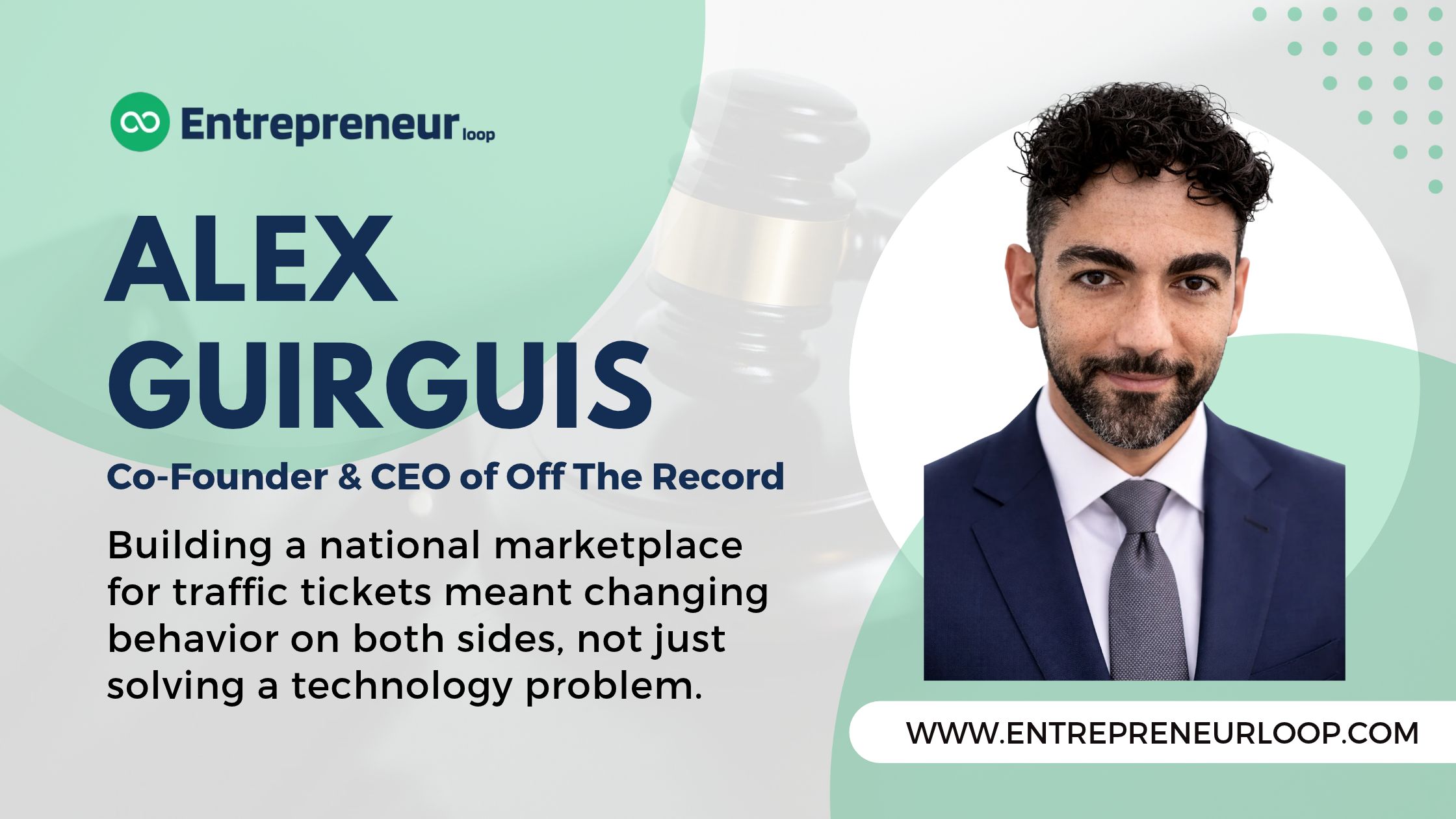
Building a national marketplace for traffic tickets meant changing behavior on both sides, not just solving a technology problem.
On the driver side, most people have been trained to treat a ticket like a utility bill: you get it, you pay it, you move on. We had to show people that a ticket is a legal and financial decision, not just a payment. That meant making the alternative simple, transparent and easy to understand. If fighting a ticket felt complicated or intimidating, people would go right back to paying it.
On the attorney side, we were asking lawyers to think about client acquisition differently. Traffic attorneys traditionally relied on referrals, advertising and their own outreach. We offered a different model: cases delivered through the platform that match the courts and charges they handle. We had to prove the volume and efficiency would make it worthwhile.
I’ll be honest about what we got wrong early on. We assumed attorneys would adopt the platform quickly once they saw the volume. What we underestimated was how much trust had to come first. These are small business owners who built their practices on relationships and reputation. Handing intake to a platform felt like losing control, not gaining efficiency. We had to earn that trust attorney by attorney and market by market. It took longer than we expected, and it taught us that marketplaces in professional services are trust problems before they’re logistics problems.
Technology turned out to be the easy part. It does exactly what you tell it to do. If there’s a bug, it’s probably your fault: you find it, you fix it, done. You own the outcome.
People are different. We can’t control human behavior. If an attorney is slow to respond, the client is the one left waiting. If an attorney misses a court date, or never tells the client how the case was resolved, the client pays the price. In many courts, a missed appearance can lead to a default guilty judgment, and a negotiated reduction can end up recorded as a guilty plea if the client doesn’t pay the agreed amount in time.
So we didn’t just build technology for court processes across thousands of jurisdictions. We built a platform that accounts for human behavior and human error. If we find that an attorney has a pattern of ghosting clients or cutting corners, we end the relationship. That keeps the network healthy. But even the best partners slip sometimes, so we give them the tools and data they need to spot problems and fix them before a client feels it.
Could someone build the Off The Record app in a weekend? Probably. Copycat apps pop up almost every year. Does that worry us? Not one bit. Building the app is the easy part. Earning the trust of drivers and attorneys, and building technology around invisible court processes and human behavior, is the hard part. That’s where we’ve spent more than a decade.
- How do you ensure quality control and maintain trust between drivers and attorneys on your platform? What vetting processes do you have in place?
Trust is the foundation of the business. Drivers usually come to us during a stressful moment, and they’re trusting us to connect them with someone who can protect their record, their insurance rates and sometimes their livelihood. If we get that wrong, nothing else matters.
Vetting starts before an attorney joins the platform. We verify that they’re licensed and in good standing, review their disciplinary history and look at their experience in the courts they want to serve. We’re not just looking for licensed attorneys. We’re looking for attorneys who regularly practice where our drivers’ cases will be heard.
From there, we keep evaluating. Running a marketplace means we can track outcomes over time. Drivers don’t pick an attorney; our SmartMatch technology connects them with an appropriate local attorney for that court and charge, so cases aren’t simply handed to whoever is available. Every case that runs through the platform gives SmartMatch more to learn from.
We’ve also built accountability into the model. Cases are backed by a money-back guarantee on eligible tickets: if a favorable outcome isn’t achieved, the client gets a full refund of the legal fee. That keeps everyone focused on results.
At the end of the day, our reputation depends on delivering. Keeping the trust of both drivers and attorneys is what has let us keep growing.
- The legal industry is traditionally slow to adopt new technology. How did you convince attorneys to join your platform and change their traditional business model?
Attorneys don’t join Off The Record because of the technology. They join because it solves real business problems: finding clients and running an efficient practice.
Attorneys are running small businesses. Solo practitioners and small traffic firms spend a lot of time and money on client acquisition: intake calls, referral networks, advertising and leads that don’t convert. It’s a lot of friction, and it’s unpredictable. What we offered was simpler: cases delivered directly, with clear details about the violation and the court, ready to act on.
The model also rewards good work. Attorneys who deliver strong results, respond quickly and keep clients happy get matched with more cases through SmartMatch. That link between performance and opportunity is very different from a traditional referral network.
In practice, adoption has been strongest among attorneys who already handle high-volume traffic and criminal work, and among those earlier in their careers who are more open to efficiency-driven tools. They saw right away that spending less time on intake meant more time practicing law.
The legal industry moves slowly, but attorneys move quickly when the economics are clear. Once we showed consistent volume and efficiency, the value was hard to ignore.
Once an attorney starts working with us, they tend to stay. When one leaves on their own, it’s usually because they’re retiring or changing careers.
The relationship changed over time, too. In the early days, attorneys saw Off The Record as bonus cases: extra income on top of their own marketing. Then something we didn’t expect happened. The more cases we sent a firm, the less it spent on its own marketing and administration. Today, many of our partner firms rely on Off The Record for most or all of their cases.
I’ll never forget the first time an attorney called to tell me they were about to buy a house. They wanted to make sure they were in good standing with us before signing the mortgage. You can bet that added to the pressure on my shoulders. I already felt responsible for my employees and their families. That day, I realized attorneys, law firms and their staff were counting on us too, counting on Off The Record to stay strong so their firms could.
- What’s your business model, and how do you balance making the service accessible to everyday drivers while ensuring fair compensation for attorneys?
Our model starts on the attorney side, with what we call a fee menu. Each law firm chooses the types of cases it wants, the courts it wants to work in, and what it charges. Some firms only take traffic tickets in a single court. Others handle traffic and criminal cases across an entire state. Where they practice and what they charge is completely up to them.
On the driver side, the fee is upfront. You see it before you book, it’s set by the exact violation on your ticket, and it covers the attorney’s work; any fine or court costs are separate. It’s also backed by a money-back guarantee on eligible tickets: if a favorable outcome isn’t achieved, the client gets a full refund of the legal fee.
SmartMatch sits in the middle. When a driver submits a ticket, it connects them with the most appropriate firm for that case, meaning one with a strong track record on that type of case in that court. Price matters too. If two firms have a similar track record, response rate and customer service rating, but one charges more, SmartMatch connects the driver with the better-priced firm. Firms know they’re competing for the business. When they manage their fee menu, they can see whether they’re competitive and what the going range is.
That competition did something we’re really proud of: it brought prices down. Before Off The Record, hiring a traffic attorney meant calling around, sitting through a consultation and getting a quote you could take or leave. Fees weren’t posted, and there was no easy way to compare. When we launched in New York, fighting a ticket typically cost around $500. Once firms could see where they stood, one attorney figured out that a lower fee would win more cases, and the others followed. In 2017, the cheapest case booked through Off The Record in New York cost $184. Today, more than one in ten New York cases books for $100 or less. We saw the same thing in Washington, our first market. Fighting a ticket in Seattle cost about $400 when we started in 2015. Today, about one in five Washington cases books for $150 or less.
We never asked a single firm to lower its fees, and we never tell attorneys what to charge. Prices settled where supply meets demand as soon as drivers could compare. The $500 price tag wasn’t the cost of the work. It was the cost of having no competition. That’s what access to justice looks like in practice.
When attorneys hear that, some of them panic. Lower prices sound like lower income. The opposite happened. At $500, very few drivers fight a ticket. At $99, a lot of them do. Attorneys earn less per case, but they handle far more cases than they ever got on their own.
The marketplace also removed a layer of markup. In our early markets, a handful of well-known firms charged clients around $400 per ticket, then paid a junior attorney about $50 to handle the case in court. When Off The Record arrived, it was those junior attorneys, the ones in court every day, who joined. They set their own fees, around $250 at first. The driver paid $150 less than the going rate, and the attorney doing the work earned several times more. That’s the power of an open, transparent marketplace.
What surprises people is how the math looks from the driver’s side. According to LendingTree, one speeding ticket raises premiums by about $525 a year on average. Now compare that with a one-time legal fee. More than half the cases booked through Off The Record cost $250 or less. With a 97% success rate, the math usually favors fighting.
- From a regulatory standpoint, how do you navigate the different traffic laws and court systems across various states and municipalities?
Traffic law working differently across thousands of courts is one of our biggest operational challenges, and it’s also the reason the model exists.
There’s no federal standard for traffic law. A speeding ticket in Manhattan is handled very differently from one in rural Texas. Deadlines vary, court procedures vary, and what’s contestable in one jurisdiction may not be in the next. Even the consequences, like fines, points and how a conviction is reported, differ by state, county and sometimes by court.
So our approach isn’t to centralize the legal system. It’s to work within it. We build a network of attorneys who are deeply experienced in their own jurisdictions and know the local courts, judges and procedures that often shape outcomes. The platform provides the infrastructure; the legal expertise is entirely local.
On compliance, we’re careful about the line between legal technology and the practice of law. Off The Record is a legal technology platform that connects drivers with independent local attorneys. Off The Record is not a law firm. The attorney represents the client, and the court decides the outcome.
Ticket types matter too. A camera citation is often a civil matter that carries no points, which is very different from an officer-issued moving violation. The right next step depends on what’s actually on the ticket.
That structure takes ongoing attention as rules evolve, especially around legal advertising and legal technology. But it’s what lets us operate across thousands of jurisdictions without forcing a single system onto something that’s local by design.
- What role does technology play in streamlining the traditionally fragmented legal process you mentioned? Are you leveraging AI or other emerging technologies?
Technology is what lets us simplify one of the most fragmented legal processes in the country without asking drivers to understand the complexity behind it.
The most important piece is SmartMatch, which I mentioned earlier. Instead of a driver trying to figure out who to call, the platform does the matching in the background.
We’ve also put a lot into intake. If you can take a photo of a ticket, you can start the process. We built Off The Record to make hiring a traffic attorney feel like a modern consumer product, not a courthouse scavenger hunt. When drivers enter their ticket details, Off The Record typically tells them what kind of violation it is and whether a court appearance is required. They see an upfront legal fee, and in most cases they don’t have to appear in court themselves.
We’re early adopters of AI, and it’s already built into key parts of our platform. Internally, AI tools have made our team faster and more accurate.
Where it gets exciting is data. Every case teaches us something: which court, which charge, what outcome, what it cost. We have big plans to put all of that to work, with AI features that tell a driver what they’re really facing the moment they get a ticket, before they’ve paid, and match them with the right attorney for their exact case. Stay tuned.
- How do you educate consumers about the true cost of traffic tickets and the value of contesting them rather than simply paying?
The biggest challenge is timing. Most people don’t research traffic tickets until they have one in hand, and by then they want it gone as fast as possible. That creates a narrow window where urgency drives the decision more than information.
Our approach is to meet drivers inside that window, between getting the ticket and deciding what to do. That means showing up where people look first, like searching what a ticket will do to their insurance or whether it’s worth fighting. In that moment, the most important thing is making the real cost clear: not just the fine, but the impact on their insurance and driving record.
We also keep the comparison simple. When a driver can see that paying means a conviction and years of higher premiums, and can see an attorney’s fee upfront before deciding, the choice looks different. The key is putting that tradeoff in real dollars, not legal terms.
Fastlane Teen comes from the same thinking. Young drivers get hit hardest: LendingTree found one speeding ticket raises a 20-year-old’s premium by about $1,184 a year. Fastlane Teen is free for every driver under 20 in the U.S. It covers the attorney’s fee on a teen’s first eligible ticket, plus 25% off the attorney’s fee on a second ticket in the membership year. Fastlane Teen is like an airbag: you hope you never use it, but you’re glad it’s there.
Outside the platform, a lot of education comes from broader awareness. Every story about the hidden cost of a ticket helps more drivers understand that the fine isn’t the whole story, before they’re ever in that position.
What changes behavior isn’t explaining how the legal system works. It’s making the financial consequences clear enough that people can see the difference for themselves.
- What metrics do you track to measure success, and what have been your key achievements since launching?
The metric that matters most is outcomes. We have a 97% success rate in achieving a favorable outcome, meaning the ticket was kept off the record entirely, through a dismissal or deferral, or its impact was meaningfully reduced, like a 6-point ticket reduced to 2 points. That number matters more than any growth metric, because the business runs on trust, and trust depends on whether fighting a ticket through Off The Record actually works.
On the achievement side, we help hundreds of thousands of drivers each year, and we’ve built a network of 1,000+ partner law firms across all 50 states.
The number I’m proudest of is the drivers helped, because each one is a person who could have just paid and chose to push back instead, often after learning for the first time that it was an option.
One achievement that doesn’t show up on a spreadsheet: Traffic Tales, our animated series that turns real traffic stops, taken from public bodycam footage, into short comedy episodes. It’s grown to close to 400,000 followers, and we regularly see comments saying it’s someone’s favorite account, or that it should be a Netflix show. Honestly, we’re still not sure it makes business sense. But we have a lot of fun making it, and if it makes us laugh and it makes our audience laugh, it’s worth it. Follow us on Instagram and TikTok (@offtherecordapp) and judge for yourself.
- Where do you see Off The Record in the next 5 years? Are there plans to expand into other areas of legal tech beyond traffic violations?
We already have. Traffic tickets are what we’re known for, but Off The Record also connects people with local attorneys for DUIs and other traffic and non-traffic misdemeanors and felonies.
The way I think about it: Amazon started with books. Books were never the end goal. They were where Amazon earned enough trust to sell people everything else. Mark and I saw that playbook up close, and it’s ours too. Traffic tickets are our books. They’re the most common way Americans end up in court, and they’re where we’ve earned drivers’ trust, one ticket at a time.
Over the next five years, we’re building toward every legal problem a consumer can have: an eviction hearing, an adoption, a medical malpractice claim. The same fragmentation and the same “just deal with it” instinct exist in all of them.
Our goal is for Off The Record to be the first place anyone goes with a legal problem. You’d understand what you’re really facing, get matched with the best lawyer for your specific case, and pay a fair fee you can see upfront.
Legal help shouldn’t feel reserved for special circumstances or big budgets. The instinct should shift from “I’ll just deal with this” to “Let me see what my options are.” That’s the shift we’re building for.
- What advice would you give to other entrepreneurs looking to disrupt traditional, established industries like the legal system?
Don’t.
Okay, I’m half joking. Old industries run on paperwork and precedent. They’re slow, they’re inefficient, and they’ve been that way for a very long time. If the industry is regulated, like the legal system, add regulators to the list of people who can tell you no. Still here? Good. Here’s what I’d tell you.
First, challenge the norm, or the default behavior. Every established industry has something people do automatically, not because it’s the best option but because it’s the only one anyone makes obvious. In traffic law, it was paying the ticket. Nobody decided paying was right; the alternative just felt harder than it was. Once you find a default like that, your job is to make the alternative so much easier that the default stops making sense.
Second, make the incumbents your partners, or at least the right ones. We never set out to replace lawyers. Off The Record isn’t a law firm, and every case is handled by a licensed local attorney. We set out to send lawyers clients and take the friction out of getting them. Not every incumbent will welcome you, especially the well-established ones who do just fine with how things work today. But plenty will, starting with the ones those established players have been squeezing. For us, that was the junior attorneys doing the courtroom work for a fraction of the fee. In a regulated industry, the people you think you’re disrupting are often the people you need most. Build something that makes their business better, and they become your biggest advocates instead of your biggest obstacle.
Third, design for how people actually behave, not how you wish they would. A lot of industries build for an ideal user who is patient, informed and motivated. Real users are busy, stressed and quick to give up. If your product requires someone to understand the system before they can use it, you’ve already lost most of your market.
Finally, don’t confuse disruption with destruction. The goal isn’t to tear systems down for the sake of it. It’s to improve them where they weren’t built for how people live today. The legal system isn’t broken by intent; parts of it are just outdated. Fix those gaps in a way that makes the system more accessible and more trustworthy, not less.
The argument at the center of Off The Record fits on the back of a ticket. Most drivers pay because nobody has made another option obvious, and the insurance increase that follows often costs far more than the fine. Guirguis had a lawyer friend to call. The company was built to give every driver the same thing, with a price on the screen before they decide.
The slower work, according to Guirguis, was earning the trust of attorneys who run small practices. Many partner firms now rely on Off The Record for most or all of their cases. The lighter side of the business lives in Traffic Tales, its animated series on Instagram and TikTok at @offtherecordapp. The next step is bigger: taking the same model to evictions, adoptions and malpractice claims, so that Off The Record becomes the first place anyone goes with a legal problem.