
Keikku Digital Stethoscope: Lapsi Health’s Clinical AI Bet

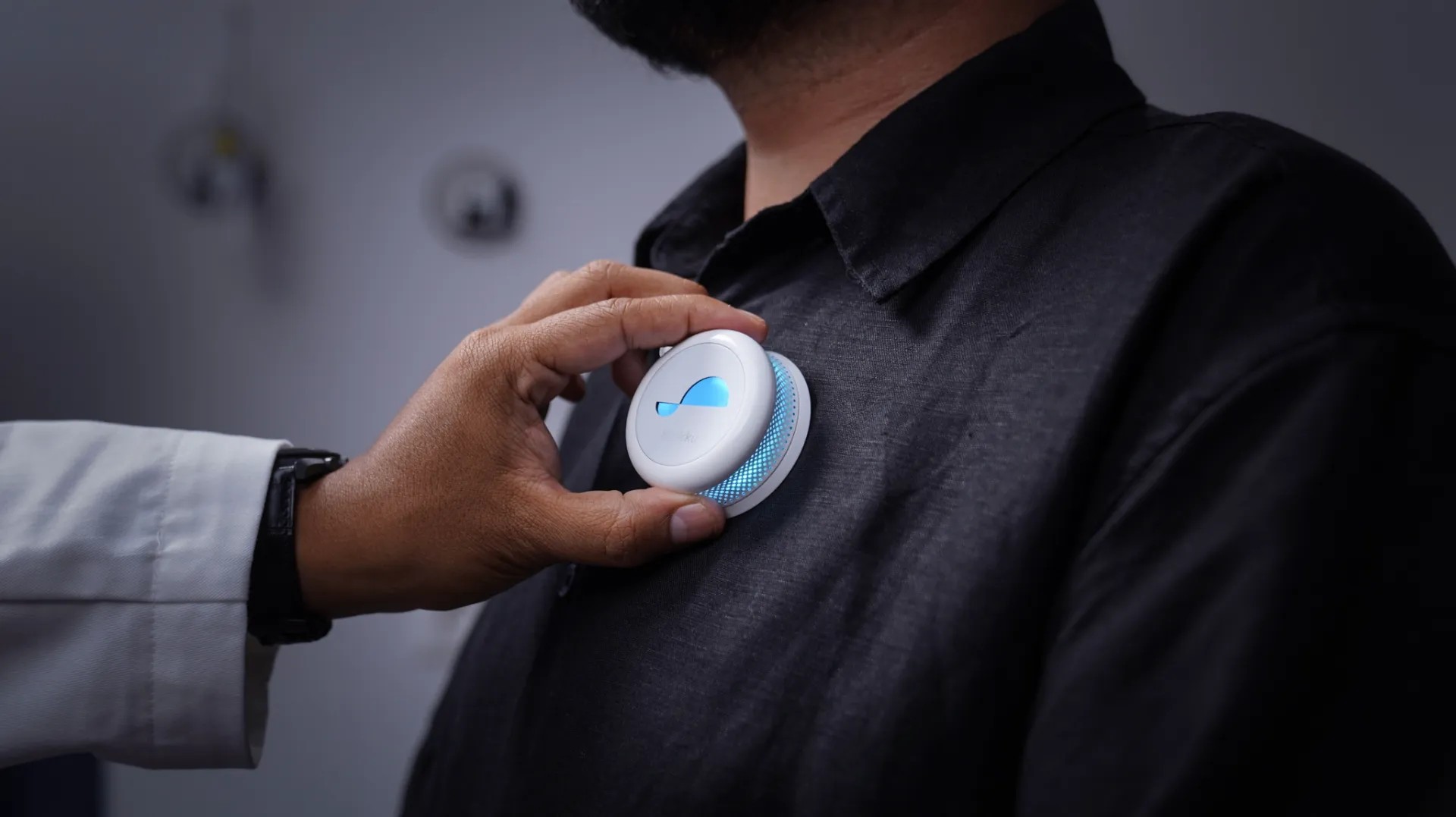
Lapsi Health won FDA clearance for the Keikku digital stethoscope and put it on sale to US clinicians in 2024 at $350, a price close to rival Eko’s devices. Two years on, the Amsterdam startup sells something bigger than a stethoscope.
The Keikku digital stethoscope is a pocket-sized, FDA-cleared electronic stethoscope from Lapsi Health. It amplifies and filters heart and lung sounds, flags possible murmurs, and can switch into an ambient AI scribe that turns a consultation into clinical notes. In Europe, Lapsi now sells Keikku mainly as a clinical AI platform.
What is the Keikku digital stethoscope?
You hold Keikku against the chest like any chestpiece. It boosts the sound, cuts background noise, filters frequencies and streams the audio to a phone app. If Lapsi’s software hears a possible murmur or an odd lung sound, the clinician gets an alert. Keikku 2.0, launched in October 2025, added an ambient mode that transcribes the visit and drafts a note for the health record.
The hardware is small. The Keikku digital stethoscope weighs about 100 grams and sends audio over Bluetooth Low Energy through a Nordic Semiconductor chip, so it behaves more like a wireless gadget than a tube-and-bell instrument.
The 2025 update also opened the Keikku digital stethoscope to other software. Lapsi built an API gateway, so the device can feed third-party scribe tools as well as its own Keikku AI. For a clinic that already pays for a scribe, this open design matters more than any single spec.
The name means “child” in Finnish. Several founders have ties to Finland, and the first idea was to help children with asthma by catching warning signs in their breathing. Lapsi was incorporated in early 2022 after a pre-seed round. Its backers include Modi Ventures, 1921 VC and Mentors Fund. 1921 VC, a fund built around type 1 diabetes, has said it invested because heart conditions linked to diabetes are what kill patients, and earlier detection could change that. That origin explains the early focus on lung sounds, years before paperwork became the selling point.
A visit with a stethoscope with AI scribe
Here is how one visit could run. A patient comes in with a cough. The doctor starts scribe mode on the Keikku digital stethoscope, talks through the symptoms, then switches to listening. The chest sounds stream to the app, and if the software hears something unusual, an alert pops up. When the visit ends, a draft note is waiting.
The value of a stethoscope with AI scribe shows up in minutes, so measure them. During a pilot, time how long notes take before and after, for at least two weeks. Track how often you edit the draft and how often the alerts send you back to listen again. Those numbers will tell you more than any brochure. For the listening side, save a week of flagged recordings and ask a colleague to review them blind. If the alerts mostly point at sounds you had already caught, they add comfort but little new information.
Two habits keep the visit safe. Tell the patient the visit is being transcribed, and record their consent. And treat every alert as a reason to listen again, not as a diagnosis.
Where Keikku is cleared, and for what
Regulators have reviewed two different things, and launch coverage often blurs them.
United States
The FDA cleared the Keikku digital stethoscope in 2024 as an electronic stethoscope that amplifies, filters and transmits body sounds. That clearance came before the scribe existed as a product.
European Union
In Europe, the order flipped. Lapsi’s European launch followed the Class I classification of Keikku Scribe under the EU Medical Device Regulation, and clinicians reach it through web and mobile apps. So the CE MDR Class I certification covers the documentation software. Class I is the lowest risk tier in the EU system.
For a buyer, the difference is practical. A European clinic looking at the Keikku digital stethoscope today is buying a regulated scribe and reference tool first. The status of the AI murmur detection in your own country is a separate question.
How Keikku became a clinical AI platform
Since its CE MDR Class I certification, the European product reads more like a software suite than a gadget. Next to the ambient AI scribe, it offers clinical reference answers drawn from more than three million peer-reviewed articles, guidelines and protocols, each with citations. Larger buyers get EHR links, single sign-on and custom workflows. The Keikku digital stethoscope is now one input among several.
The company’s own description has moved with the product. In an October 29, 2026 announcement naming former Philips Latin America chief Fabia Tetteroo-Bueno to its board, Lapsi called Keikku a clinical AI platform built on an FDA-cleared ambient microphone system. It also said Keikku is deployed at institutions in Europe and the USA, and that Tetteroo-Bueno will guide its push across Latin America.
The shift makes business sense. A stethoscope is a one-time sale in a market where Eko started years earlier. Software is a monthly or yearly bill, and the Keikku digital stethoscope gives Lapsi a physical foothold in the exam room that pure-software scribes lack. The risk runs the other way too. Ambient scribing is a crowded field, and Lapsi now competes there with much larger companies.
Keikku vs Eko: the evidence gap
Eko is the obvious benchmark for the Keikku digital stethoscope. Eko launched CORE 300 on October 22, 2026 with FDA clearance for adults and children, analog and digital listening in one chestpiece, and FDA-cleared AI for structural murmur detection. For a quick digital stethoscope comparison 2026 buyers can scan, here is how the three devices line up.
| Keikku 2.0 | Eko CORE 300 | Eko CORE 500 | |
|---|---|---|---|
| Maker | Lapsi Health | Eko Health | Eko Health |
| Launched | October 2025 (first version 2024) | October 2026 | On sale through 2026 |
| Listening | Digital | Analog and digital in one chestpiece | Digital, with 3-lead ECG |
| AI murmur detection | Alerts, per the company | FDA-cleared, structural murmurs | Murmur and AFib detection with Eko+ |
| Built-in AI scribe | Yes | Not stated | Not stated |
| Published outcome studies | None found | Eko platform studies | Eko platform studies |
Evidence is the widest gap in this digital stethoscope comparison 2026. In a 2026 European Heart Journal Digital Health study, Eko’s AI-enabled stethoscope caught murmurs linked to moderate-to-severe valve disease with 92.3% sensitivity, against 46.2% for traditional stethoscopes. A larger randomized trial in The Lancet reported 1.9 times more valve disease, 2.3 times more heart failure and 3.5 times more atrial fibrillation detected. The same report put Eko’s installed base above 750,000 devices in mid-2026. I found no similar published accuracy study for the Keikku digital stethoscope’s murmur alerts.
Eko’s lead has a running cost, though. Its AI detection on the CORE 500 depends on an Eko+ membership, so the sticker price is not the full price. I also found no published subscription terms for Keikku’s AI features. Ask both companies for a three-year total cost before you compare them.
Who should buy the Keikku digital stethoscope, and who should wait
Picture a two-doctor family practice that spends its evenings on notes. If those doctors want one device that listens to chests and drafts the visit note, the Keikku digital stethoscope is the only product here built around both jobs. Its open gateway also lets them keep a scribe they already trust.
Wait, for now, if AI murmur detection is your main reason to go digital. A heart clinic or a screening program should want published sensitivity numbers, and today those exist for Eko. Lapsi may publish its own data, but buying on a promise is a poor trade when a tested option sits on the same shelf.
Any ambient AI scribe also changes the doctor’s job. A September 2026 UK review of 27 papers found that ambient scribes write longer notes than clinicians do, which turns physicians from authors into editors. In one study it cited, 94.7% of 356 sampled notes were free of significant errors. Put the other way, about one note in 19 had a real problem.
Lapsi says data from the Keikku digital stethoscope is encrypted in transit and handled to HIPAA standards, and that its European version is built for GDPR and care in several languages. Those are company claims, so they belong in the contract.
Questions to ask Lapsi before you sign
- Which Keikku features are cleared in my country, the scribe, the murmur alerts, or both?
- What do the AI features cost each year, and what happens to my notes if I stop paying?
- Where is patient audio stored, and for how long?
- Which EHR systems and third-party scribes does the gateway support today?
The verdict on Lapsi Health’s bet
Lapsi has turned a $350 gadget into a wedge for a clinical AI platform, and the Latin American board hire shows it plans to sell that platform widely. The hardware still matters, because no pure-software scribe can put a sensor on a patient’s chest. The open question is proof. Until Lapsi publishes accuracy data, the Keikku digital stethoscope is a strong documentation tool with a murmur feature you should treat as a hint, not a verdict.
If you run a clinic, book a demo and run the two-week timing test before you commit. If you build health products, watch whether a stethoscope maker can win in the scribe market. The answer will shape how the next wave of medical device startups prices its software.
Frequently Asked Questions
How much does Keikku cost?
Keikku launched in the US in 2024 at $350 for healthcare professionals. The second version, Keikku 2.0, was listed at $375 when it arrived in October 2025. Prices in Europe and Latin America were not published in the sources reviewed, and any yearly software fees should be confirmed with Lapsi Health before purchase.
Who makes Keikku?
Keikku is made by Lapsi Health, a medical technology company founded in 2022 and headquartered in Amsterdam, with an office in Houston. Its co-founders include CEO Jhonatan Bringas Dimitriades and chief medical officer Diana van Stijn, both physicians. The company holds ISO 13485 certification for its quality management system.
How long does the Keikku battery last?
Lapsi Health says Keikku 2.0 runs for up to 72 hours between charges. That covers several clinic days for most users, though heavy use of streaming and the ambient scribe mode is likely to shorten it. Plan to charge it overnight, the same way you would charge a phone.
Can a digital stethoscope replace an echocardiogram?
No. A digital stethoscope with AI helps a clinician decide who needs further tests, but it does not image the heart. In Eko’s published studies, echocardiography served as the reference standard. A flagged murmur should lead to a referral or an echo, and a clear result does not rule disease out.
Is Keikku HIPAA and GDPR compliant?
Lapsi Health says Keikku encrypts data in transit and meets HIPAA requirements in the US, and that its European platform is designed for GDPR. These are company statements. Clinics should confirm data storage location, retention periods and patient consent steps in their contract before recording any consultations.
Does Keikku work outside the United States?
Yes. Keikku’s AI documentation platform launched across Europe after its scribe software received CE MDR Class I status, and Lapsi is expanding into Latin America. Availability and regulatory status differ by country, so check what is cleared locally before buying, especially for the AI murmur alerts.