
TypeSafe AI’s $870M Series A Sparks Hacker News Debate on AI Boom Sustainability

A 25-person startup that had been public for exactly 24 days closed an $870 million Series A at a $7.5 billion valuation on October 9, 2026, and the tech community immediately asked the obvious question: does any of this make sense? TypeSafe AI’s funding round, led by Andreessen Horowitz with Sequoia Capital and existing investor DCVC, landed on Hacker News the same day that OpenAI’s annualized revenue turned out to be roughly $20 billion lower than investors had believed. The two stories together drove hundreds of comments about whether AI valuations are tracking fundamentals at all.
What Did TypeSafe AI Actually Build, and Why Is a16z Paying $7.5 Billion for It?
TypeSafe released Jev in early access on September 15, 2026, after two years in stealth. Founder Diogo Almeida described Jev as the first entry in a new model class the company calls System One, designed for rapid, structured decision-making inside software. The distinction matters. The framing on TypeSafe’s homepage is deliberately provocative: LLMs “produce words for people,” while Jev produces typed decisions.
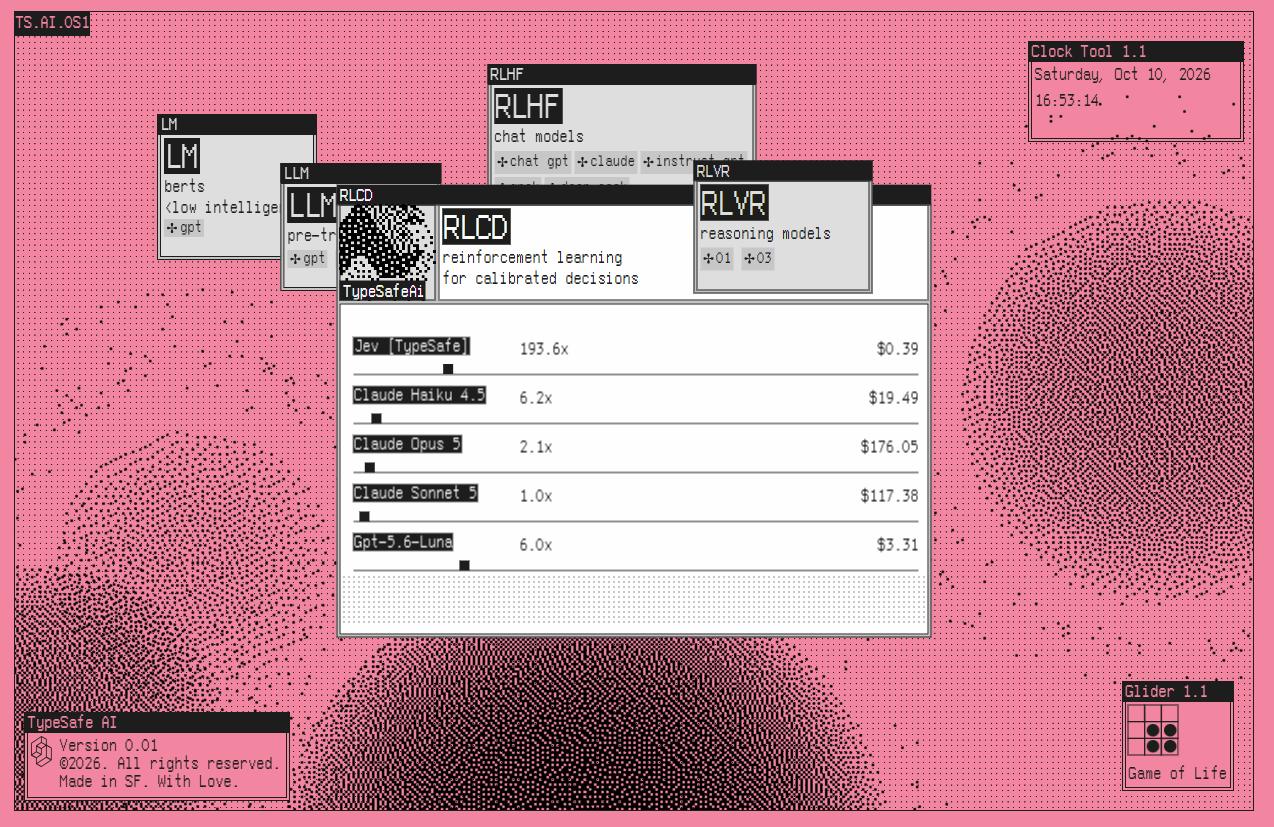
Almeida said TypeSafe built a new stack focused entirely on automation: a new model architecture, a parallel sampler, and a training method the company calls Reinforcement Learning for Calibrated Decisions (RLCD). The practical result is a model that returns a choice, a score, or a probability from predefined options rather than generating free text. At $0.042 per million input tokens with output free, Jev is priced like infrastructure, not like a frontier model. TypeSafe claims that is 238 times lower than Claude Fable 5.1’s input price.
TypeSafe’s headline benchmark numbers are large enough to invite skepticism. TypeSafe’s own workflow evaluations headline a striking “193.6x Faster, 444.6x Cheaper,” which the company’s own blog admits are “on the higher end of real world gains.” Independent tests find real but more modest advantages. One independent test found Jev was 2.0 to 3.6 times faster at the median, 4.7 to 7.5 times cheaper than two small models, and about as accurate as those small models. The honest use case is high-volume routing, classification, and agent branching, not general-purpose reasoning. Jev has no chat interface, a 32K context window, and no text or code generation. It is positioned to run alongside an LLM, not instead of one.
TypeSafe was founded in 2024 by Diogo Almeida, Erik Gafni, and Sasha Sheng. CEO Almeida previously co-developed reinforcement learning from human feedback at OpenAI and worked on InstructGPT, ChatGPT, and GPT-4. Sheng comes from Meta’s AI research division. The team is roughly 25 people.
Martin Casado, general partner at Andreessen Horowitz and a board member at TypeSafe as of the Series A, described the company’s direction in a16z’s investment announcement: “TypeSafe AI is tackling one of the most critical challenges in enterprise AI deployment.” TypeSafe’s own blog post described the investor roster as “Andreessen Horowitz, with participation from Sequoia Capital, existing investor DCVC, and the tech illuminati.”
TypeSafe says roughly a third of Fortune 500 companies used Jev during its 24-day early access window. That figure is unaudited and comes from the company. Taken at face value, it suggests enterprise demand for cost-efficient, non-generative AI infrastructure is real. Taken with appropriate skepticism, it is the kind of claim that a $7.5 billion valuation requires.
Why Does the OpenAI $50 Billion ARR Story Matter to This Conversation?
OpenAI’s annualized revenue sits at approximately $50 billion as of late September 2026, roughly $20 billion below the $70 billion figure that had been widely circulated. The gap is not a downgrade of OpenAI’s own projections. It is an accounting methodology difference between how OpenAI and Anthropic each count revenue from cloud marketplace sales.
Anthropic counts sales through AWS and Google Cloud as revenue. OpenAI does not. When analysts applied a consistent methodology to both companies’ numbers, OpenAI’s figure came in lower. The underlying business has not changed. What changed is which number the market had been using.
That nuance did not survive the speed of Hacker News. Commenters treated the $20 billion gap as evidence of inflated AI sector metrics broadly, and the TypeSafe story arrived at exactly the wrong moment to escape that framing. A startup valued at $7.5 billion, 24 days out of stealth, on the same morning that OpenAI’s revenue turned out to be 29 percent lower than assumed: the proximity was enough to merge the two stories in the community’s mind.
Is the AI Funding Boom Sustainable? What Hacker News Actually Said
The short answer from the October 10 thread is: nobody agrees, and that disagreement is itself informative. Comments split roughly between two camps. One camp argued that TypeSafe’s pricing model, $0.042 per million input tokens with free output, is defensible infrastructure economics and that the valuation reflects the total addressable market for enterprise automation at scale. The other camp pointed to the 25-person headcount, the 24-day product history, and the unaudited Fortune 500 claim as signs that the round is priced on narrative more than on revenue.
Neither camp is obviously wrong. The AI startup valuation bubble debate on Hacker News reflects a structural problem in the sector: the time between product launch and nine-figure funding has compressed to weeks, while the information available to assess whether a product works at scale remains thin. TypeSafe’s benchmarks are promising and also self-reported. Almeida’s observation that “we have been super good at human language for four years, but it’s not useful for automation because computers speak a different language” frames a real problem. Whether Jev solves it at $7.5 billion scale is a question the next 12 months of enterprise contracts will answer.
The counterargument worth taking seriously is timing risk. Jev’s value proposition depends on sitting between an LLM and structured outputs, a position that model providers could close by improving native function-calling and structured output reliability. OpenAI, Anthropic, and Google have all pushed structured output features in 2025 and 2026. If frontier models get significantly better at reliable JSON and typed decisions, Jev’s performance and cost advantages narrow. That is the when-not-to-use case: if your workload fits neatly inside a frontier model’s native tool-calling, Jev may be an unnecessary layer.
The TypeSafe AI $870M Series A and the OpenAI revenue accounting story are not the same event. But they landed on the same platform, on the same morning, and they are both fundamentally about howthe market prices AI companies when revenue data is incomplete and product timelines are compressed. That convergence is what made October 10 a useful day for anyone trying to read the sector’s actual mood.
Frequently asked questions
What did TypeSafe AI actually raise, Series A or Series B, and how much?
TypeSafe AI raised $870 million in a Series A round at a $7.5 billion valuation, announced October 9, 2026. The round is a Series A, confirmed by TypeSafe AI’s own blog post, Wilson Sonsini’s deal advisory disclosure, and Crunchbase.
Who led the TypeSafe AI funding round and who else participated?
Andreessen Horowitz led the round, with Sequoia Capital and existing investor DCVC also participating, along with a group of angel investors TypeSafe described as “the tech illuminati.” A16z general partner Martin Casado joined TypeSafe AI’s board as part of the deal.
What is the Jev model and why did it attract $870M in under a month?
Jev is TypeSafe AI’s first production model, launched September 15, 2026. It is designed for structured, typed decision-making in software automation rather than free-text generation. Jev returns choices, scores, or probabilities from predefined options and is priced at $0.042 per million input tokens with free output, targeting high-volume enterprise routing and classification workloads. TypeSafe claims roughly one-third of Fortune 500 companies used it during early access.
Why is OpenAI’s annualized revenue $20 billion lower than previously reported?
OpenAI’s annualized revenue stood at approximately $50 billion as of late September 2026, not the roughly $70 billion figure that had circulated. The gap reflects an accounting methodology difference, not a change in OpenAI’s own projections or business performance. When analysts applied a consistent methodology, the $20 billion difference emerged from how each company records cloud marketplace revenue.
How do Anthropic and OpenAI count revenue differently?
Anthropic counts sales made through cloud partners such as AWS and Google Cloud as its own revenue. OpenAI does not count equivalent marketplace revenue the same way. When the same accounting approach is applied to both companies, OpenAI’s reported figure drops by roughly $20 billion. The underlying business at OpenAI has not changed; the number that was being compared across companies was not calculated on a consistent basis.
What did Hacker News commenters say about AI valuation sustainability on October 10, 2026?
The October 10 discussion split into two broad camps. One group argued TypeSafe’s infrastructure pricing model is economically defensible and the valuation reflects the total addressable market for enterprise automation. The other pointed to the 25-person team, 24-day product history, and unaudited adoption claims as signs the round is priced on narrative rather than proven revenue. No consensus emerged, which was itself the most informative outcome.
Is the $7.5B TypeSafe valuation justified given the company is less than a month out of stealth?
That depends on whether early-access Fortune 500 usage converts to signed contracts and whether Jev’s cost and speed advantages hold as frontier model providers improve native structured-output capabilities. The valuation is defensible if the addressable market for machine-native AI infrastructure is as large as a16z believes. It is hard to justify on trailing revenue alone for a company with 25 employees and a product that has been live for 24 days.