
Assured Health Series A: $19M Bet on Agentic AI to Fix Healthcare’s Costliest Bottleneck

The average credentialing delay costs a medical practice $9,000 in lost revenue per provider, per day — a figure that makes the Assured Health Series A round not just a funding milestone, but a direct attack on one of healthcare’s most stubborn financial drains. On July 22, 2026, the New York City-based startup closed a $19 million raise to accelerate a platform that replaces the industry’s laborious, manual credentialing workflows with autonomous AI agents that actually execute the work — not just track it.
The Assured Health funding update brings the company’s total fundraising to $25 million, a signal of growing investor confidence in AI-native infrastructure for healthcare operations. The round was led by Insight Partners, with continued participation from First Round Capital and Kindred Ventures — the same backers who supported Assured through its $6 million seed round in September 2025.
What the Assured Health Series A Is Actually Solving
Provider credentialing is, at its core, a verification process — confirming that a doctor, nurse practitioner, or therapist holds valid licenses, certifications, and qualifications before they can see patients and bill insurance. Simple in theory. Agonizing in practice.
Most payer approvals still take 60 to 180 days, depending on payer type and state. During that window, a clinician sits idle and a practice bleeds. Delays in credentialing directly delay revenue, often creating $135,000 to $900,000 or more in deferred billings over 90 to 120 days, depending on specialty and volume. For hospitals, the stakes are even higher: one in five hospitals loses more than $1 million a year because of delays in getting providers credentialed.
Nearly one in five organizations reported having between $500,000 and a few million dollars on hold for payers during the last fiscal year due to incomplete or slow enrollments. These aren’t edge cases — they’re the industry standard. And that’s precisely the problem the Assured Health Series A round is designed to dismantle.
How Assured’s Agentic AI Platform Actually Works
Assured isn’t just another dashboard bolted on top of the same manual processes. “Assured is the first platform we have seen that performs the work itself, not just tracks it,” said Teddie Wardi, managing director at Insight Partners.
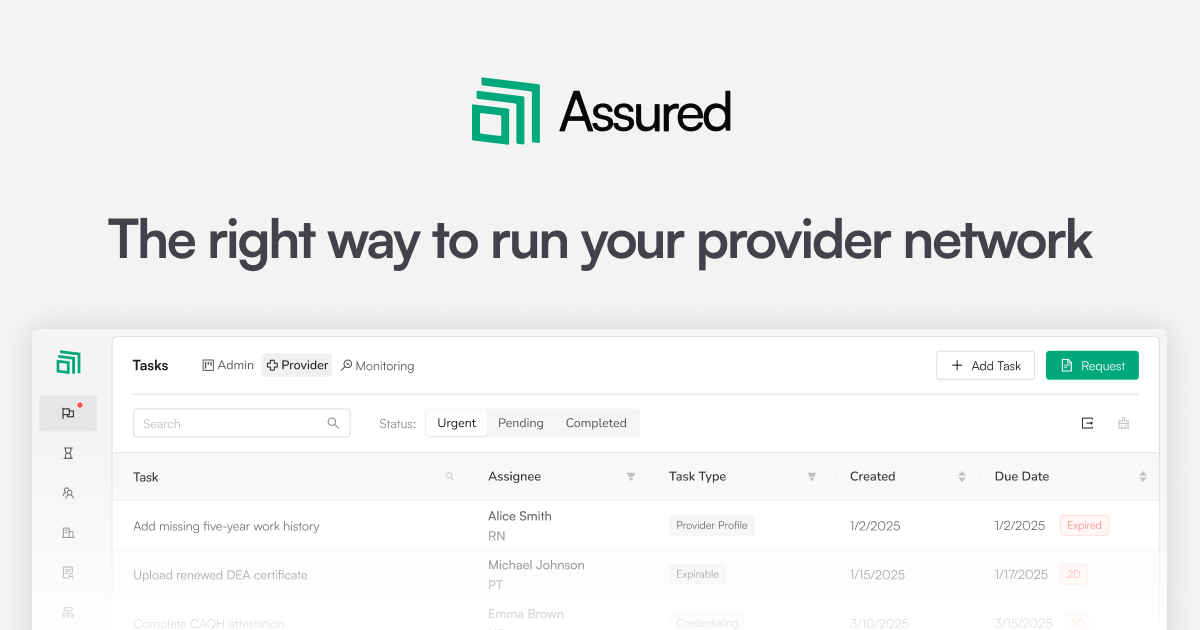
The distinction matters enormously. Assured’s AI platform deploys specialized software agents that interact directly with primary sources and payer enrollment gateways, reducing manual operational drag by dozens of hours per week for provider groups. The architecture converts plain-language operational rules into automated, end-to-end workflows.
Its AI agents verify provider information using 2,000 primary sources, prepare applications based on state and payer requirements, and flag missing information. The result? The platform can help organizations credential providers within days, get them in-network 30% faster, and save operations teams dozens of hours each week.
As an AI provider credentialing startup, Assured also holds a credential that few competitors can claim. Assured holds official NCQA certification as a Credentials Verification Organization (CVO), enabling it to support healthcare organizations operating delegated credentialing agreements with payers. That certification is a meaningful moat — it means Assured can conduct credentialing verifications directly rather than routing them through third parties.
Varun Krishnamurthy and the Founding Story Behind Assured
Co-founders Rahul Shivkumar and Varun Krishnamurthy launched Assured in early 2024, but the idea traces back to their previous company, Dawn Health, a virtual platform for treating sleep disorders. The founders weren’t theorizing about healthcare’s administrative burden — they were drowning in it.
Varun Krishnamurthy is the Co-Founder and CEO of Assured Health, leading innovations at the intersection of technology and healthcare. Previously, he co-founded Dawn Health, which was successfully acquired by HCO. That operational experience — scaling a virtual clinic across multiple states, hiring providers, battling credentialing timelines — is what convinced Varun Krishnamurthy and his co-founder that the market needed an entirely different approach.
Healthcare administration is broken. Qualified providers sit idle for months, paperwork drags on for weeks, and patients wait for critical care. Everyone loses: providers, patients, and organizations. That founding conviction now underpins a platform serving a rapidly expanding roster of healthcare clients.
Insight Partners Assured Health: Why This Investor Bet Big
The Insight Partners Assured Health partnership is telling. Insight Partners is one of the most active growth-stage investors in B2B SaaS and enterprise software globally, and their decision to lead this Assured Health Series A round reflects a broader conviction that healthcare administration is ripe for AI disruption.
The agentic AI in healthcare market is projected to expand from USD 1.14 billion in 2026 to USD 33.66 billion by 2035, with a CAGR of 45.6%. That’s the kind of market backdrop that makes a $19 million Series A look like an early-entry play rather than a big bet. Sixty-one percent of healthcare respondents say they are already building and implementing agentic AI initiatives or have secured budgets, and 85% plan to increase investment over the next two to three years.
The Insight Partners team saw what many legacy vendors missed: credentialing isn’t a niche compliance function. It’s a revenue gateway. Every day of delay between a provider’s first day and their first billable claim is a day of revenue that can never be recovered.
Traction: Real Customers, Real Results
Assured serves more than 100 healthcare organizations — spanning health systems like Houston Methodist to digital health providers like Tono Health, Blossom Health, and Birches Health. That’s a diverse client base, not a narrow niche.
The Tono Health case is particularly striking. Virtual dermatology provider Tono Health reported completing over 120 payer applications in a single month following its transition from legacy credentialing vendors to Assured, supporting expansion across 32 states. That kind of throughput — 120 applications in 30 days across 32 states — would have required a large operations team under the old model. Assured’s agents handled it autonomously.
For context on competitive positioning, at the health system level, Assured competes with BPO firms that staff people, often offshore, to manually handle credentialing and enrollment. Among software vendors, competitors like Verifiable and Credential Stream still require humans to do the underlying work while the software just tracks it. Assured’s pitch as an agentic AI healthcare startup is that this distinction — doing vs. tracking — is everything.
What’s Next for the Assured Health Series A Round
The Assured Health funding update came with a clear product roadmap. In the first quarter of next year, the startup plans to launch a new product focused on privileging — the labor-intensive process hospitals use to verify a new doctor’s references and confirm they’re qualified to perform procedures like surgery. Privileging has historically been even more manually intensive than credentialing, making it a natural expansion frontier.
The broader agentic AI healthcare landscape supports this ambition. Deloitte’s 2026 US Health Care Outlook Survey found that over 80% of healthcare executives expect both agentic AI and generative AI to deliver moderate-to-significant value across clinical, business, and back-office functions in 2026. And the pressure to automate isn’t slowing down — industry-wide, provider wait times increased 19% in just two years, rising from 26 days in 2024 to 31 days in 2026.
For health systems, group practices, and digital health companies wrestling with provider onboarding delays, the Assured Health Series A round signals that a credible, fully autonomous alternative now exists — and it’s attracting serious capital.
Key Takeaways
- The problem is massive: Inefficient credentialing costs the healthcare industry over $2 billion annually, with delays causing approximately $9,000 in lost revenue per provider, per day.
- Assured’s scale: The platform cross-references provider credentials against more than 2,000 primary verification sources in real time.
- The funding: Assured Health closed its Series A round, bringing its fundraising total to $25 million.
- The market: The global agentic AI in healthcare market is projected to grow from $1.83 billion in 2026 to $19.71 billion by 2034.
- NCQA-certified: Assured carries NCQA CVO certification, a rare quality validation in the credentialing space.
- Privileging next: Hospital privileging — an even more complex verification process — is already on the product roadmap.
Frequently Asked Questions
What is the Assured Health Series A, and how much did the company raise?
Assured Health closed a $19 million Series A funding round led by Insight Partners, with continued participation from First Round Capital and Kindred Ventures. The round brings the company’s total fundraising to $25 million, including a $6 million seed round closed in September 2025.
What does Assured Health actually do?
Assured Health is a New York City-based provider operations platform that automates provider credentialing, licensing, payer enrollment, and network management using autonomous AI agents. Instead of tracking these tasks, the platform executes them end-to-end by interacting directly with primary sources and payer enrollment gateways.
Who are the co-founders of Assured Health?
Assured Health was co-founded by Varun Krishnamurthy, who serves as CEO, and Rahul Shivkumar. Both previously co-founded Dawn Health, a virtual sleep disorder platform that was acquired by HCO. Their firsthand experience with the credentialing process while building Dawn Health was the direct inspiration for Assured.
How does Assured Health reduce the time to get providers in-network?
Assured’s AI agents verify provider credentials against more than 2,000 primary sources, prepare applications based on state and payer-specific requirements, and proactively flag missing or inaccurate information before submission. This approach reduces time-to-in-network by 30% compared to traditional methods, compressing a process that normally takes months down to days.
What is NCQA CVO certification, and why does it matter for Assured Health?
NCQA (National Committee for Quality Assurance) CVO (Credentials Verification Organization) certification is one of the healthcare industry’s highest quality standards for credentialing verification. It allows Assured to conduct credentialing verifications directly for health systems and health plans operating delegated credentialing agreements, giving the platform a significant competitive and regulatory advantage.
Who does Assured Health compete with in the market?
Assured competes on two fronts. At the health system level, it goes up against BPO firms that use offshore staff to manually process credentialing and enrollment. Among software vendors, it competes with platforms like Verifiable and Credential Stream, which Assured’s co-founder argues still rely on humans to do the actual underlying work while the software provides tracking and reporting.
What is the financial impact of provider credentialing delays that Assured Health aims to solve?
Credentialing delays are a major revenue problem across U.S. healthcare. Estimates put the loss at $6,000 to $8,000 per provider per month at a minimum, with some analyses citing $9,000 per provider per day in lost billings. One in five hospitals reportedly loses more than $1 million annually due to credentialing-related delays, and a 90- to 120-day backlog can defer $135,000 to over $900,000 in revenue for a single provider group.