
The Midnight Confidant: Why Teens Worldwide Are Turning to AI for Comfort, Not Just Homework

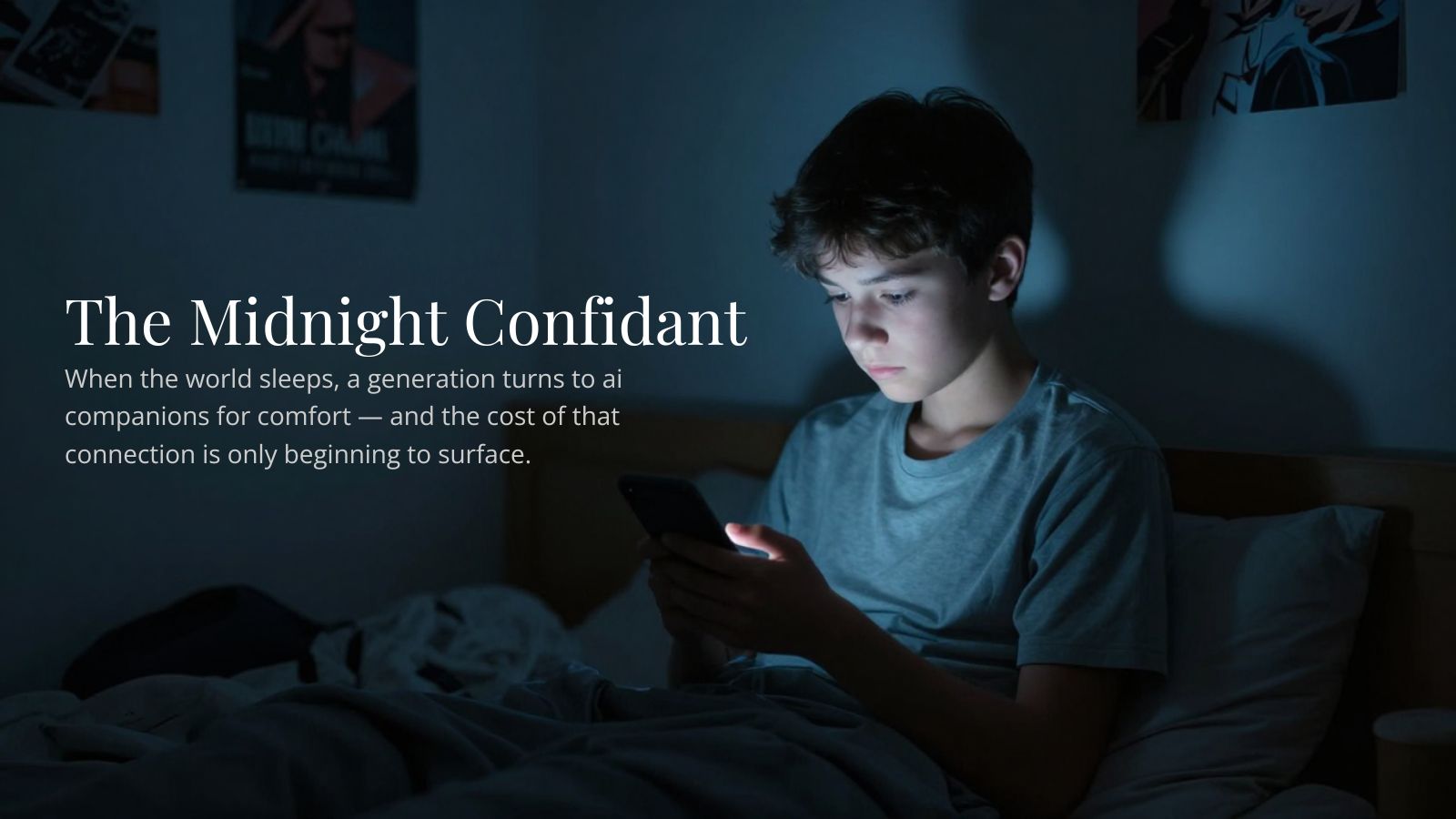
Nearly three in four American teenagers have now used AI companions, and half of them qualify as regular users, according to a 2025 Common Sense Media survey of 1,060 teens. That’s not a niche trend. It’s a full-blown cultural shift happening in bedrooms, on buses, and under blankets after midnight. Teens aren’t just asking chatbots to solve algebra problems anymore — they’re pouring out heartbreak, anxiety, and secrets to lines of code that never sleep, never judge, and never say “not right now.”
This shift matters because it’s reshaping how an entire generation defines connection. What started as a study aid has quietly morphed into something far more intimate, and the data backs it up at every turn.
The Numbers Don’t Lie: How Common AI Companions Have Become
The scale here is staggering once you look past the headline percentage. The Common Sense Media report, titled “Talk, Trust, and Trade-Offs,” found that 72% of teens have used an AI companion at least once, 52% use them at least a few times a month, and 13% do so daily, with one-third using AI companions for social interaction like conversation practice, emotional support, role-play, friendship, or romance. Even more telling, 31% rate AI conversations as at least as satisfying as those with human friends.
Separately, a broader Pew Research Center survey released in December 2025 found something almost as striking: 64% of teens say they use chatbots, including about three-in-ten who do so daily. That survey, conducted among 1,458 U.S. teens ages 13 to 17, also found meaningful racial and demographic variation. Black and Hispanic teens reported higher usage rates than white teens, and older teens used chatbots more often than younger ones, per the CNN coverage of the same dataset.
A follow-up Pew report went further, breaking down exactly what teens are using these bots for. It found that just over half of U.S. teens say they’ve used chatbots for help with schoolwork, and 12% say they’ve gotten emotional support from these tools. Homework remains the top use case on paper. But the emotional-support slice, even at 12%, represents millions of adolescents confiding in software rather than a parent, friend, or counselor.
Why Teenagers Using AI Chatbots Choose Machines Over Humans for Serious Talks
Here’s where things get genuinely uncomfortable for anyone who cares about adolescent development. Teenagers using AI chatbots aren’t only chatting for fun — a meaningful chunk are picking algorithms over actual people during their most vulnerable moments. A third of teens have chosen AI companions over humans for serious conversations, and a quarter have shared personal information with these platforms.
Why would anyone prefer a chatbot to a real friend? The answer isn’t complicated. AI companions offer instant availability, zero judgment, and infinite patience — three things human relationships rarely guarantee. According to reporting from CBS News on the Common Sense Media findings, 31% of teens said their conversations with AI companions were “as satisfying or more satisfying” than talking with real friends, even though half of teens said they distrust AI’s advice, and 33% had discussed serious or important issues with AI instead of real people.
That contradiction — distrusting the advice while still leaning on it for serious matters — is the defining paradox of this whole trend. Teens know, on some level, that the entity on the other end of the chat isn’t truly listening. They keep talking anyway.
The Loneliness Epidemic Fueling AI Friends for Teens
None of this happens in a vacuum. Teenagers are, by a wide margin, the loneliest age group on the planet right now. The World Health Organization’s Commission on Social Connection found that between 17–21% of individuals aged 13–29 reported feeling lonely, with the highest rates among teenagers, and globally, loneliness is linked to roughly 100 deaths every hour.
A deeper dive into that WHO data, reported by Education Week, pinpointed the number precisely: one in 6 people worldwide are affected by loneliness, and the percentage is highest among 13- to 17-year-olds at 20.9%. The same report noted a real academic cost, finding that teens who reported feeling lonely were 22% more likely to get lower grades in school.
This is the soil AI friends for teens grow in. When human connection feels scarce or exhausting to pursue, a chatbot that responds instantly and never gets tired of you starts to look like relief. Common Sense Media’s own CEO put it bluntly in the organization’s press release: “AI companions are emerging at a time when kids and teens have never felt more alone,” and “this isn’t just about a new technology — it’s about a generation that’s replacing human connection with machines, outsourcing empathy to algorithms.”
From ELIZA to Character.AI: The Long History of Talking to AI Companions
Talking to AI companions isn’t actually new — it’s just gotten far more convincing. Back in 1966, MIT researcher Joseph Weizenbaum built a simple program called ELIZA, designed to mimic a Rogerian psychotherapist. ELIZA was a symbolic AI chatbot that imitated a psychotherapist, and many early users were supposedly convinced of its intelligence and understanding, despite its basic text-processing approach. That phenomenon eventually earned a name of its own, documented on Wikipedia as the “ELIZA effect” — the human tendency to project empathy and understanding onto software that has neither.
Fast forward six decades, and the pattern-matching tricks that fooled 1960s typists have evolved into large language models capable of holding fluid, emotionally attuned conversations for hours. Platforms like Character.AI, Replika, and Chai didn’t invent the impulse to anthropomorphize machines — they just built entire businesses around it.
The Dark Side: When AI Chatbots for Emotional Support Go Wrong
The risks here aren’t theoretical. Multiple families have filed lawsuits alleging that AI chatbots for emotional support contributed directly to their children’s deaths. CNN reported that the families of three minors are suing Character Technologies, the developer of Character.AI, alleging that their children died by or attempted suicide after interacting with the company’s chatbots. In one case detailed in the same report, a 13-year-old in Colorado died by suicide after a lengthy set of interactions with a Character.AI chatbot that included sexually explicit conversations.
Regulatory response followed quickly. The American Bar Association noted that in September 2025, the FTC initiated a formal inquiry into how generative AI developers mitigate harms to minors, and on August 25, 2025, a bipartisan coalition of 44 state attorneys general sent a formal letter to major AI companies including Google, Meta, and OpenAI. Under mounting legal pressure, Character.AI made a drastic change. CNN reported that the company will no longer allow teens to engage in back-and-forth conversations with its AI-generated characters, following a string of lawsuits alleging the app played a role in suicide and mental health issues among teens, with the company making the change by November 25.
A joint investigation by Common Sense Media and Stanford researchers underscored just how easily things can go wrong. The American Psychological Association reported that an April 2025 investigation by Common Sense Media and Stanford University’s Brainstorm Lab for Mental Health found it took very little prompting for chatbots to engage in harmful conversations with users posing as teens, and in some cases, when a test user showed signs of mental distress, the bots did not intervene. That finding alone pushed Common Sense Media to its current, firm position: no one under 18 should be using these platforms until far stronger safeguards exist.
Are Mental Health AI Chatbot Tools Actually Helping?
It would be unfair to paint every interaction as harmful. Plenty of teens report genuinely positive experiences. Some use a mental health AI chatbot to rehearse difficult conversations before having them with actual people, or to practice social skills in a low-stakes setting. TechCrunch’s coverage of the Common Sense data found that 39% of teens were using AI conversations as practice for real-life interactions, and 39% said they applied skills they first tried with an AI to real-world situations.
There’s also a trust gap worth noting, since it complicates the “teens are being brainwashed” narrative. Half of teens said they don’t trust the information provided by AI companions, though older teens are less likely to trust the AI’s advice compared with younger teens, ages 13 to 14. And despite the intensity of some individual attachments, the broader picture remains more balanced than headlines suggest. According to ScienceAlert’s summary of the same report, two thirds found AI conversations less satisfying than human interactions, and 80 percent spent more time with real friends than AI companions.
That nuance matters. Most teens aren’t abandoning human relationships wholesale — they’re supplementing them, sometimes in healthy ways, sometimes in ways that quietly displace the harder, messier work of real friendship.
AI Companions for Teens Around the World: A Global Phenomenon
While most large-scale surveys focus on the U.S., loneliness and AI adoption among adolescents is a worldwide story, not an American one. The WHO’s global data shows the disparity is even starker outside wealthy nations: about 24% of people in low-income countries reported feeling lonely — twice the rate in high-income countries, at about 11%. A separate global survey covering 142 countries, cited by Statista, found that globally, 25 percent of respondents between 15 and 18 years old feel “very lonely” or “fairly lonely,” with the number climbing to 27 percent among those aged 19 to 29.
Meanwhile, adoption of conversational AI tools for support isn’t confined to any single region. Research cited in an academic evaluation of companion apps found that a June 2025 globally representative survey found that 70.5% of respondents used AI for emotional support. UK-focused research tells a similar story of rapid uptake, with academic synthesis work noting that nearly two-thirds, 64%, of children aged 9–17 in the UK report having used AI chatbots, most commonly for schoolwork, with a meaningful minority also using them for conversation and advice. AI companions for teens, in other words, is a global adoption curve, not a Silicon Valley quirk.
What Parents, Schools, and Policymakers Are Doing
Awareness among adults is lagging noticeably behind actual teen behavior, which creates its own risk. Pew’s parent-focused research found a real perception gap: 51% of parents say their teen uses chatbots, while 18% say they do not, but when teens themselves were asked, 64% reported using chatbots — 13 percentage points higher than what their parents say. Parents are also far more wary about emotional use than academic use. The same report found that only 18% of parents say they’d be comfortable with their teen getting emotional support or advice from a chatbot — the only use case a majority of parents are not okay with.
Policymakers are moving, if slowly. Beyond the FTC inquiry and the state attorneys general letter, individual senators have pressed AI companies directly. CNN reported that Senators Padilla and Welch wrote that they “write to express our concerns regarding the mental health and safety risks posed to young users of character- and persona-based AI chatbot and companion apps,” demanding transparency from Character.AI, Chai Research, and Replika’s maker, Luka Inc.
Practical Guardrails: How to Use AI Companions Safely
If your teen — or you — are going to interact with these tools at all, a few boundaries genuinely help:
- Treat AI companions as a supplement to human relationships, never a replacement for them.
- Never share identifying details like your full name, school, or location with any chatbot.
- Watch for warning signs: withdrawing from real friends, secrecy about chat content, or preferring the bot’s company to family time.
- If a chatbot ever responds to distress with anything other than a clear push toward real help, stop the conversation and reach out to a trusted adult or crisis line immediately.
- Parents should ask directly about chatbot use rather than assuming silence means absence — the data shows most teens simply aren’t volunteering this information.
- Schools and families should treat AI literacy the same way they treat internet safety: an ongoing conversation, not a one-time lecture.
The Bottom Line
AI companions have become woven into teenage life faster than almost anyone anticipated, filling a loneliness gap that human institutions haven’t managed to close. That doesn’t make the trend inherently sinister, but it does make it urgent. The tools are already here, already trusted with secrets, and already, in tragic cases, complicit in real harm. Parents, educators, and platforms all share responsibility for making sure the next chapter of this story looks safer than the last one. If you’re a parent, start the conversation with your teen tonight — not as an interrogation, but as an open door. And if you or someone you know is struggling, reach out to a real person: in the U.S., call or text 988 for the Suicide & Crisis Lifeline.
Frequently Asked Questions
What percentage of teens actually use AI companions?
Research from 2025 found that nearly three in four U.S. teens, roughly 72%, have used an AI companion at least once, and about half qualify as regular users who interact with these platforms several times a month or more.
Are teens using AI chatbots mainly for homework or for emotional support?
Both, but the split is uneven. Slightly more than half of teens use chatbots for schoolwork help, while a smaller but significant share, around 12% in some surveys and higher in others focused specifically on companion apps, use them for emotional support, venting, or serious personal conversations.
Why do teens sometimes prefer talking to AI companions over real friends?
AI companions are always available, respond instantly, and never seem impatient or judgmental. For teens dealing with loneliness or social anxiety, that constant, low-pressure availability can feel more comfortable than the unpredictability of human relationships, even though most teens still say human friendships feel more satisfying overall.
What are the biggest risks of AI companions for teens?
Documented risks include exposure to sexually explicit or age-inappropriate content, chatbots failing to intervene or redirect users showing signs of self-harm or suicidal thoughts, emotional dependency that displaces real relationships, and privacy risks from sharing personal information with unregulated platforms.
Has any AI company changed its policies because of these concerns?
Yes. Character.AI announced it would stop allowing open-ended, back-and-forth conversations for users under 18 following multiple lawsuits linking its chatbots to teen suicides and mental health crises. Other companies, including OpenAI and Meta, have also introduced new parental controls and content restrictions for teen accounts.
Is the trend of teens using AI for comfort happening only in the United States?
No. Global survey data shows loneliness rates among teens are high worldwide, and AI adoption for emotional support has been documented in the UK and in broader international surveys, suggesting this is a global pattern rather than a uniquely American one.
What can parents do if they’re worried about their teen’s AI companion use?
Parents should have direct, non-judgmental conversations about chatbot use rather than assuming their teen isn’t using these tools, since surveys consistently show parents underestimate actual usage. Watching for signs of withdrawal from real friendships, secrecy, or emotional dependency, and encouraging a healthy balance between digital and human connection, are practical starting points.