
Jonathan Sellers has set up business operations in the United States, the United Kingdom, South Africa and Panama, and came away convinced that founders give too little thought to overlooked markets. Panama surprised him most. He expected to sign documents electronically and found that many business and administrative processes there still need a wet-ink signature.
That gap between how a country looks from a distance and what it’s like to work there shaped The Borderless Founder, the platform he founded and hosts. Its first documentary series took him to ten countries across Latin America, Africa and Asia, from Brazil and Paraguay to Nigeria, Kenya, Morocco, Malaysia and Uzbekistan. He interviewed local founders and experts on camera, sometimes meeting them for the first time as he walked in to film. He chose video because, as he sees it, many of these places are still judged by what they looked like 20, 30 or even 50 years ago.
The route wasn’t fixed in advance. Sellers started with about 40 countries, heard back from about 15, and added Morocco and Uzbekistan while already travelling. A missed yellow fever vaccination rule sent him back to the United States from São Paulo instead of on to South Africa, and a transit rule he’d misread in Ürümqi, China, left him relying on temporary permission from authorities to get home.
In an exclusive interview with Neha Mehra, founder of Entrepreneur Loop, Sellers explains why founders should judge a market by what their business needs rather than by its reputation, what surprised him in Tashkent, and the four checks he’d run before booking a flight.
1. Hi Jonathan, thank you for joining us at Entrepreneur Loop. Could you please introduce yourself to our readers and tell us about The Borderless Founder and what you set out to do with it?
My background is in entrepreneurship, digital marketing and international business operations. Through my businesses, I’ve established operations in the United States, the United Kingdom, South Africa and Panama, gaining firsthand experience of both the opportunities and complexities of operating internationally.
The Borderless Founder grew out of those experiences and my belief that many compelling business opportunities exist in markets that international entrepreneurs don’t traditionally consider.
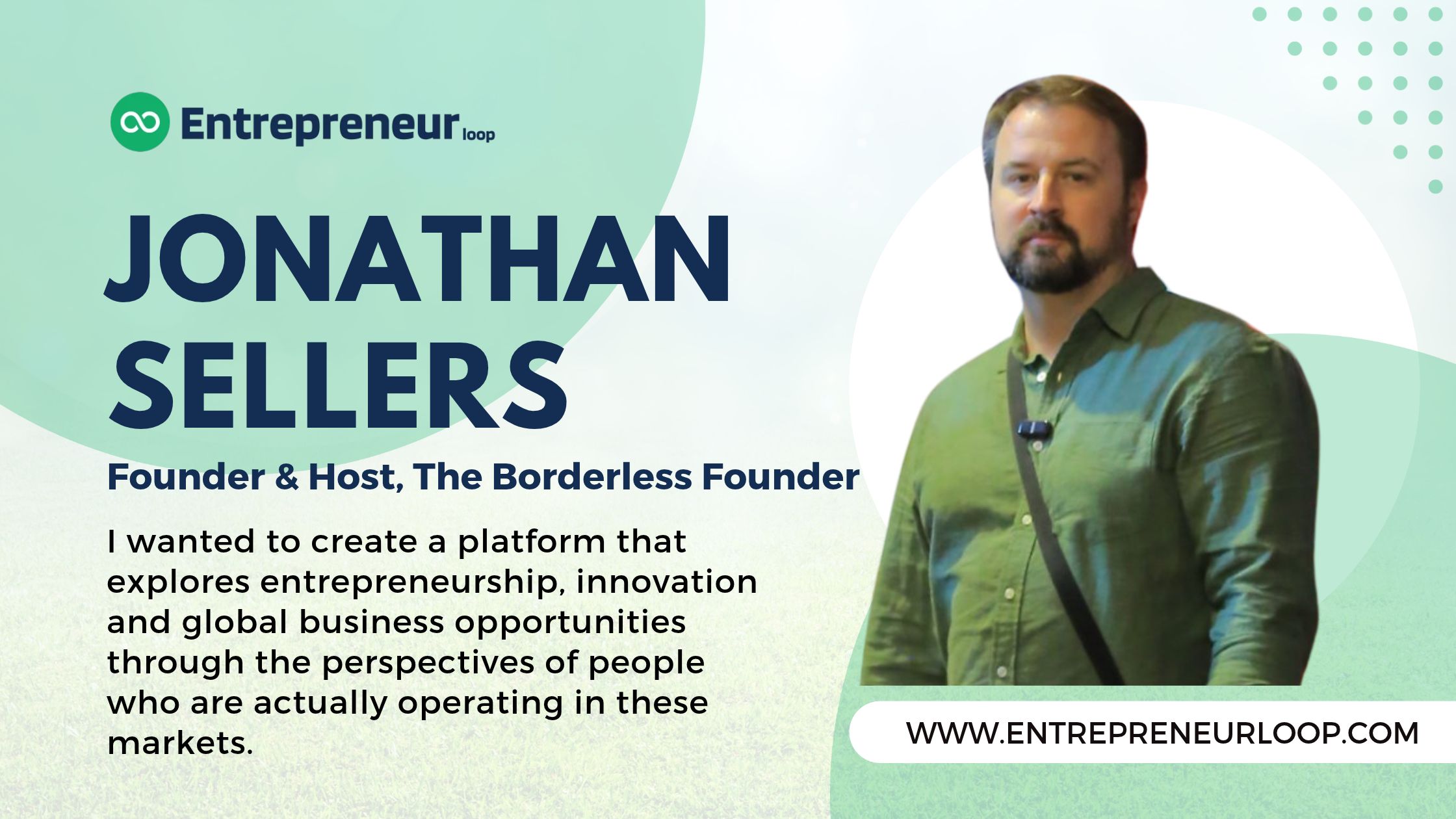
I wanted to create a platform that explores entrepreneurship, innovation and global business opportunities through the perspectives of people who are actually operating in these markets.
Our first series took me to ten countries across Latin America, Africa and Asia, where I interviewed entrepreneurs, business leaders and other experts about their experiences and the opportunities within their respective markets.
Ultimately, the objective is to broaden the way entrepreneurs think about international business and give local business communities a platform to share their stories with a global audience.
2. You’ve set up business operations in the United States, the United Kingdom, South Africa and Panama. Which of those countries surprised you most once you were actually operating there?
Panama probably surprised me the most, particularly regarding some of the practical requirements of operating a business.
One example is the continued requirement for wet-ink signatures in many business and administrative processes. Coming from an environment where so many transactions and agreements can be completed electronically, I wasn’t expecting physical signatures to remain such a significant part of day-to-day business operations.
There is a human component to certain processes that is practically a requirement of doing business there. While there are indications that some of these processes may become more digital in the future, they remain important considerations today.
Other differences, such as more employee-friendly employment laws in markets outside the United States, were largely things I anticipated.
The experience in Panama demonstrates that researching a country and actually operating there are two different things. Some of the most important practical considerations only become apparent once you’re actively doing business in a market.
3. Your work starts from the belief that some of the best opportunities sit in markets international entrepreneurs rarely consider. Why do you think so many founders overlook them?
There are established perceptions about countries and their suitability as business destinations. Some of those perceptions are influenced by the marketing and international promotion countries have undertaken, while others are based on legitimate considerations such as market size, infrastructure, economic conditions and governmental systems.
However, those perceptions don’t necessarily reflect the suitability of a particular market for an individual business.
When you consider that there are approximately 195 countries in the world, there are numerous opportunities that don’t fit the conventional definition of an ideal business destination.
A market might not be particularly attractive to one entrepreneur but could offer exceptional opportunities to another, depending on their business model, strategic objectives and operational requirements.
I think entrepreneurs should challenge some of these established perceptions and evaluate markets based on what their businesses actually need. In many cases, the greatest opportunity for a particular business may exist somewhere that wasn’t originally on its radar.
4. You could have shared what you’d learned through consulting or a book. Why did you choose to make a documentary series instead?
There were two primary reasons. The first was changing consumer behaviour. People are increasingly consuming information through video, and the growth of short-form content has further changed expectations around how quickly and accessibly information can be delivered.
The second reason was the importance of visually demonstrating the reality of these markets.
In many countries, the international perception of what a place looks like, the infrastructure it has and the resources available may be significantly different from reality.
Governments and businesses in many of these markets have spent years, sometimes decades, attracting investment, modernising infrastructure and developing sophisticated business and technology ecosystems. In some cases, they are developing world-class technologies and facilities.
Yet international perceptions may still be based on what these countries looked like twenty, thirty or even fifty years ago.
By going inside businesses, visiting offices and walking through commercial districts, we can show people what these places actually look like today.
For many of these countries, their international reputation needs to catch up with their reality. Video is an effective medium for helping to close that gap.
5. The first series covers Brazil, Uruguay, Panama, South Africa, Nigeria, Kenya, Morocco, Malaysia, Paraguay and Uzbekistan. How did you decide on that list?
I initially identified approximately forty countries that I believed could offer interesting stories and compelling international business opportunities.
I began reaching out to individuals and organisations in those markets to explore potential collaboration and filming opportunities. There was interest from approximately fifteen countries, and the ten markets ultimately featured in the first series developed through those conversations and relationships.
Interestingly, the final list wasn’t completely established before filming began.
During my second international filming trip, I was already travelling when the opportunities to film in Morocco and Uzbekistan materialised. I extended my itinerary and coordinated the additional travel to capture those stories.
The process was intentionally flexible. Rather than establishing a rigid list of countries and attempting to make everything fit within it, I allowed the relationships and opportunities that developed throughout the project to influence where we went.
That approach ultimately resulted in a diverse collection of markets across three continents, each offering a different perspective on entrepreneurship and international business.
6. In each country you were asking local founders and executives to talk openly on camera, often soon after meeting you. How did you earn that trust so quickly?
There were three important elements.
With many of the core contributors, I had preparation meetings and shared information about the project before arriving. That allowed us to establish a relationship and develop a mutual understanding of what we were trying to accomplish.
However, many interviews were added while I was already in the country. In some cases, the first time I met a contributor was when I walked through the door to film their interview.
I think that speaks to the passion these individuals have for their countries and the willingness they have to take advantage of an opportunity to share their perspectives with an international audience.
Numerous contributors also told me throughout the project that I was easy to speak to.
My objective isn’t to interject myself into their stories or impose a particular narrative. I’m there to give them a platform.
I’m not looking for perfect answers. I’m looking for real answers.
I think that approach creates a more comfortable environment and encourages people to speak openly about their experiences.
7. Ten countries in one year is a lot of flights, visas and logistics. Could you tell us about a moment during filming when things didn’t go to plan?
There were certainly a couple of memorable moments.
My first filming trip included Panama, Paraguay, Uruguay and Brazil, and was originally supposed to conclude in South Africa. In the complexity of coordinating that trip, I overlooked the yellow fever vaccination requirement associated with travelling from Brazil to South Africa.
I discovered the issue at the airport in São Paulo and had to return to the United States instead. I subsequently received the vaccination and rescheduled South Africa for my second trip.
The second experience occurred after adding Uzbekistan as my final filming destination. My original return flight departed from Hong Kong, so I arranged a connection from Uzbekistan through Ürümqi, China.
Based on my initial research, I believed I could transit through China without obtaining a visa. Unfortunately, the requirements applicable to my specific transit through Ürümqi were different from what I had understood.
Thankfully, the authorities there granted me temporary permission to continue my journey, and I eventually made it home.
Both experiences were reminders that international travel requirements can depend on your specific itinerary, not simply your nationality or final destination.
8. Which of the ten markets turned out to be most different from what you expected before you arrived?
One of the things I intentionally did throughout the project was avoid researching the tourism and sightseeing aspects of the countries before arriving. I coordinated the interviews and filming opportunities but wanted to experience the places themselves without too many preconceived expectations.
Of the ten countries, I had previously visited only South Africa and Panama.
Uzbekistan was particularly compelling. I wasn’t aware of the extent of the modernisation that had taken place in Tashkent or the contrast between its historical and contemporary environments.
You can experience the centuries-old traditions of Chorsu Bazaar, see the influence of Soviet-era architecture and then visit the incredibly modern Tashkent City development, all within the same city.
I found Tashkent to be a remarkably clean and interesting place, with a combination of history, culture and modern development that I hadn’t anticipated.
My only disappointment was that I didn’t have more time there. I would love to return and explore both Tashkent and the broader country in considerably more depth.
9. Is there one entrepreneur you met on the road whose story has stayed with you since?
There are numerous entrepreneurial stories that I continue to think about, but one that I believe has particularly significant global potential is that of Dr. Hamed Faghiri of Dorod Group Berhad in Kuala Lumpur, Malaysia.
He is developing an approach to food production that challenges how we think about access to fresh produce, particularly in urban environments.
During my visit, he showed me his rooftop farm in central Kuala Lumpur, where vegetables are grown and supplied directly to surrounding buildings, allowing customers and residents to access exceptionally fresh produce.
What impressed me wasn’t simply the equipment or technology he has developed. It was the broader ecosystem and philosophy behind it.
His objective goes beyond selling a product or service. He is passionate about fundamentally changing how people access fresh food and is continually working to bring that vision to markets around the world.
He also took the time to show me around Kuala Lumpur, and I genuinely appreciated the opportunity to spend time with him.
It’s that combination of innovation, personal passion and commitment to meaningful change that has stayed with me.
10. What do businesses most often get wrong when they hire in a new country for the first time?
I think there are two particularly important mistakes businesses make when hiring internationally.
The first is attempting to avoid establishing the appropriate legal and operational arrangements for employing people in a new market. In many cases, businesses misuse independent contractor relationships when the nature of the relationship is more appropriately classified as employment.
This can result in individuals not receiving the employment benefits they should be entitled to and assuming tax and administrative responsibilities that would otherwise be addressed through proper employment and payroll arrangements.
The second mistake is treating international employees as a separate team rather than as part of the company’s core team.
When businesses hire internationally, particularly in less traditional talent markets, there can be a tendency to view those individuals simply as external support resources.
To get the best out of everyone, companies need to integrate their international colleagues into their teams, communicate effectively with them and ensure they feel genuinely included in the organisation.
International hiring should be about building a stronger team, not simply accessing lower-cost labour.
11. Having spent time across Africa, Asia and Latin America, where do you think international founders should be looking over the next five years?
The answer will always depend on the business, the customers it wants to serve and its operational requirements. However, I believe Africa will offer some of the most significant opportunities over the coming years.
One particularly interesting observation came from my conversation with Chilande Kuloba-Warria in Nairobi. She highlighted how international funding and development projects often gravitate towards English-speaking African markets, while many French-speaking markets are experiencing significant population growth and development.
I believe the opportunities emerging across Francophone Africa could create renewed interest in French-language learning among international entrepreneurs and business professionals.
I also see considerable potential throughout Latin America.
Regional trade agreements such as Mercosur create opportunities for entrepreneurs to establish themselves in countries such as Uruguay, Paraguay and Bolivia while positioning their businesses to access a much larger regional market.
Rather than automatically targeting the largest or most internationally recognised economies, entrepreneurs should consider how establishing themselves in smaller markets might provide strategic advantages and access to broader regional opportunities.
12. What comes next for The Borderless Founder after these first ten countries?
We’re currently planning our activities for 2027, with three primary areas of focus.
The first is continuing to produce Market Spotlights. We want to explore more countries and share stories from markets that offer promising investment, partnership and employment opportunities. We’re already in discussions with potential partners in 17 countries that we’re evaluating for potential Market Spotlights in 2027.
The second is expanding our coverage to include relevant international business events. That could include startup conferences, international business forums or other events that bring together entrepreneurs and business leaders from different countries.
These events provide an opportunity to explore multiple markets and perspectives within a single environment.
The third is developing more commentary and discussion-based content. We want to explore what we’ve learned throughout the project, examine specific topics in greater depth and potentially bring back previous contributors for more detailed conversations about their areas of expertise.
The objective is to continue expanding The Borderless Founder as a platform for exploring international entrepreneurship, innovation and business opportunities while creating more opportunities for local experts to share their knowledge with a global audience.
13. For a founder weighing their first market outside their home country, what should they do before they book a flight?
Start by defining why you’re considering that market. Are you looking for talent, new customers, manufacturing capabilities, strategic partnerships or expanded service coverage?
Then evaluate the market against four pillars:
Talent & Skills: Availability of the people and expertise your business requires.
Cost & Economics: The overall financial implications and economic viability.
Operational Fit: Infrastructure, logistics, time zones and compatibility with your operations.
Compliance & Risk: Legal, regulatory and other risks associated with operating there.
Compare alternative markets against those same criteria.
Once you’ve identified a promising market, test it strategically before making significant commitments.
For international hiring, this could mean beginning with legitimate independent contractor projects, progressing to an Employer of Record arrangement when appropriate, and eventually establishing a local entity when the business case justifies it.
For market entry, it could involve distribution relationships, strategic partnerships or joint ventures.
Large corporations typically have the resources to evaluate these decisions systematically. Small and medium-sized businesses can also access international opportunities, but they need to be particularly strategic about managing risk, complexity and financial commitments.
You don’t need to jump into a market with both feet to discover whether it’s the right opportunity for your business.
14. To finish on a lighter note: after a year on the road, which place from the series would you go back to tomorrow, purely for yourself?
Uruguay would probably be my first choice.
I would love to spend more time in Montevideo and visit Punta del Este, which I didn’t have the opportunity to do during filming.
Nairobi would be a very close second, followed by Kuala Lumpur and Tashkent.
One of the most enjoyable aspects of this project was discovering how many of these places I would genuinely love to return to, independently of any business or filming objectives.
When you’re travelling primarily to coordinate interviews and produce content, you don’t always have the opportunity to fully experience a destination from a personal perspective.
Each of those four destinations left me wanting to explore more, and I would happily return to any of them tomorrow.
Sellers’ case comes down to timing. A country’s reputation can trail years behind its offices, infrastructure and technology, and founders who rely on the old picture may pass over a market that suits them better than the obvious choices. His own trips show the other side of that. Wet-ink signatures, vaccination rules and transit visas rarely come up in desk research, and some lessons only arrive once you’re on the ground.
He plans to keep testing the idea. For 2027, The Borderless Founder is working on more Market Spotlights, coverage of international business events and longer discussion pieces that bring back earlier contributors. Talks are already under way with potential partners in 17 countries. Readers can follow the series at theborderlessfounder.com.