
The Physical AI Revolution: Why 2026 Hardware Startups Are Doubling Down on Edge Computing and Robotics Infrastructure

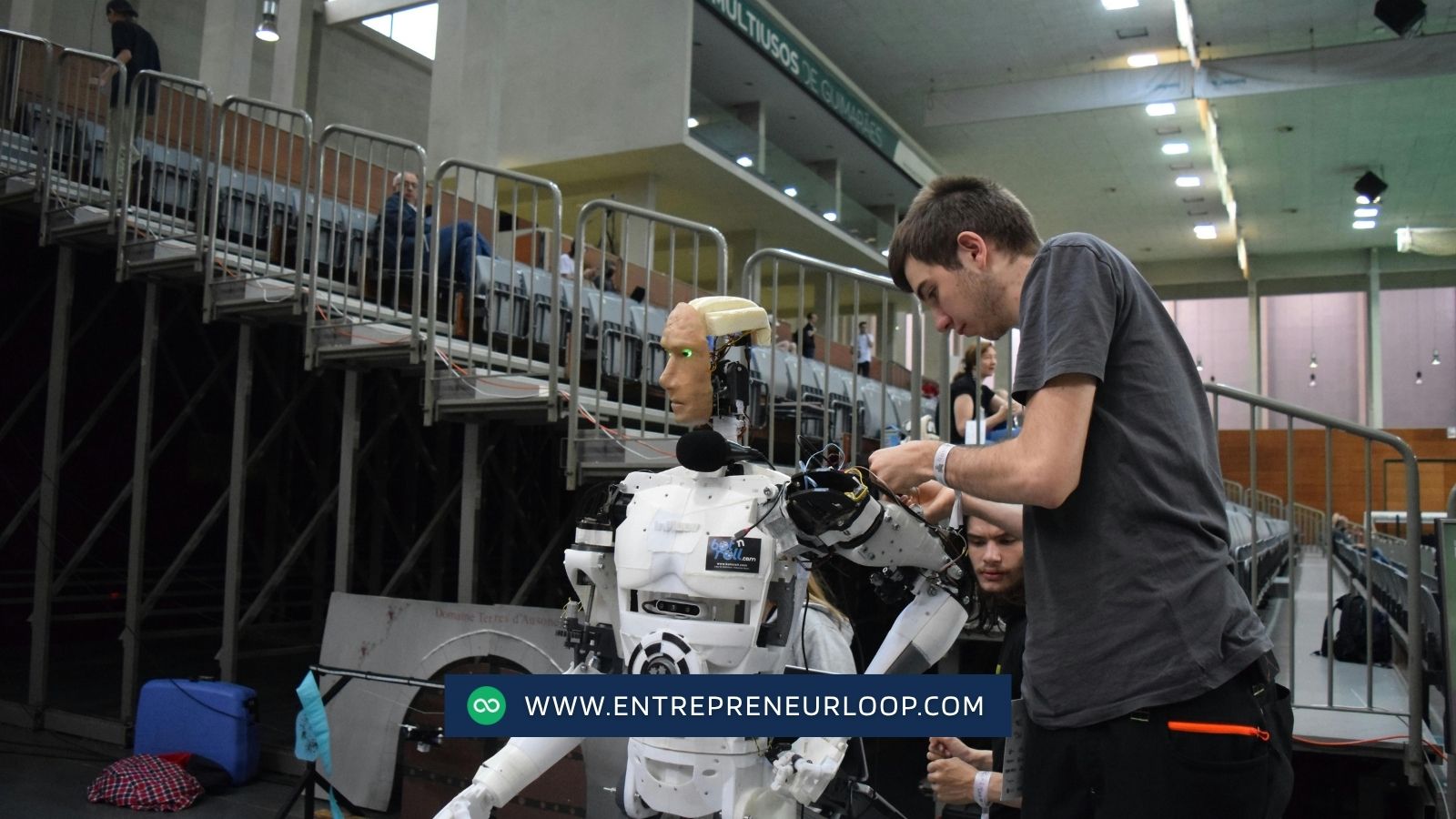
Robotics startups have raised $18.8 billion globally so far in 2026 — already past the $15 billion logged across all of 2025 and well above the $14.1 billion of the 2021 peak, with half the year still to go. That’s a capital regime shift. If you’re building or investing in physical AI startups right now, it reframes nearly every infrastructure decision you’ll make this year.
Here’s what’s driving it: physical AI — machines that sense, reason, and act in the real world — cannot depend on the cloud for moment-to-moment decisions. Latency kills. A factory arm can’t wait 800 milliseconds for a server response. A warehouse autonomous mobile robot that loses its network connection can’t simply pause and wait. The result is an industry-wide architectural bet on edge computing for robotics: moving the brain out of the data center and onto — or right beside — the machine itself. Founders who understand why that bet is being placed, and can explain it clearly to investors, will build better infrastructure and raise more credible rounds than those who simply note the trend and move on.
Why Hardware Is Having Its Moment After a Decade of “Software Eats Everything”
Venture capital spent much of the last decade treating embodied AI as a science project. The market now treats it as infrastructure — the physical layer of the intelligence stack, as indispensable long-term as cloud compute was in the prior cycle.
The pivot has a direct cause: AI models got good enough at vision, language, and planning that the limiting factor shifted from the software brain to the physical body and the compute that animates it. Analysts tracking the 2026 funding wave see a broader movement pushing intelligence from the cloud to the edge and into physical systems, with “hardware moats” re-emerging as a key investment theme — physical AI solutions involve complex, difficult-to-replicate hardware and integrated systems that software-only competitors cannot copy.
Physical AI capital is concentrating on proven winners. In 2026 year-to-date, follow-on rounds represent 92% of deals and 94.2% of capital. Investors are not spreading bets across fresh teams — they’re loading up on companies that have already demonstrated hardware depth, data strategy, manufacturing access, and real deployment partners. That concentration tells you exactly where embodied AI hardware investment is actually going: to teams that have proven they can ship full-stack systems, not polished demo machines.
The largest checks make the thesis concrete. Austin’s Saronic raised $1.75 billion at a $9.25 billion valuation for autonomous maritime defense, Germany’s Neura Robotics pulled in $1.4 billion for humanoids, and Skild AI raised $1.4 billion at a valuation north of $14 billion to build an “omni-bodied” brain that can operate any robot. Three billion-dollar rounds in a single category within months of each other signals conviction, not coincidence.
The Core Infrastructure Problem: Why Cloud AI Breaks at the Machine
This is the question most market-sizing reports skip entirely. Why can’t physical AI startups just route everything through cloud inference the way a SaaS product does?
Latency is the first and hardest constraint. Real-time control and fleet coordination live in the tens-of-milliseconds band. A cloud round trip lives in the hundreds-to-thousands. No amount of bandwidth fixes a speed-of-light-plus-queuing problem — the compute has to move closer.
A cloud-based vision system might process images faster in aggregate, but every frame has to travel from camera to server and back. That round trip typically adds 50–200ms of latency depending on network conditions. For a robot running a pick-and-place operation at 30 cycles per minute, 200ms means the part has moved 15–20mm on the conveyor between when the camera captures the image and when the robot receives coordinates. You can compensate for that — but compensation adds complexity, and complexity adds failure modes. That’s exactly what industrial robotics infrastructure in 2026 cannot afford at scale.
The second constraint is data sovereignty. Factory-floor data is competitive intelligence and, increasingly, regulated. Sovereignty has shifted from a compliance checkbox to a core architectural decision, because the moment a robot’s perception stream leaves the site, you’ve handed your operational fingerprint to someone else’s region. For any startup selling into automotive, pharma, or defense manufacturing, that isn’t a philosophical concern. It’s a contract requirement.
The third constraint is reliability. Assume you’ll lose connectivity — dead zones, congestion, maintenance windows, firewall changes. If losing the network creates unsafe behavior, a local fallback isn’t optional. Cloud can still handle many tasks just fine, but safety cannot hinge on a connection.
These three constraints are why autonomous systems edge computing has become the default architectural assumption for serious physical AI deployments. The choice of edge over cloud is physics, not preference.
The Three-Tier Architecture Every Physical AI Founder Should Know
A working robot runs on three tiers of compute, and conflating them is how infrastructure plans collapse in production. The first tier is onboard: reflexes, balance, collision avoidance, the tight motion loop. This runs on an embedded AI accelerator bolted to the robot itself — chips like NVIDIA’s Jetson Thor — because closed-loop motion control that keeps a machine upright demands sub-10ms response and cannot wait on a network hop.
The third tier is the cloud: training new models, large-scale fleet learning, heavy offline work with no millisecond deadline. Fine where it is.
The tier nobody planned for is the one in the middle — an on-site inference cluster serving models too large for the robot’s onboard compute but too latency-sensitive for the cloud. This mid-tier is where most of the unresolved architectural debt in physical AI currently sits, and where a new class of infrastructure startups is actively building. On-device inference for robots at this middle layer is the real engineering frontier of 2026 — not the foundation model training loop that captures all the press coverage.
Here’s how the tiers break down in practice for autonomous mobile robots or humanoids in a factory setting:
TierLatency TargetWhat Runs HereTypical HardwareOn-robot (onboard)Sub-10msMotion control, collision avoidance, balanceNVIDIA Jetson Thor, embedded NPUFacility edge (on-site)10–50msFleet coordination, complex perception, VLA inferenceGPU-equipped edge serversCloud50ms+ acceptableModel training, fleet analytics, OTA updatesAWS, GCP, Azure
This three-tier model is the architecture that major autonomous mobile robot vendors including Locus Robotics, MiR, and OTTO Motors deploy in production.
Robot Foundation Models Deployment: From Simulation to the Shop Floor
Robot foundation models deployment is where the technical picture gets genuinely interesting for founders. The category is attracting enormous capital because the promise — a single model controlling many different robot embodiments across diverse tasks — would collapse the per-robot software cost that makes wide deployment so expensive today.
Notable investments in Q1 2026 include Skild AI, which raised $1.4 billion for developing foundation models for robots, and Apptronik, securing $520 million for humanoid robots aimed at industrial labor. What links both bets is the belief that vision-language-action models — VLAs — will become the intelligence layer spanning the whole physical AI stack, handling perception and actuation through a single learned policy rather than hard-coded pipelines.
The practical bottleneck is training data. Robot manipulation data is extremely expensive to acquire. Unlike large language models that can draw on virtually unlimited internet text, every robot training episode requires hardware time, operator attention, and real-world error recovery. The workaround gaining traction in 2026 is simulation-to-real training: running thousands of robot instances in parallel inside a physics simulator, generating synthetic training data, then transferring learned policies to real hardware. In simulation, you can run hundreds of episodes per hour essentially for free. Randomizing lighting, texture, and physics across runs makes the resulting policies more adaptable to real-world variation. With GPU parallelism, 4,096 environments times 100 randomization configurations equals 409,600 diverse experiences per batch — which is a primary reason 2026 sim-to-real policies substantially outperform prior approaches.
The infrastructure implications matter for how you structure your team and your architecture. Simulation-to-real training happens in the cloud during development, but the resulting models run at the edge during deployment. That workflow demands a tight edge-to-cloud bridge, versioned model management, and hardware-in-the-loop testing before any policy update goes live on a production robot. Startups treating this as a DevOps problem — rather than a pure research question — are raising the largest rounds.
NVIDIA’s Full-Stack Bet and What It Means for Every Physical AI Startup
Any honest examination of the physical AI infrastructure layer has to address NVIDIA’s position. NVIDIA is applying the CUDA playbook — build the platform, attract the developers, own the ecosystem — to robotics, autonomous vehicles, and industrial automation.
NVIDIA’s Jetson Thor module delivers 2,070 FP4 teraflops of AI compute while consuming as little as 40 watts, making it the primary hardware target for on-device inference for robots at the onboard tier. The platform now has over 2 million developers building on NVIDIA’s robotics stack, with Agility Robotics, Amazon Robotics, Boston Dynamics, and Figure among early Jetson Thor adopters. That isn’t an ecosystem in formation — it’s a network effect that’s already compounding.
NVIDIA has also expanded its Cosmos 3 world foundation model family with Cosmos 3 Edge: a 4-billion-parameter model that helps embodied systems see, reason in real time, and generate actions through on-device inference. Developers can post-train Cosmos 3 Edge for specific embodiments and sensors in about a day — closing the sim-to-real gap — then deploy directly on Jetson Thor for real-time vision analysis and on-device robot policy. That one-day fine-tuning cycle matters operationally. Startups that can update their robot’s behavior in a day rather than weeks compress a competitive advantage that shows up in every customer conversation.
The practical upshot for founders is straightforward: if your startup is building on this stack, you’re inheriting developer distribution and a hardware ecosystem that customers already trust. If you’re building against it, understand what you’re actually competing with before you walk into a pitch.
A concrete deployment illustrates the stakes. NVIDIA’s Jetson Thor is powering next-generation humanoid and robotic systems across industries, with Agility Robotics planning to adopt it as the onboard compute platform for the sixth generation of its Digit humanoid — commercially deployed in warehouse and manufacturing environments for logistics tasks including stacking, loading, and palletizing. That’s production deployment, not a controlled lab, and it’s where the architecture has to hold.
What Investors Are Actually Underwriting in 2026
The funding pattern reveals the infrastructure thesis more clearly than any analyst report. Real-world data loops are the strongest credibility signal right now. FieldAI, Mind Robotics, Physical Intelligence, Generalist AI, and NEURA Robotics all frame their funding around data, deployment, or learning infrastructure. Demos matter less than repeatable data access — a pattern that’s become more visible as investors move from first check to follow-on at scale.
The strongest validation signal is unavoidable edge execution. Vehicles, robots, offshore systems, construction equipment, and cameras often cannot wait on centralized cloud inference. That operational necessity explains the largest checks in the category far better than any market size projection.
For investors, the broader read is that robotics has merged with the AI-infrastructure capital thesis: physical automation capacity is being priced the same way compute capacity is priced — as a scarce resource worth paying for regardless of near-term revenue multiples. For founders, that framing has a concrete implication: your infrastructure story is your funding story. Showing that your robot generates proprietary operational data, that your edge architecture processes it without depending on cloud availability, and that your simulation-to-real pipeline shortens re-training time for new tasks — that separates a credible physical AI startup from another demo video in an investor’s inbox.
It’s also worth noting what doesn’t get funded. Privacy and cloud-cost reduction alone are not enough to attract large rounds. The biggest checks attach to autonomy, physical productivity, infrastructure deployment, or hardware platforms — categories where edge inference is operationally mandatory, not merely convenient.
What the Top-Funded Physical AI Startups Have in Common
The entry bar in physical AI is genuinely high. A credible company now needs hardware depth, data strategy, safety credibility, manufacturing access, deployment partners, and AI talent — and the 2026 YTD median round of $165M, with 72% of deals above $100M, reflects that. Normal seed-to-Series-A venture heuristics no longer describe this category.
The companies clearing that bar share a pattern. They are building full-stack robotics platforms that own the data loop from sensor through inference to actuation. FieldAI, Waabi, Bedrock Robotics, Bubble Robotics, SkyfireAI, and Tutor Intelligence all connect perception to physical execution — and the data rewards companies that control sensing, inference, and action together rather than outsourcing any layer of that chain.
New-company formation is still fundable, but it’s more fundable around bottleneck layers than around launching another capital-intensive robot-body company. The two new-company financings that did close in 2026 — Lyte (robot component and perception infrastructure) and General Intuition (simulation and training-data platform) — both target specific infrastructure gaps rather than trying to ship a full humanoid from scratch.
If you’re an early-stage physical AI founder, here’s the architectural checklist worth running today: Can your robot generate proprietary training data at scale? Does your edge inference layer function when the cloud is unavailable? Is your simulation-to-real pipeline fast enough to update policies without months of re-testing? Can you demonstrate real-world deployment — not a controlled lab — to a customer or investor? The startups answering yes to all four are the ones shaping physical AI startup funding trends in 2026.
Build for the Machine, Not the Dashboard
Physical AI cannot be won with better reporting or faster APIs. The physics are non-negotiable. A robot arm that drops a component cannot roll back the action. A fleet of autonomous mobile robots that freezes because the WAN went down fails publicly, expensively, and in front of a paying customer.
The winners building industrial robotics infrastructure in 2026 treat edge computing for robotics as a first-class engineering constraint — not a deployment afterthought. They train in simulation, deploy at the edge, generate real-world data that closes the loop back into their models, and build the manufacturing access that turns a working prototype into a scalable product.
The capital has already voted. Building infrastructure worthy of it is the actual work.
If you’re at a physical AI startup evaluating your edge architecture: benchmark your round-trip inference time on your target hardware today, not after your Series A. That number will define your deployment story more than any benchmark you run in the cloud.
Frequently Asked Questions
What is physical AI and how is it different from regular AI?
Physical AI refers to artificial intelligence systems that perceive, reason, and act in the real world through robotic embodiment — including humanoids, industrial robots, drones, and autonomous vehicles. Unlike software AI, which operates in purely digital environments, physical AI must handle continuous, noisy real-world physics where the consequences of actions are immediate and often irreversible. The stakes for latency, reliability, and sensor accuracy are far higher.
Why do robots need edge computing instead of cloud computing?
Three core reasons — latency, reliability, and data sovereignty. A cloud round trip adds 800–2,400ms of delay; real-time robot control requires responses under 10ms. Factory networks drop, and a robot that stops when connectivity fails is not truly autonomous. Factory-floor data is also competitive intelligence and increasingly regulated, making on-site processing a compliance and security necessity rather than a pure performance optimization.
Which physical AI hardware startups have raised the most funding in 2026?
The largest rounds in 2026 include Saronic ($1.75B for autonomous maritime defense), Skild AI ($1.4B for an omni-bodied robot foundation model), NEURA Robotics (up to $1.4B for humanoids), Apptronik ($520M for the Apollo humanoid), and Mind Robotics ($500M for an AI-enabled industrial robotics platform). Several of these companies have raised multiple rounds within the same year.
What is a robot foundation model and how does it run at the edge?
A robot foundation model — like Skild Brain or NVIDIA’s Isaac GR00T — is a large pretrained model that can control many different robot embodiments across diverse tasks, similar to how an LLM generalizes across text tasks. It is trained in the cloud using simulation and real-world data, then compressed and optimized for on-device inference so it can run locally on hardware like NVIDIA Jetson Thor, operating without a constant cloud connection during deployment.
Is humanoid robot investment in 2026 justified or is it a bubble?
The funding is real, but deployment economics have not yet been fully proven. Investors are pricing the category on platform potential, not near-term revenue. The more credible bets sit on companies with repeatable deployment data, manufacturing access, and customer contracts — rather than impressive demos alone. The risk is genuine: supply chains for actuators and sensors cannot scale as fast as the capital inflow assumes, and no humanoid has yet achieved broad commercial deployment at scale.
What are the biggest technical challenges for deploying physical AI at scale?
The primary challenges are the sim-to-real gap (models trained in simulation often fail on real hardware in novel environments), data scarcity (robot manipulation data is expensive and slow to collect), manufacturing constraints (actuators, sensors, and end-effectors are not produced at the volumes investment theses assume), and edge inference efficiency (running large foundation models on power-constrained onboard hardware without sacrificing response time).
How is NVIDIA positioning itself as the full-stack platform for physical AI?
NVIDIA is replicating its CUDA developer-ecosystem strategy in robotics. Its stack spans simulation training (Isaac Sim, Isaac Lab), world foundation models (Cosmos), open robot foundation models (Isaac GR00T), edge compute hardware (Jetson Thor), and developer tooling integrated with Hugging Face’s LeRobot framework. Every robot that runs on this stack requires Jetson compute, giving NVIDIA a recurring hardware revenue position across the entire physical AI industry.
What is the difference between embodied AI and physical AI?
The terms are largely used interchangeably in 2026. Embodied AI emphasizes the research framing — AI that learns through physical interaction with an environment, grounded in sensors and actuators rather than text or images alone. Physical AI is NVIDIA’s preferred term and tends to appear in industry and product contexts. Both describe the same core idea: AI systems that reason and act in the real world through a physical body, not operating purely in software.