
Google.org Backs Froncort.AI: Can AI TB Screening Find India’s Missing Cases?

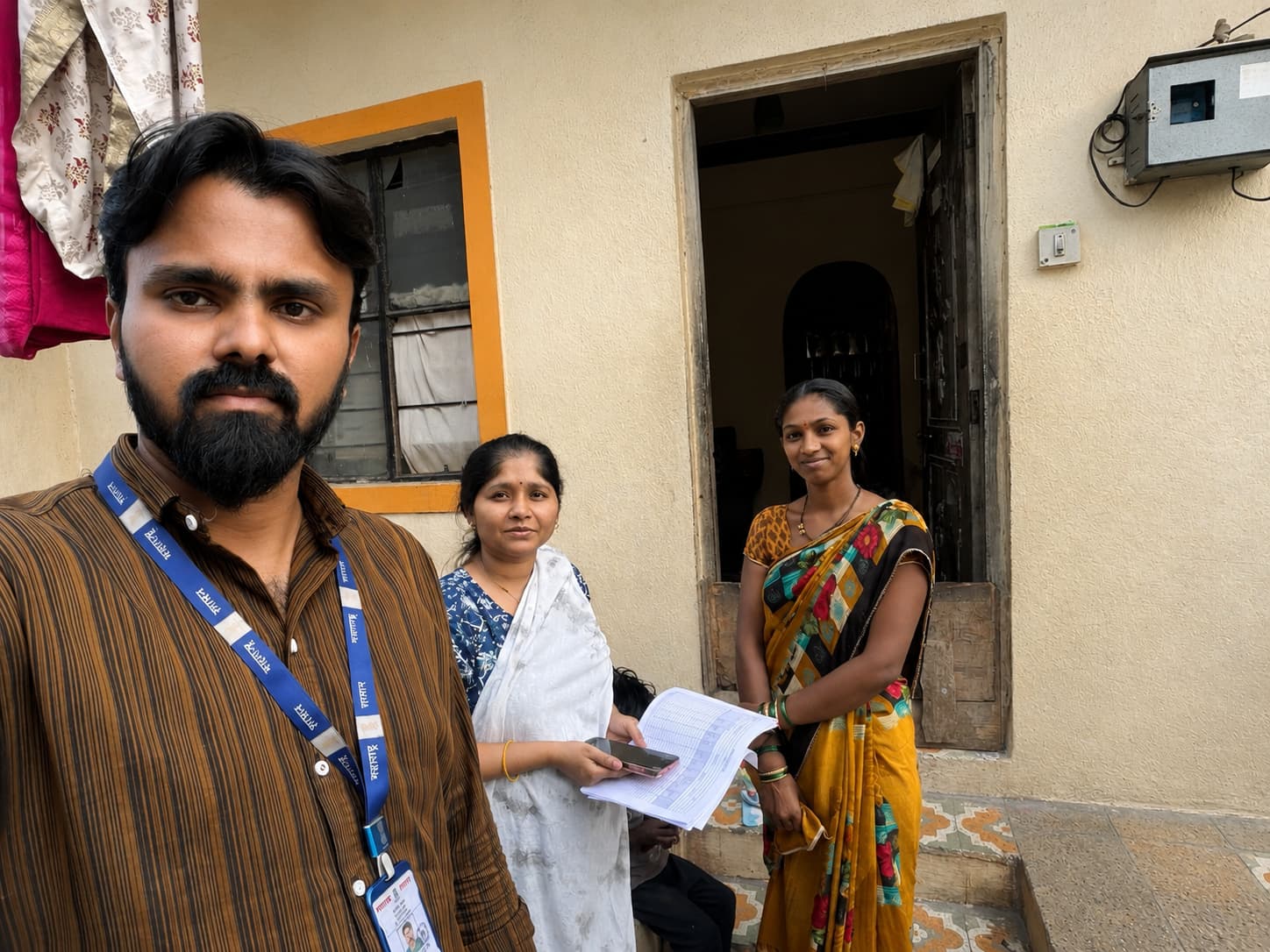
AI TB screening, in Froncort.AI’s version, does not diagnose anyone. The software ranks 300-meter zones by predicted tuberculosis risk and converts that ranking into visit routes for health workers. In a Pune pilot, guided teams confirmed a similar number of lung TB cases while screening about one-third as many people, though the study was small.
The timing gives the grant extra weight. Two days later, the World Health Organization published its Global Tuberculosis Report 2026, and its central gap is the one this tool targets: of an estimated 10.6 million people who developed TB in 2025, about 2.2 million were never diagnosed or reported. Whether AI TB screening can close that gap at scale is unproven, and the startup’s own study says so.
How Does Froncort.AI’s AI TB Screening App Work?
mAI-NETRA is the mobile version of AI-NETRA, the company’s public health platform. Its inputs are government health program data, satellite-derived signals from Google’s Earth AI models and local indicators such as settlement density, land use, rainfall and flood exposure. The output is practical: ranked work plans, household clusters and walking routes.
Field conditions shaped the design. The startup’s website describes an app that runs offline with automatic sync, gives voice guidance in several languages and works on basic Android phones. TB and malaria modules exist today, with leprosy, dengue, cholera and leptospirosis planned.
The rollout plan covers up to eight high-burden districts in three Indian states, home to 2 million to 3 million people. Simple arithmetic puts the grant at roughly 77 cents to $1.15 per person covered. Froncort.AI’s stated goals are 20% more TB cases found and fewer than half as many people screened per confirmed case. Those are targets, not results.
The Google.org grant is part of a wider program. Google is distributing $30 million across 15 organizations that use AI in public services, and the recipients were named Sept. 15 from more than 2,600 proposals. Froncort.AI plans to publish mAI-NETRA as an open-source blueprint other governments can adapt. This is the second Google.org grant to the startup; the first paid for the validation study.
What Did the Pune Pilot Show About AI TB Screening?
The pilot showed better efficiency, not more total detection. Maharashtra’s State TB Office partnered on the Pune district study, and the diagnostics nonprofit FIND handled implementation. A two-week AI-guided sweep across four TB units was compared with a standard campaign from December 2024 to January 2025.
The Efficiency Numbers
| Measure | AI-guided sweep | Standard campaign |
|---|---|---|
| People screened | 66,095 | 177,322 |
| Lab-confirmed pulmonary TB cases | 10 | 9 |
| People screened per confirmed case | 6,610 | 19,702 |
| Cost per confirmed case | About 930,000 rupees | About 2.76 million rupees |
| All forms of confirmed TB | 15 | 32 |
Guided teams needed 6,610 screenings per confirmed case, against 19,702 under standard practice, a 66% drop. The study team also surveyed community health workers known as ASHAs after the campaign. Of 101 respondents, 92% reported a lighter workload.
A retrospective test pointed the same way. Applied to a March 2025 campaign, the model’s plan would have captured 89% of notified cases from under one-third of the screened population.
Where the Evidence Runs Thin
The table’s last row complicates the story. Counting every form of confirmed TB, the guided sweep found 15 cases and the standard campaign found 32. Per 100,000 people screened, that works out to about 23 versus 18, a far narrower edge than the headline result. In a July blog post, the company said the pilot found no difference in total detection on that measure, which it attributed to ranking areas without giving them equal diagnostic capacity.
The study report lists its own limits:
- The two arms ran in different time periods.
- Only the standard arm had a mobile X-ray van.
- The main result rests on 10 confirmed cases.
- Results reflect the tool plus training plus a new workflow, not the algorithm alone.
- Predictions are weakest where past case reporting is sparse.
With 10 cases against nine, one or two diagnoses either way would change the picture. The authors’ recommendation reads: “A concurrent, like-for-like trial with harmonized case definitions is the appropriate next step.” Until that trial exists, the case for AI TB screening by geography is promising and unconfirmed.
Why Does India Want AI TB Screening Now?
India screens for TB at enormous volume, and the yield per person is low. The health ministry said Nov. 12 that more than 250 million people were screened between Dec. 7, 2024, and Nov. 8, 2026, which turned up 4.86 million cases. About 1.5 million of those people had no symptoms. The ministry’s own list of tools already includes AI-enabled X-rays and AI for identifying hotspots.
The burden explains the effort. WHO’s 2025 report attributed a quarter of the world’s TB cases in 2024 to India. This year’s picture is less complete: a national prevalence survey is still under technical discussion with WHO, and an updated India country profile will follow. On deaths, the ministry reported a 38% fall since 2015, compared with 35% globally.
Money is the other pressure. Domestic TB funding worldwide rose 14% to $5.6 billion between 2024 and 2025, partly offsetting a decline in international financing. India covers 96% of its TB program needs from domestic funds. A standard Pune campaign that spends about 2.76 million rupees per confirmed case is the baseline any tuberculosis screening tool in India has to beat.
How Is Geographic Targeting Different From AI Chest X-Ray Tools?
X-ray AI reads an image of a person already at the machine. Geographic targeting decides where the team goes in the first place. The first approach has a longer record: a 2023 study in PLOS Digital Health described a program in Nagpur where 10,481 people were screened and AI reading accounted for a roughly 15.8% increase in TB yield. The same paper documented deployment barriers, including software installation, network connectivity and workflow integration.
The two methods are complements, and the Pune pilot shows why. Its guided teams went to the right places without the X-ray van that the comparison campaign used. An AI TB screening program that pairs risk maps with portable imaging has not yet been tested head to head against standard active case finding with the same equipment.
When Can Targeted Screening Miss Cases?
Targeting can miss people in places the data does not describe well. AI-NETRA predicts neighborhood risk from Nikshay notification data, India’s TB case registry. A settlement with poor access to testing reports few cases, so it can look safe when it is not. The study flags this dependence directly.
There is a second trade-off. Targeted campaigns cover fewer people by design. Capturing 89% of notified cases from a third of the population still leaves about 11% outside the plan. For districts with thin surveillance records, blanket active case finding may remain the safer choice until reporting improves. The company’s own position is that precision targeting and thorough community screening should be used in sequence.
What to Watch as AI TB Screening Scales
The Google.org grant moves mAI-NETRA from a four-unit pilot toward a population of up to 3 million. The evidence so far supports one claim: guided teams reached confirmed lung TB cases with far fewer screenings. It does not yet support a claim of more total cases found.
Three developments will show whether AI TB screening holds up. The first is whether a concurrent trial with matched X-ray access is run. The second is results from the eight-district deployment against the 20% detection target. The third is WHO’s updated India profile, which will reset the baseline every tuberculosis screening program in India is measured against.
Frequently Asked Questions
What is Froncort.AI?
Froncort.AI is a health AI company based in Pune, India, founded in 2024 by physician-scientist Ujjwal Rao. It builds AI-NETRA, a public health platform that predicts where infectious disease risk is concentrated, and RegDoc, a regulatory documentation tool used by clinical research organizations, drugmakers and medical device companies.
How much did Google.org give Froncort.AI?
Google.org awarded Froncort.AI a $2.3 million grant, plus $200,000 in Google Cloud credits and pro bono engineering support. The company is one of 15 recipients of the $30 million Google.org Impact Challenge: AI for Government Innovation. It is the second grant Google.org has made to the startup.
What is mAI-NETRA?
mAI-NETRA is a mobile app for frontline health workers. It uses government health data and satellite-derived signals to rank small zones by disease risk, then produces household clusters and visit routes. The company says it works offline, supports voice guidance in several languages and runs on basic Android phones.
Does AI TB screening find more tuberculosis cases?
Not proven yet. In the Pune pilot, AI-guided teams confirmed 10 lung TB cases among 66,095 people, while a standard campaign confirmed nine among 177,322. That shows better efficiency. Counting all forms of TB, the guided sweep found 15 cases and the standard campaign found 32.
What are the limits of the Pune pilot study?
The pilot compared campaigns run in different periods, only the standard arm had a mobile X-ray van, and the main result rests on 10 confirmed cases. The authors recommended a concurrent trial with matched conditions before drawing firm conclusions about detection.