
Nvidia-Backed Simplismart Raises $14 Million To Turn GPUs Into AI Services

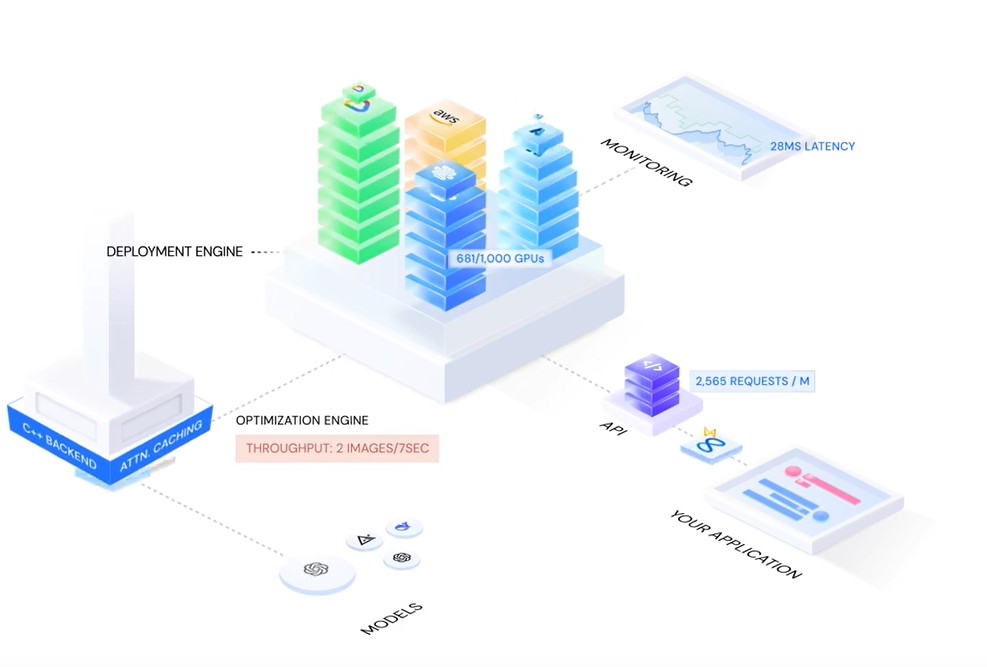
The Bengaluru startup sells software that makes existing chips serve AI models faster and cheaper, a bet that sets it apart from billion-dollar U.S. rivals.
Simplismart, a Bengaluru-based AI inference software company, has raised $14 million in a Series B round led by Dallas Venture Capital, with Nvidia participating alongside Accel, Shastra VC and Micromax. The company announced the funding on Oct. 27, 2026, about two years after a $7 million Series A led by Accel.
Simplismart sells software that connects trained AI models to graphics processing units, or GPUs, and tunes how those models run so each response costs less and arrives faster. It does not own data centers. Enterprises use it to serve their own models, and cloud providers use it to sell AI services built on their GPUs.
The company said its annualized revenue run rate grew 14-fold over the past six months. It did not disclose the dollar figure behind that multiple. “This funding will allow us to take that platform to more enterprises and cloud providers globally,” co-founder and CEO Amritanshu Jain said in a statement. Simplismart plans to spend the money on its inference engine, on partnerships with cloud providers and sovereign AI operators, and on expansion in North America.
What Does Simplismart Do?
Simplismart works in the layer between an AI model and the hardware that runs it. Once a model is trained, every answer it produces requires inference, the computation that turns a prompt into output. A popular product repeats that work millions of times a day. Small gains in speed or cost per request compound quickly.
The company sells two products. Enterprises get an inference and orchestration platform for deploying models on their own cloud accounts or hardware. Cloud providers get software that lets them offer inference services under their own brands without building the stack themselves. Unlike inference providers that buy or reserve GPU capacity and resell it, Simplismart owns no compute.
Its own customer numbers show what that tuning looks like. For enterprise AI company Ema, the target was about 200 milliseconds of latency at roughly 9 cents per million tokens, the company said in its funding announcement. Simplismart said its search surfaced options from 5 cents at 350 milliseconds to 12 cents at 100 milliseconds, then shipped a production setup at 7 cents and 180 milliseconds. These figures come from Simplismart and have not been independently verified.
Simplismart also said it powers the serverless inference layer of Shakti Studio, a product from Indian cloud provider Yotta. Jain and Devansh Ghatak, former engineers at Oracle and Google, founded the company in 2022. It operates from Bengaluru and San Francisco.
How the Simplismart Funding Round Came Together
Dallas Venture Capital put close to $5 million into the round, Jain said about the deal. Dayakar Puskoor, managing partner at the firm, said in a statement that it backed Simplismart for its technical work on a critical need in AI infrastructure and for its founding team’s execution.
The final deal looks different from what circulated earlier this year. In May, Nvidia was reported to be in advanced talks to lead a roughly $20 million round at a valuation near $100 million. Later reports had the company discussing $40 million to $50 million at up to three times that price. What closed was smaller, led by a U.S. venture firm, with Nvidia as a participant. The round reportedly values Simplismart at about $100 million including the new capital, and Jain has said the Series B is closed and will not be extended.
Why Is Nvidia Backing Software That Can Cut GPU Use?
Nvidia’s own product line offers the clearest answer. Software that squeezes more output from each GPU can mean a customer needs fewer chips for the same workload, which looks odd for a company that sells GPUs. Yet Nvidia publishes Dynamo, an open-source inference framework that does similar work: it splits inference phases across GPUs, routes requests to avoid redundant computation and extends memory by caching data on cheaper storage.
Simplismart and Nvidia work on technical integrations around Dynamo. For its cloud-provider product, the startup works with Nvidia to help operators deploy and manage AI infrastructure at scale, and it previously built on Nvidia Inference Microservices, or NIM.
Nvidia has backed other inference companies, too. It reportedly anchored about $150 million of Baseten’s $300 million Series E in January 2026. Nvidia has not publicly explained its Simplismart investment. Whether cheaper inference ultimately raises or lowers total GPU demand is a question the market has not settled.
How Big Is the AI Inference Market?
Estimates vary widely, and that spread is itself useful information. Fortune Business Insights, in a report last updated June 8, 2026, valued the global AI inference market at $103.73 billion in 2025. It projects $117.80 billion in 2026 and $312.64 billion by 2034, a 12.98% compound annual growth rate, with North America holding 41.78% of the market in 2025.
Market.us put the 2025 figure at $108.05 billion and forecast $513.12 billion by 2035, a 16.6% annual growth rate. Both are paid industry reports, and their long-range forecasts diverge sharply, so treat the totals as directional. These market figures also include chips and servers. The slice available to an optimization software company such as Simplismart is far smaller than the headline number.
Simplismart vs. Baseten and Fireworks: The Inference Startup Funding Gap
Simplismart’s round is small next to its U.S. rivals. Fireworks, Baseten and Together AI raised nearly $4 billion in a matter of weeks this summer, as investors poured money into companies that run open-weight and custom models for businesses.
| Company | Latest disclosed round | Headline valuation | Announced |
|---|---|---|---|
| Simplismart | $14 million Series B | About $100 million (reported) | October 2026 |
| Baseten | About $1.5 billion | $13 billion | June 2026 |
| Fireworks AI | $1.505 billion Series D | $17.5 billion | July 2026 |
Size is only part of the gap. Baseten’s latest round reportedly used a dual-tier structure, with some investors entering at $11 billion rather than the $13 billion headline. Simplismart is pitching a different trade: instead of competing for scarce GPUs and reselling capacity, it licenses the software layer to companies that already own the chips. That model needs less capital. It also limits how much of each customer dollar Simplismart keeps.
India’s Sovereign AI Push Creates Cloud-Provider Demand
India’s government has spent two years building shared GPU capacity, and that hardware needs software before customers can use it. Under the IndiaAI Mission, more than 38,000 GPUs have been offered at ₹65 per hour, and the IT ministry announced Feb. 17, 2026, that 20,000 more would follow. The program carries an outlay of more than ₹10,300 crore.
Those chips sit with empanelled cloud and data center operators, which must package them for startups, researchers and enterprises. Simplismart’s cloud-provider product targets that packaging job, and the Yotta deployment is an early example. The company has named sovereign AI partnerships as a priority for the new funds.
The Risks for Simplismart’s AI Inference Model
The first risk is the free alternative. Dynamo is open source, and Nvidia keeps adding features to it. A cloud provider with strong engineers could build on it directly rather than license a vendor’s stack, so Simplismart has to stay measurably faster and cheaper than what customers can assemble themselves.
Large cloud platforms pose a second threat, since they sell managed model serving inside contracts enterprises already hold. Switching away carries real friction. Simplismart has to win on performance or on deployments those platforms handle poorly, such as on-premises or in-country setups.
The disclosed numbers need caution as well. A 14-fold rise in run rate means little without the base, which the company has not shared. An earlier report that Simplismart discussed a valuation of $300 million to $400 million was never confirmed.
For buyers, optimization software is not always the right first step. A team serving a few thousand requests a day will often save more engineering time by calling a hosted model API than by tuning its own deployment. The math changes once token volumes reach billions per month, or when data-residency rules require models to run on specific hardware or inside national borders.
What Simplismart’s Raise Means for AI Buyers and Founders
The round is a modest check with a clear signal: investors, including the largest GPU maker, now pay for software that makes existing chips earn more. Here is how different readers can act on it.
- Enterprise buyers: Set a target pair before any vendor trial, such as maximum latency in milliseconds and maximum cost per million tokens, as Ema did. Ask vendors to show the full trade-off curve rather than a single benchmark.
- Cloud and data center operators: Price the build-versus-license decision against Dynamo’s free stack and the engineering headcount you would need to run it.
- AI infrastructure founders: An asset-light model can attract a strategic investor without a mega-round, but expect investors to ask for absolute revenue, not growth multiples.
If you run AI features in production, pull last month’s inference bill and token count this week. Divide one by the other to get your cost per million tokens, then compare it with the 7-cent figure Simplismart reported for Ema, keeping in mind that model size and latency targets shift that number. A large gap is your cue to benchmark an optimization vendor or Dynamo against your current setup.
Frequently Asked Questions
What does Simplismart do?
Simplismart builds software that runs trained AI models on GPUs faster and at lower cost. Enterprises use its inference and orchestration platform to deploy their own models, while cloud providers use it to sell branded AI inference services on their hardware. The Bengaluru company, founded in 2022, does not own computing infrastructure.
How much did Simplismart raise in its Series B?
Simplismart raised $14 million in a Series B round announced Oct. 27, 2026. Dallas Venture Capital led the round and invested close to $5 million, with Nvidia, Accel, Shastra VC and Micromax participating. The deal reportedly values the company at about $100 million including the new capital.
Why did Nvidia invest in Simplismart?
Nvidia has not publicly explained the investment. The two companies already work together: Simplismart builds integrations around Nvidia’s open-source Dynamo inference framework and partners with Nvidia on its cloud-provider product. Nvidia has also backed other inference companies, including a reported anchor investment in Baseten in January 2026.
What is AI inference?
AI inference is the computation a trained model performs each time it answers a prompt, classifies an image or makes a prediction. Training happens once or occasionally, but inference runs every time someone uses the product, so its cost grows with usage and often dominates the long-term expense of running AI features.
How big is the AI inference market?
Fortune Business Insights valued the global AI inference market at $103.73 billion in 2025 and forecasts $312.64 billion by 2034. Market.us estimated $108.05 billion for 2025. The Fortune Business Insights figure includes hardware, software and platforms, so the share open to optimization software companies is much smaller.
Who are Simplismart’s competitors?
Simplismart competes with U.S. inference platforms such as Baseten, Fireworks AI and Together AI, which together raised nearly $4 billion within weeks in mid-2026. It also faces managed model serving from large cloud platforms and Nvidia’s own free Dynamo framework, which cloud providers can adopt without a vendor.