
King Charles Meets US Tech CEOs: Inside the Blair House Summit on UK Startup Challenges

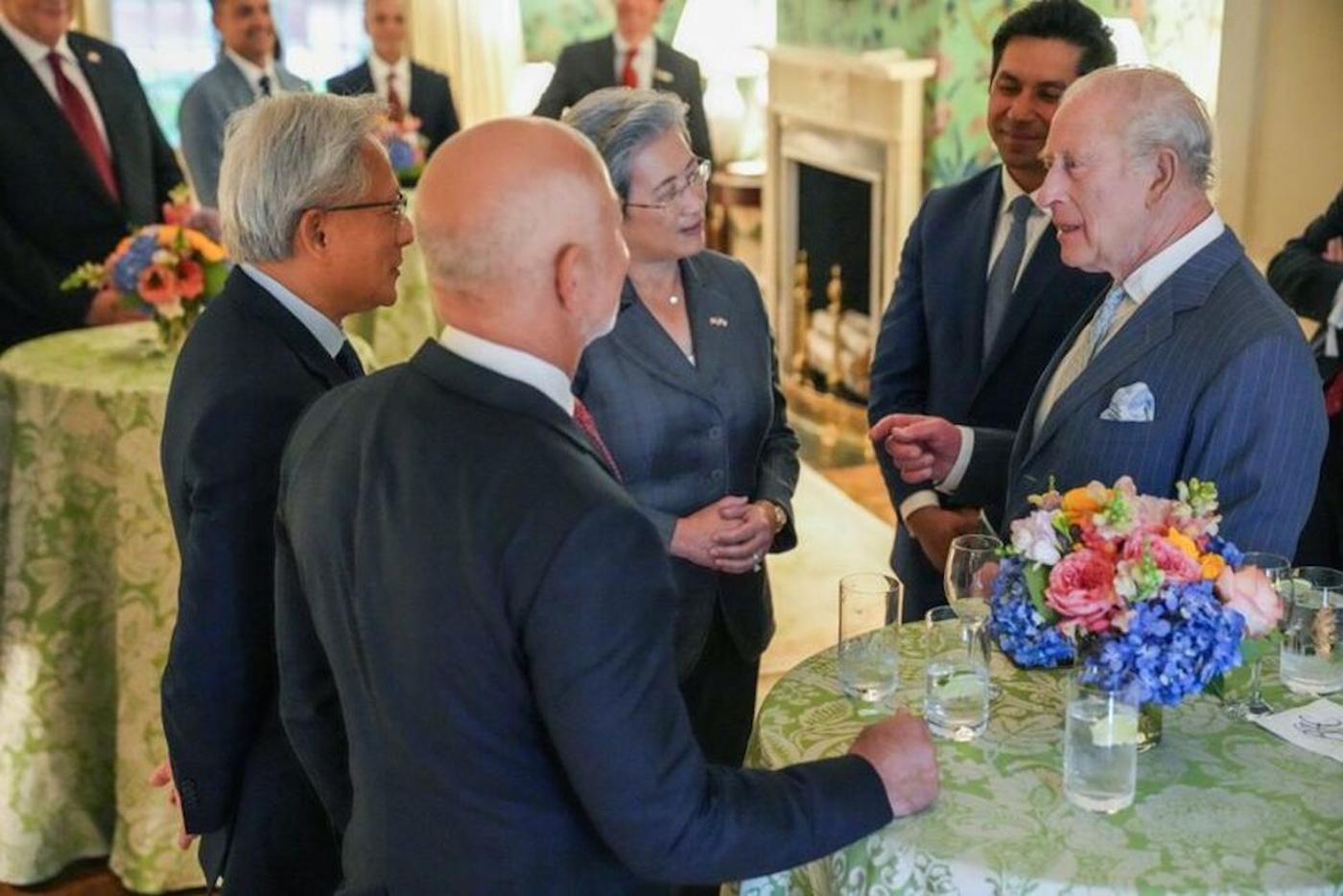
On April 28, 2026, King Charles III sat across from some of Silicon Valley’s most powerful figures and delivered a pointed message about Britain’s deepest startup wound — a funding crisis killing university innovation before it reaches investors. Held in the Lee Drawing Room at Blair House, the official U.S. government guest residence in Washington, D.C., this moment marked a new chapter in royal diplomacy: King Charles meets us tech CEOs not for ceremony, but for commerce. The gathering was confirmed by Reuters as a cornerstone of his four-day U.S. state visit. It proved that the Crown’s modern role extends far beyond parades and podiums — straight into venture capital and artificial intelligence.
Who Was in the Room? King Charles Meets US Tech CEOs at Blair House
Six of America’s most recognizable technology executives gathered for the roundtable. Amazon founder Jeff Bezos, Apple CEO Tim Cook, Nvidia CEO Jensen Huang, AMD CEO Lisa Su, Salesforce CEO Marc Benioff, and Alphabet President Ruth Porat all sat with the king. According to Fox News, Meta and quantum computing firm IonQ were also represented — making this a strikingly broad cross-section of the global tech industry. The British government described the reception as an effort to reinforce the UK as a “tier-one destination” for global tech investment.
Charles broke the ice with characteristic wit. “You’re all deadly competitors,” he told the assembled executives. Huang shot back immediately: “No one has to die.” That playful exchange set the tone for what followed — a frank, substantive conversation about where British innovation actually breaks down.
King Charles Startup Funding: The “Valley of Death” Problem
The heart of the meeting was King Charles startup funding — or more accurately, the structural absence of it at the most critical stage. Charles zeroed in on companies that spin out of university research labs only to collapse before reaching a Series A investor. “These are the people I always think have the greatest difficulty getting off the ground,” he told the room. Then he invoked the phrase that haunts British tech: “They get into this terrible valley of death.”
The metaphor is painfully accurate. As Sifted has documented, the biggest hurdle for UK university spinouts is a chronic shortage of proof-of-concept (PoC) funding — the money needed to test an idea and make it ready for venture capital. That gap falls precisely between the end of a research grant and the point where technology becomes commercially viable. Since 2014, 1,300 spinouts from 91 UK universities have generated over £20 billion in investment and nearly 29,000 jobs. Countless more never made it that far.
Huang responded with a solution, not a diagnosis. Big opportunities in AI and quantum robotics are materializing rapidly, he said, but “we just need a vibrant VC ecosystem and a startup culture.” It was a call to action. The king’s message had landed.
King Charles Bezos Meeting: Rejection, Amazon, and a Royal Quip
The King Charles Bezos meeting produced the evening’s most memorable exchange. Bezos shared that when he launched Amazon in 1995, he faced 40 straight investor rejections before finally raising $1 million. Charles didn’t miss the moment. “And all those 40 are kicking themselves,” he quipped. The anecdote illustrated the exact argument Charles had been making throughout the session — exceptional ideas still die at the funding stage. Even Amazon nearly did.
AMD’s Lisa Su was visibly energized by the conversation. After the King Charles Bezos meeting and wider roundtable wrapped, she posted on X with a photograph and a short note: “Enjoyed the discussions.” Some executives also spoke about the investments their companies had already committed to the UK, a reference to a wave of mega-pledges made the previous September during President Trump’s state visit to Britain.
The September 2025 Backdrop: $42 Billion in UK Tech Pledges
The Blair House meeting didn’t come out of nowhere. It followed a landmark September 2025 moment when Microsoft, Google, Nvidia, and OpenAI collectively pledged £31 billion ($42 billion) toward UK investments in AI, robotics, and energy. Microsoft committed $30 billion toward AI infrastructure. Nvidia pledged £11 billion in UK AI factories, and Google promised $6.8 billion for AI research and infrastructure.
Those are macro-level commitments — impressive in scale. But King Charles’s question at Blair House was sharper: will any of that money actually reach early-stage British startups? Data from EU-Startups showed UK spinouts raised a record €3.8 billion in equity investment in 2024. However, scale-up funding remains dangerously concentrated. According to techUK’s analysis of the UK-US Tech Prosperity Deal, moving beyond headline commitments toward concrete mechanisms for pre-Series A ventures remains the defining challenge.
King Charles Congress Speech Sets the Diplomatic Stage
Before the tech roundtable, King Charles US visit today had already dominated global news cycles for hours. His King Charles Congress speech — delivered to a joint meeting of both chambers — lasted 28 minutes and drew several standing ovations. He framed the U.S.-U.K. relationship as “at its heart a story of reconciliation, renewal, and remarkable partnership.” Only the second British monarch ever to address Congress, Charles followed his late mother Queen Elizabeth II, who delivered that honor in 1991.
Time magazine noted that Charles celebrated the alliance while also gently pushing back on areas where London and Washington diverge. The full text of the King Charles Congress speech was published on the official Royal Family website, cementing its place in the historical record. Taken together, the King Charles US visit today — from the South Lawn to Congress to Blair House — constructed a coherent narrative: Britain is open for business, and its king is personally lobbying for it.
King Charles Trump Meeting and the State Dinner 2026
Earlier on April 28, the King Charles Trump meeting took place in the Oval Office. NBC News reported that British Foreign Secretary Yvette Cooper and Vice President JD Vance were both present. Trump called it “a really good meeting” and described Charles as “a fantastic person” in remarks captured afterward. The bilateral talks remained closed to cameras — a notable departure from Trump’s usual approach with foreign leaders.
That evening, the King Charles state dinner 2026, hosted by Trump in the East Room of the White House, became the most talked-about social event in Washington in nearly 20 years. CBS News confirmed it was the first white-tie dinner at the White House since Queen Elizabeth’s 2007 visit. Bezos, Cook, and Huang — the same executives who had debated UK startup funding hours earlier — were among the 120-person guest list. Charles gifted Trump the original bell from HMS Trump, a British submarine launched in 1944. “Should you ever need to get hold of us, just give us a ring,” the king quipped.
The King Charles state dinner 2026 was more than a banquet. It was the closing chapter of a masterfully orchestrated day that moved from geopolitics to technology to toasts.
What’s Next for UK Startup Funding?
The king made his case directly, with charm and conviction, to the people who can actually write the checks. The King Charles Trump meeting established the political goodwill. The King Charles Congress speech delivered the historical framing. But the Blair House tech roundtable — where King Charles meets us tech CEOs and argues for the entrepreneurs who never get a seat at the table — may prove to be the most economically consequential moment of the entire visit.
NPR’s analysis noted that Charles positioned himself as a bridge between tradition and modern economic ambition. That’s a delicate balancing act for a constitutional monarch — one he executed precisely. Britain’s universities produce extraordinary research. The pipeline of talent is real and deep. What remains broken is the bridge between the lab and the market.
If even one of the executives in that room redirects a fraction of their capital toward the UK’s early-stage ecosystem, the king’s gamble will have paid off. Now, Silicon Valley has to decide whether to respond in kind.
Frequently Asked Questions
When and where did King Charles meet US tech leaders during his state visit?
King Charles met with US tech executives on April 28, 2026, in the Lee Drawing Room at Blair House — the official U.S. government guest residence in Washington, D.C. — as part of his four-day state visit to the United States.
Which tech leaders attended the Blair House meeting?
The meeting included Amazon founder Jeff Bezos, Apple CEO Tim Cook, Nvidia CEO Jensen Huang, AMD CEO Lisa Su, Salesforce CEO Marc Benioff, and Alphabet President Ruth Porat. Fox News also reported that Meta and IonQ were represented.
What did King Charles say about UK startups?
Charles raised the issue of university-born startups struggling to secure early-stage funding, calling this critical funding gap the “valley of death.” He said these companies “have the greatest difficulty getting off the ground” and struggle to find investors after their research grants run out.
What did Jensen Huang say at the Blair House meeting?
Nvidia CEO Jensen Huang highlighted AI and quantum robotics as massive opportunities but stressed the need for “a vibrant VC ecosystem and a startup culture” to help companies in the UK capitalize on those sectors.
Did King Charles address Congress during his US visit?
Yes. Charles delivered a 28-minute address to a joint meeting of Congress on April 28, 2026 — only the second time a British monarch has done so. His late mother, Queen Elizabeth II, was the first, addressing Congress in May 1991.
What happened at the King Charles and Trump Oval Office meeting?
King Charles and President Trump held a bilateral meeting in the Oval Office on April 28, 2026. The meeting was closed to press. Afterward, Trump described it as a “really good meeting” and called Charles “a fantastic person.”
What is the UK’s “valley of death” problem for startups?
The “valley of death” describes the funding gap that UK university spinouts fall into between the end of their research grants and the point where their technology is mature enough to attract venture capital. Proof-of-concept (PoC) funding — which bridges that gap — remains alarmingly scarce in the UK, leaving many promising inventions unable to reach commercialization.