
Short-Form News Video Gets a Vetted Upgrade: Inside the SaySo App Launch

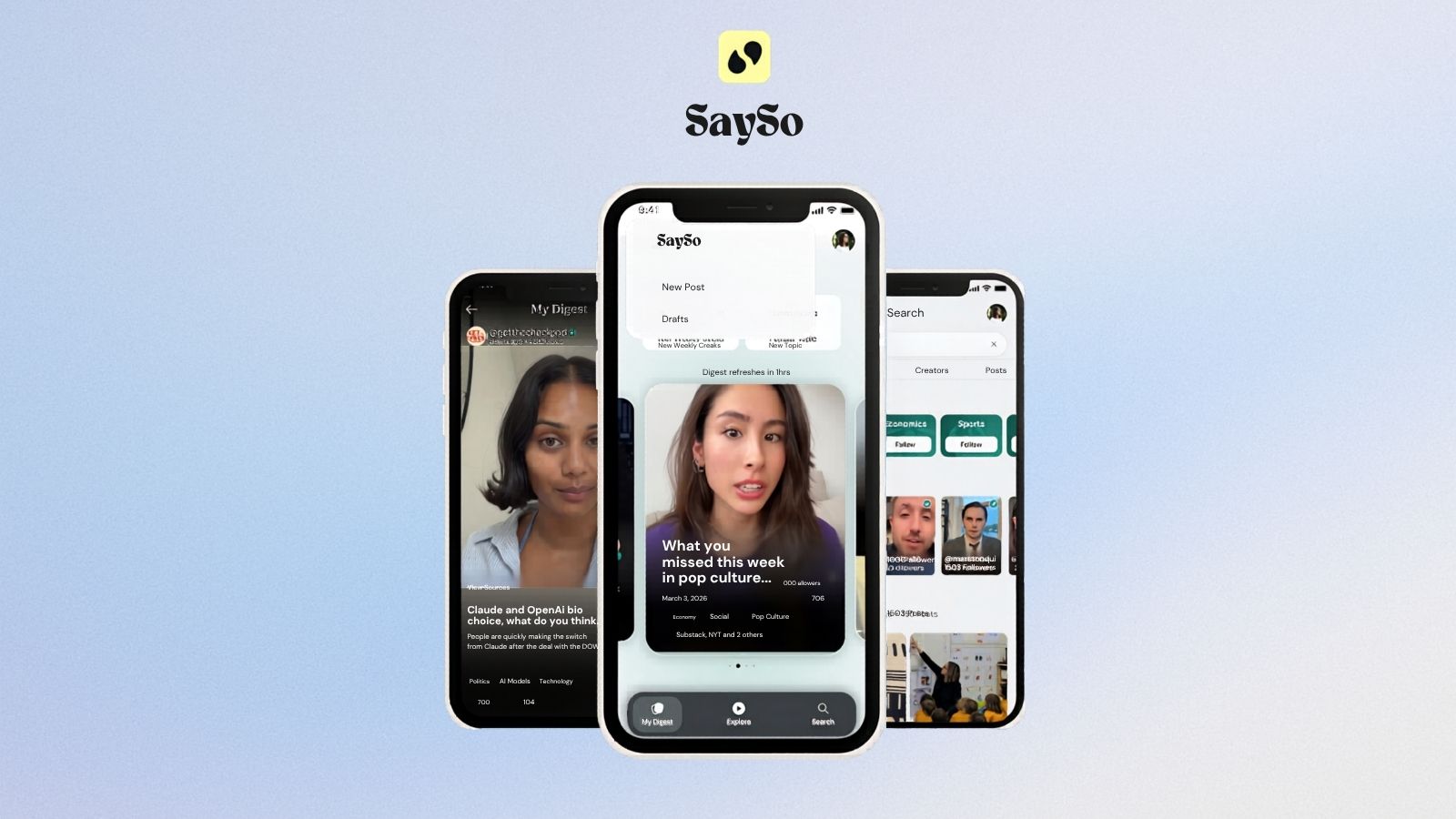
Only 56% of U.S. adults now say they have a lot of or some trust in the information they get from national news organizations — down a full 20 points since 2016, according to Pew Research. Into that widening trust vacuum steps SaySo, a short-form news video app built on a deceptively simple premise: curate less, vet more. Designed to deliver curated news from vetted creators and independent journalists, SaySo launched for iOS users in the U.S. and Canada this month after a private beta that began in November. It’s one of the most intentional attempts yet to build a verified news source app that competes directly with the algorithmic chaos of mainstream social platforms.
What Is SaySo and Who Built It?
SaySo is the flagship app of Caliber, formerly known as The News Movement, which was founded in 2022 and rebranded in 2025 to focus on social, short-form journalism. CEO and co-founder Ramin Beheshti previously served as chief product and tech officer at Dow Jones. He envisioned the platform as something close to “Apple News+ but for creators” — a verified news source app that handpicks its roster rather than opening the gates to anyone with a camera.
Under Beheshti’s guidance, Caliber already reaches more than 100 million users each month through its growing family of socially native, creator-led brands. About 65% of this audience is under the age of 35. That built-in promotional pipeline separates SaySo from most other social journalism apps 2026 has produced — it isn’t starting from scratch. Looking ahead, the company plans to launch SaySo in the U.K. in the summer, with further expansion into additional markets throughout 2026 and 2027.
Short-Form News Video and the Trust Crisis Powering Its Rise
Trust in digital news has not just declined — it has structurally collapsed for specific demographics. Gallup analysis found a clear generational divide in media trust, noting that in the most recent three-year period, only 43% of adults aged 65 and older trust the media, compared with no more than 28% in any younger age group. Poynter’s reporting on the same data puts it bluntly: fewer than three in 10 Americans now trust newspapers, TV, and radio to report the news fully, fairly, and accurately.
And yet people keep consuming short-form news video. Across all markets, the share of people who watch news via social video jumped from 52% in 2020 to 65% in 2025, mirroring platforms’ pivot toward short-form video, according to the Reuters Institute’s 2025 Digital News Report. The format isn’t the problem. The gatekeeping — or lack of it — is. Many users drawn to social platforms like TikTok, Instagram, and YouTube to stay up to date on news are increasingly complaining about misinformation and AI slop cluttering their feeds, and worries about trust have grown, especially in light of lawsuits against Meta and concerns over TikTok’s ownership.
How the Personalized News Daily Digest Works
The core experience inside SaySo is a feature called the Digest — a curated, finite queue of videos waiting each morning. The Digest presents users with a finite number of videos — around 12 per day — with the express point of informing them quickly and accessibly with news content from trustworthy sources, not keeping them glued to their phones. That’s the personalized news daily digest model in action: sized for completion, not engineered for addiction.
SaySo aims to offer a calmer, more intentional alternative to algorithm-driven feeds, where users can choose how much time they want to spend — whether it’s one minute or five — on stories from vetted, independent creators. The official SaySo app listing puts the philosophy plainly: the platform is “optimized for your understanding,” not your attention. That distinction, subtle as it sounds, is the entire product strategy.
The personalized news daily digest also functions as an anti-doom-scroll mechanism by design. Users follow voices they trust, explore topics at whatever depth suits them, and walk away genuinely informed rather than anxious. For a media landscape defined by outrage cycles, that’s a meaningful design choice — not just a marketing line.
Vetted News Creator Platforms: SaySo’s Editorial Model
At launch, SaySo onboarded approximately 30 creators. That number is deliberately small. All of its content creators are vetted by Caliber, making SaySo one of the few vetted news creator platforms to apply editorial standards at the point of creator selection rather than after-the-fact content moderation. Among them is Nico Agosta, who first gained attention with his “Stocking the Capitol” video series on Congressional financial dealings; Dr. Victoria, who focuses on racial justice and social change; and Isabel Ravenna, an independent journalist with bylines in outlets like National Geographic.
Content doesn’t auto-publish — everything goes through a moderation queue so most problems are caught before they reach readers, and if something slips through and gets flagged, the team investigates, addresses it directly with the creator, and takes it down if it crosses the line. Additionally, SaySo is developing a “community notes” feature, allowing users to participate in the accountability process through a crowdsourced fact-checking approach similar to that of X and TikTok.
This layered approach — human vetting, editorial moderation, and community accountability — is what distinguishes vetted news creator platforms like SaySo from open social networks. Independent journalist video content published here carries an implicit editorial endorsement that a TikTok post simply never will. The creator base, which the company aims to grow to 100 by the end of the year, will be incentivized to promote SaySo because it offers them a share of the revenue generated — while platforms like TikTok and Instagram typically offer meager payouts to all but their most popular creators.
Social Journalism Apps 2026: The Competitive Reality
The market for social journalism apps 2026 is crowded, fast-moving, and largely defined by scale plays. TikTok, YouTube Shorts, and Instagram Reels have trained hundreds of millions of users to expect short-form news video in a vertical format. That’s the gravitational field SaySo is operating within.
News creators and influencers operating in social and video networks have become a significant source of news — the Reuters Institute’s own Digital News Report indicates that personalities and news creators often eclipse traditional news brands in terms of attention. Pew Research finds that around 21% of U.S. adults and more than a third of under-30s now regularly get news from creators or influencers, with the majority saying that the way these personalities present the news helps them better understand current events.
SaySo doesn’t compete with TikTok on scale. It goes narrower. As Beheshti told Press Gazette, the distinction from Substack is curation: “What Substack don’t do that we’re offering is that curation. We are selecting creators to come onto this platform based on a set of values.” That editorial posture is what separates serious social journalism apps 2026 from platforms that have simply dressed up algorithmic chaos in a journalistic costume. Caliber also has a promotional advantage in that it can use its other brands, including TNM, The Recount, and Capsule, to drive SaySo adoption.
Trust in Digital News — The Stakes Beyond Market Share
The crisis around trust in digital news extends well past journalism industry navel-gazing. The World Economic Forum Global Risks Report identified misinformation and disinformation as the most pressing risks for the coming years, and more than half of global respondents — 58% — agree they are worried about what is real and fake online when it comes to news. Trust in digital news, at these levels, is a democratic problem as much as a media one.
Global trust in news at 40% has remained stable for the third consecutive year, per Reuters Institute data cited by IFJ — which means it’s not recovering, just not worsening. SaySo’s architecture responds to that with structure rather than slogans. Independent journalist video content run through a moderation queue, creators selected for values, a personalized news daily digest that respects your time — none of this individually rebuilds trust in digital news. Together, it forms a serious attempt at something the industry has largely failed to deliver inside a short-form video product.
What’s Next for SaySo?
SaySo has no immediate monetization plans; while it focuses on fine-tuning its product and growing its audience, it will probably not generate any revenue this year. When it does come time to activate revenue, the primary product will likely resemble a freemium model, with users paying for additional features like more Digests or enhanced access to creators. Rather than traditional display or native advertising, certain product features might be underwritten by sponsors, similar to the Apartment Therapy model.
Short-form news video as a format will only accelerate. The question SaySo has to answer isn’t whether the demand exists — that’s settled. The question is whether a verified news source app model can hold its editorial standards as it scales its creator base and enters new international markets. The architecture is thoughtful. The mission is clear. Now it needs an audience willing to trade the scroll for something more intentional.
SaySo is available now on the App Store for iOS users in the U.S. and Canada.
Frequently Asked Questions
What is SaySo and when did it launch?
SaySo is a short-form news video app developed by Caliber, formerly known as The News Movement. It launched for iOS users in the United States and Canada in April 2026, following a private beta that began in November 2025.
Who are the creators currently on SaySo?
At launch, SaySo featured approximately 30 vetted creators. Notable names include Nico Agosta (known for “Stocking the Capitol,” a series on Congressional financial dealings), Dr. Victoria (racial justice and social change), and Isabel Ravenna, an independent journalist with bylines in outlets including National Geographic. Caliber aims to grow the creator roster to 100 by end of 2026.
How does SaySo’s Digest work?
The Digest is a curated, finite queue of short videos — typically around 12 per day — personalized to the topics and creators a user follows. Unlike algorithmic social feeds, the Digest is intentionally designed to be completable, giving users control over their news consumption time rather than maximizing time-in-app.
How does SaySo vet its creators?
Every creator on SaySo is vetted by Caliber before any content is published. Content does not auto-publish — it flows through an editorial moderation queue first. The platform is also building a “community notes” feature, adding a crowdsourced fact-checking layer on top of editorial review.
Who founded SaySo and Caliber?
Caliber is led by co-founder and CEO Ramin Beheshti, who previously served as chief product and technology officer at Dow Jones. Caliber was established in 2025 as a holding company encompassing The News Movement, The Recount, and the lifestyle newsletter Capsule.
Does SaySo have a business model?
Not yet — SaySo is not expected to generate revenue in 2026. Future plans point toward a freemium model offering enhanced Digest access, deeper creator connections, and potentially sponsor-underwritten features. Creators on the platform will receive a share of revenue, a deliberate contrast to the low payouts typical on TikTok and Instagram.
When will SaySo expand beyond the U.S. and Canada?
A United Kingdom launch is confirmed for summer 2026, with further international expansion expected throughout the rest of 2026 and into 2027.