
Europe’s Defense AI Giant Helsing Funding Nears $1.2B at $18B Valuation

A Munich-based startup founded just four years ago is on the verge of closing one of the largest private defense tech raises in European history. Helsing funding has reached a new milestone, with the company in advanced talks to secure $1.2 billion at a valuation of roughly $18 billion, according to reporting from the Financial Times. The round is being led by U.S. growth firm Dragoneer Investment Group, with existing backer Lightspeed Venture Partners acting as co-lead — and multiple sources told the FT that the deal was oversubscribed several times over. That’s not just a fundraise. It’s a declaration that European defense AI is no longer playing catch-up.
What the Latest Helsing Funding Round Reveals About the Deal
The Dragoneer Lightspeed defense tech 2026 investment comes at a striking valuation premium. The $18 billion figure represents nearly a 30% increase in dollar terms over the €12 billion ($14 billion) Helsing achieved less than a year ago, when Daniel Ek led the company’s €600 million Series D in June 2025. The fundraising plans are described as being at an advanced stage, though the timing has not yet been formally confirmed.
Critically, while the round is being led by American investors, Helsing remains roughly 80% European-owned, according to a person familiar with the fundraising who spoke to the FT. That detail matters enormously in the context of European sovereign defense. The company has long positioned itself as a native alternative to U.S. defense tech giants, and this capital structure signals an attempt to maintain that identity even as Wall Street money flows in.
If it closes at the reported numbers, this Helsing funding round would be the largest ever raised by a German startup and would cement the company as the most valuable private tech firm in Germany.
From €100M Seed to $18B: The Helsing Funding Journey
Understanding today’s Helsing funding milestone requires a look at its remarkable capital trajectory. Founded in March 2021 by Dr. Gundbert Scherf, Torsten Reil, and Niklas Köhler, the company launched with a single belief: modern warfare had become a software problem, and Europe had no credible firm to solve it.
The founding trio brought rare credentials. Scherf previously served as a Special Advisor in the German Federal Ministry of Defense, while Reil famously dropped out of an Oxford biology PhD to found NaturalMotion, a gaming company he later sold to Zynga for $527 million. Köhler brought deep machine learning expertise. Together, they secured a €100 million seed investment from Prima Materia, Daniel Ek’s investment vehicle, in November 2021 — the first of what would become a string of increasingly ambitious Helsing funding rounds.
The trajectory has been steep. A Series C in July 2024 valued Helsing at approximately €4.9 billion. Less than a year later, the Series D reset the number to €12 billion. Now, the reported $18 billion target marks the third major valuation step-change in under 24 months. Helsing has raised a total of $1.63 billion across eight rounds to date, prior to this latest raise.
Helsing’s Expanding Product Arsenal Justifies the Price Tag
One reason investors keep bidding up the Germany military drone startup funding news cycle around Helsing is product velocity. The company started as a pure-software play — its Altra platform processes sensor data from multiple drones in real-time, combining feeds to identify targets and compress decision timelines for operators. That alone would be compelling. But Helsing has moved fast beyond software.
In December 2024, Helsing announced the HX-2, a 12-kilogram kamikaze loitering munition with a range of approximately 100 kilometers that can operate in GPS-denied environments using onboard AI. The drone has been deployed in Ukraine’s Donbas. In February 2026, Germany’s Bundestag budget committee approved an initial €269 million contract for HX-2 munitions, with a framework that could grow to €1.46 billion over seven years. That’s real government revenue, not just a pitch deck.
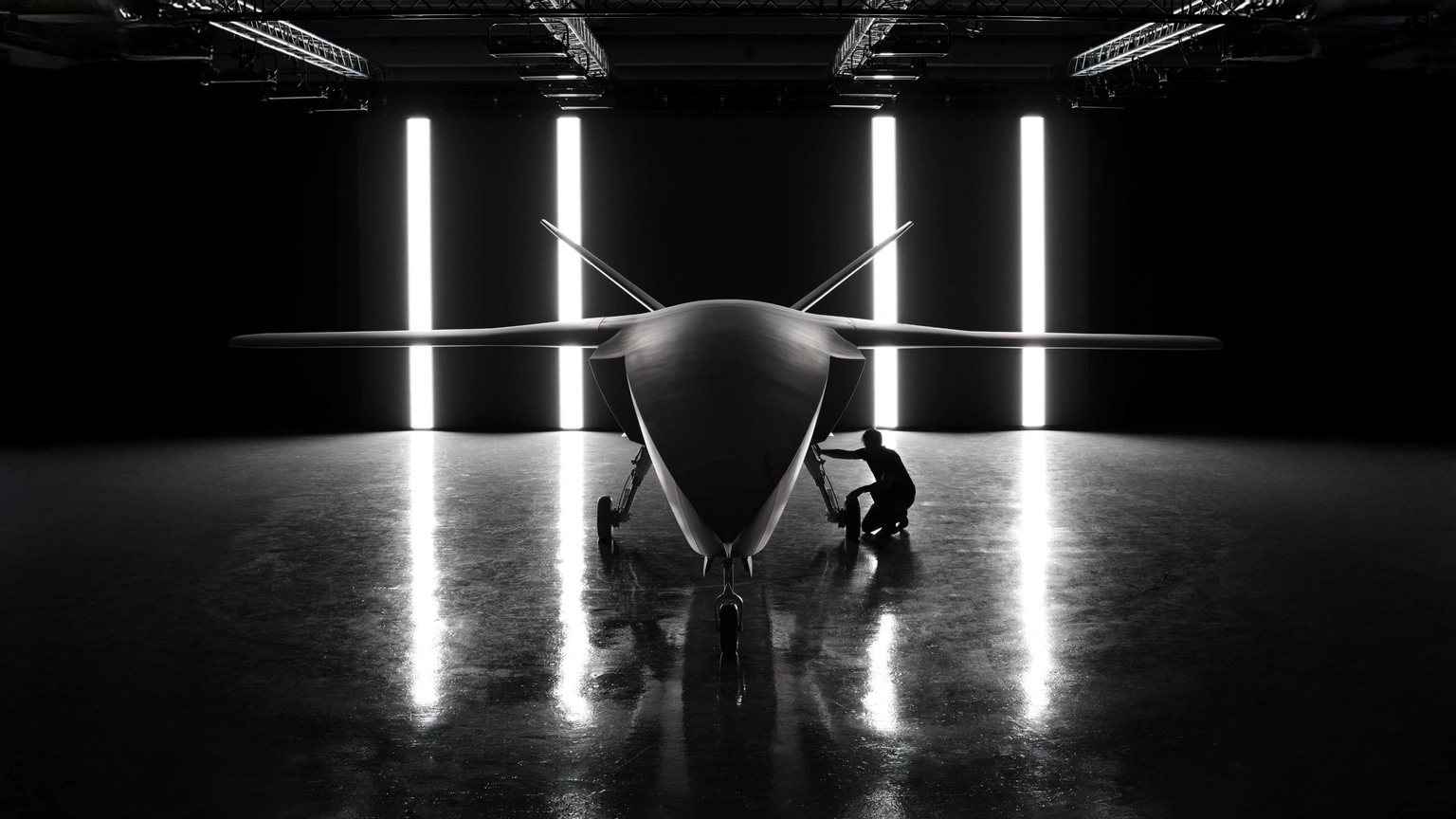
The portfolio now reaches well beyond flying weapons. Helsing acquired Spanish robot dog company Keybotic in January 2026, adding ground-based autonomous systems. The company also introduced Lura, a submarine detection and surveillance platform, expanding into underwater defense systems. And its CA-1 Europa — an unmanned aircraft designed to fly alongside crewed fighters — is targeting a first flight in 2027. Each acquisition and product adds a new dimension to a platform investors now treat as multi-domain rather than single-domain.
Daniel Ek Helsing Drone Investment and the Sovereignty Thesis
The Daniel Ek Helsing drone investment story is inseparable from a bigger geopolitical narrative. Helsing has branded itself as the “sovereign” alternative for European countries, staking out the position that AI defending European democracies should be built in Europe — not imported from the U.S. or China. Ek’s backing through Prima Materia, and his continued role as company chairman, has given Helsing an unusual degree of cultural credibility alongside its technical capability.
That philosophy extends to Helsing’s ethics framework. The company sells exclusively to democracies and runs company-wide ethics workshops to evaluate potential customer countries. In a sector often criticized for opacity, this approach has been a differentiator when navigating European government procurement.
Lightspeed Venture Partners described Helsing as building “AI based foundational technology at the forefront of military modernization that is so critical for democratic Europe.” That framing — pairing financial returns with democratic values — reflects a broader reframing happening across Silicon Valley, where defense investing is being repositioned as supporting democratic resilience rather than just weapons development.
Helsing vs Anduril: Europe’s Answer in a Global Race
Any serious analysis of this European defense AI startup raise latest round demands a comparison with the U.S. market. Helsing vs Anduril Europe defense AI is perhaps the most-discussed competitive dynamic in the sector. Anduril, founded by Palmer Luckey in 2017, is currently in talks for a new round that could value the company above $60 billion, nearly double its $30.5 billion valuation from June 2025. The gap in absolute valuation is real. So is the gap in revenue scale, with Anduril estimated at $2.1 billion in 2025 revenue versus Helsing’s earlier-stage profile.
But the Helsing vs Anduril Europe defense AI dynamic isn’t zero-sum. European governments face acute pressure to build sovereign capabilities that aren’t subject to U.S. export controls or political conditions. Germany’s share of total EU defense tech fundraising rose from 4% in 2019 to 11% in 2024, a structural shift that shows institutional capital increasingly flowing toward homegrown champions. Helsing is the obvious beneficiary.
For context, other European peers are significantly smaller. German drone maker Quantum Systems raised €180 million in November 2025 at over €3 billion valuation, while Lisbon-based Tekever raised £400 million in early 2025 at above £1 billion. Helsing’s scale dwarfs them both.
Why Dragoneer Lightspeed Defense Tech 2026 Signals a Structural Shift
The Dragoneer Lightspeed defense tech 2026 partnership arriving at this scale marks a real turning point. The number of firms actively investing in defense tech increased 41% in 2025, with mainstream venture capital dropping previous ethical objections and reframing the sector as supporting democratic values. Total defense tech VC funding jumped to a record $49.1 billion in 2025, nearly double 2024’s $27.2 billion. Dragoneer, known for backing Spotify and Airbnb in their growth stages, placing capital here signals that defense AI has crossed into mainstream growth-equity territory.
European defense tech funding itself rose from around €200 million in 2021 to €2.6 billion in 2025, according to McKinsey. That 13x increase in four years reflects a continent rearming at pace. At the NATO Summit in The Hague in June 2025, allies agreed to a new benchmark of at least 3.5% of GDP for core defense spending, a commitment that could lift European defense spending toward €800 billion by the end of the decade. Startups with government contracts, live battlefield deployments, and multi-domain portfolios sit directly in the path of that spending wave.
The Validation Question: Battlefield Results and Real Contracts
Not everything is straightforward for this European defense AI startup raise. Politico reported, citing an internal German defense ministry briefing, that the HX-2 hit its target in five out of 14 missions in the Donbas in early 2026. Helsing pushed back, attributing the shortfall to intense Russian electronic warfare and pointing to confirmed strikes against a Russian tank, logistics truck, and two howitzers.
The operational debate sits awkwardly alongside the fundraising enthusiasm. But two things are also true: Oleksandr Kamyshin, an adviser to President Zelensky on strategic industries, recently praised Helsing’s work in Ukraine, lending the company real battlefield credibility. And the Bundestag’s seven-year HX-2 framework contract means real procurement has moved past the pilot stage. The Germany military drone startup funding news cycle is no longer purely speculative — it has a revenue base attached.
Conclusion: Why This Helsing Funding Round Sets the Tone for 2026
This isn’t just a big check. The latest Helsing funding round — $1.2 billion at $18 billion — is the most visible signal yet that European defense AI is graduating from promising sector to established asset class. Investors are pricing in a future where software-defined autonomous systems dominate the battlefield, European governments have the political will and budget to buy them domestically, and Helsing has the multi-domain product portfolio to capture that demand. If the deal closes as reported, it will set a new benchmark for every defense tech founder, investor, and government procurement officer on the continent.
Frequently Asked Questions
What is the Helsing funding round announced in May 2026?
Helsing is in advanced talks to raise $1.2 billion at a valuation of approximately $18 billion, according to the Financial Times. The round is being led by Dragoneer Investment Group and co-led by existing investor Lightspeed Venture Partners. Sources told the FT that the deal was oversubscribed multiple times, though the exact timing has not yet been finalized.
Who are the founders of Helsing?
Helsing was founded in March 2021 by three co-founders: Dr. Gundbert Scherf, a former McKinsey partner and Special Advisor to the German Federal Ministry of Defense; Torsten Reil, a former Oxford computational biology researcher who previously founded and sold gaming company NaturalMotion to Zynga for $527 million; and Niklas Köhler, a machine learning engineer and physicist.
How does the $18 billion Helsing valuation today compare to its previous valuation?
The new $18 billion figure represents nearly a 30% increase in dollar terms from Helsing’s June 2025 Series D valuation of €12 billion (approximately $14 billion), which was itself a dramatic leap from the €4.9 billion the company was valued at in July 2024.
What products does Helsing make?
Helsing builds a multi-domain portfolio of AI-enabled defense systems. Key products include the HX-2, a 12-kilogram kamikaze drone with a range of approximately 100 kilometers; the Altra reconnaissance-strike software platform; the CA-1 Europa unmanned wingman aircraft (targeting first flight in 2027); the Lura submarine surveillance platform; and ground-based systems via its January 2026 acquisition of Spanish robotics company Keybotic.
How does Helsing compare to Anduril in the defense AI space?
Anduril, the U.S. defense AI giant founded in 2017, holds a significantly larger valuation — approximately $30.5 billion as of its June 2025 Series G — and is reportedly in talks for a round that could value it near $60 billion. However, Helsing occupies a structurally different market as Europe’s sovereign defense AI provider, operating under European ownership and governance requirements that make it a distinct alternative to U.S. systems for European governments.
Why is Daniel Ek involved with Helsing?
Spotify founder Daniel Ek first invested in Helsing in November 2021 through his investment vehicle Prima Materia, providing a €100 million seed round. Ek later led Helsing’s €600 million Series D in June 2025 and serves as the company’s chairman. His backing reflects a belief that European tech leaders have a responsibility to build sovereign defense AI rather than leave the field to U.S. or Chinese competitors.
What is Helsing’s stance on ethics?
Helsing sells exclusively to democratic governments and operates a formal ethics framework with company-wide workshops to evaluate potential customers. The company uses quantitative and qualitative guidelines to determine which countries are eligible to purchase its technology, with the final decision resting with the co-founders, according to Helsing’s official company documentation.