
Indian Startup TakeMe2Space Launches Orbital Edge Computing Satellite on SpaceX Mission

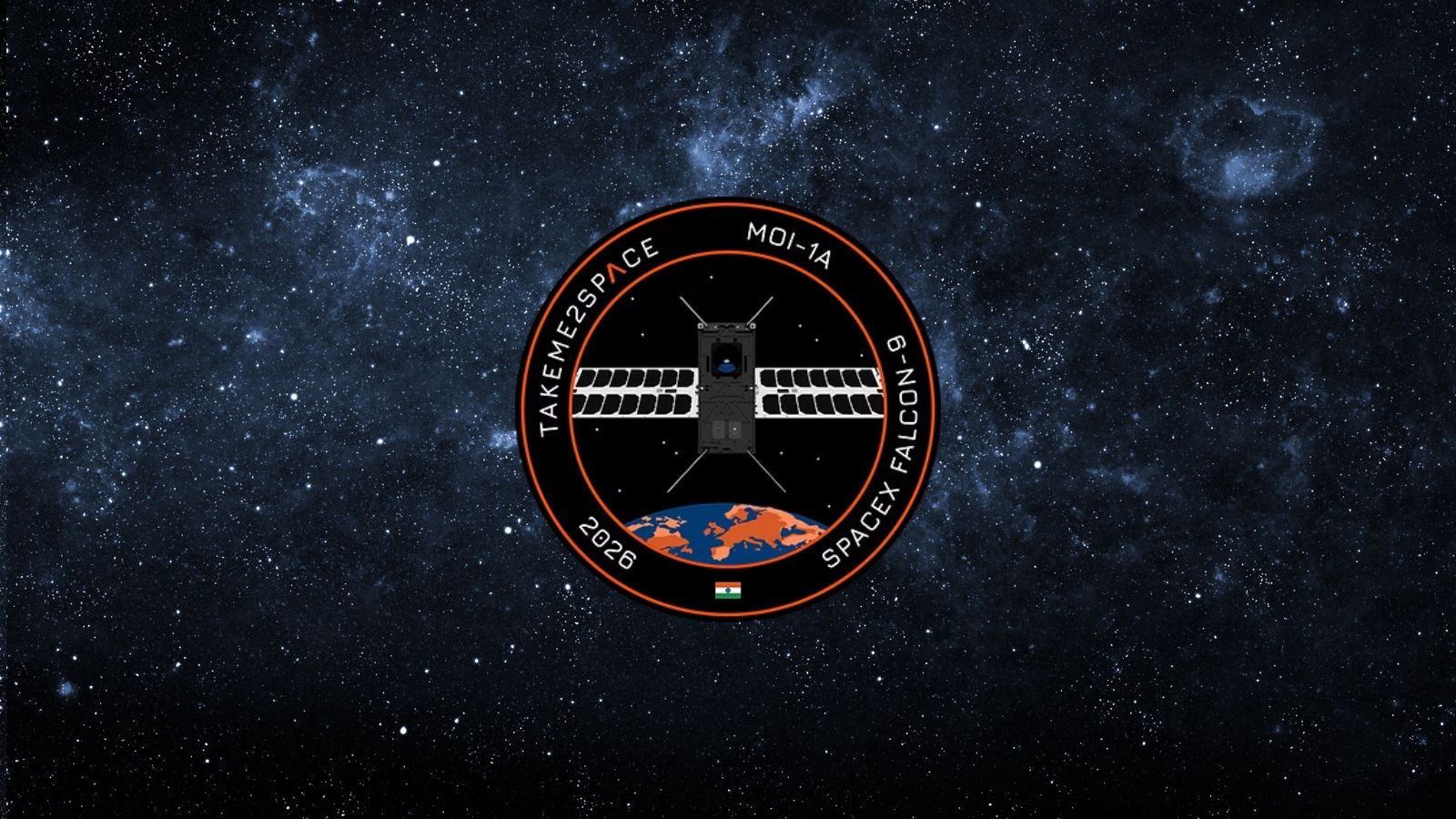
A 50-kilogram spacecraft built in Hyderabad is about to test whether space companies can sell answers instead of raw pixels. Indian startup TakeMe2Space plans to send its MOI-1A satellite into orbit on October 1 aboard SpaceX’s Transporter-18 rideshare mission, calling it the country’s first orbital computing satellite.
An orbital edge computing satellite processes data on board as it flies over a target area, then transmits only the processed result to the ground instead of the full raw file. TakeMe2Space’s MOI-1A does exactly that: it runs customer AI models using an Nvidia Orin NX satellite chip and about 150 watts of power, cutting the amount of raw imagery that needs to be downlinked. The company says 23 customers, including mapping firms and universities, have already signed on for the mission.
What Is TakeMe2Space’s Orbital Edge Computing Satellite?
MOI-1A weighs under 50 kilograms and carries a Nvidia Orin NX edge-computing processor built for size- and power-constrained environments. Founder and chief executive Ronak Samantray describes it plainly: customers upload a containerized AI model, the satellite runs it while passing over a chosen patch of Earth, and only the output comes down. Nothing else about the pitch is complicated, and that simplicity is the point.
The math behind it is a straightforward trade. “The customer who sees value in our first-generation satellites is the one paying to download a lot of raw data and then do the compute,” Samantray said in comments carried by the Indian Express. “The reduction in the cost of not downloading it offsets the premium they pay for compute in orbit.” Ground stations and bandwidth cost money per byte, so shrinking the byte count changes the unit economics for anyone dealing in large imagery datasets.
Commercial customers span agriculture, mining, supply-chain management and insurance, alongside geospatial firms and schools. Little Place Labs, a US-based space data analytics company, is among the confirmed users. That customer mix matters for satellite based edge computing generally, because it shows demand isn’t limited to defense or intelligence buyers. Farmers checking crop stress and insurers assessing flood damage need fast, cheap, specific answers far more than they need full-resolution scenes of the planet.
How Does In-Orbit AI Data Processing Actually Work?
In-orbit AI data processing on MOI-1A follows three steps: a customer uploads a containerized model, the satellite executes it during a pass over the target region, and only the compressed analytical output is beamed to Earth. This flips the traditional Earth-observation pipeline, where satellites downlink raw pixels and all the AI inference in space happens later on ground servers. TakeMe2Space isn’t inventing that architecture; it is trying to prove it can be sold at a profit.
The company already tested the underlying approach. Its MOI-TD technology demonstrator launched on December 30, 2024, and ran more than 20 experiments in low Earth orbit, proving it could upload applications, execute AI inference on orbit and download results reliably. That mission is why Samantray can talk about MOI-1A with confidence rather than hope. Proving a concept once in a lab-style demo is different from selling it to 23 paying accounts, though, and October 1 is the real test of that gap.
What Happened to TakeMe2Space’s Earlier MOI-1 Satellite?
TakeMe2Space’s previous satellite, MOI-1, was destroyed when the third stage of ISRO’s PSLV-C62 rocket failed on January 12, 2026, taking down 16 satellites including payloads from fellow Hyderabad startups Dhruva Space and Eon Space Labs. MOI-1 had been billed internally as an early orbital data center prototype, an advanced 14-kilogram, 120-watt compute satellite meant to rent out onboard processing time at roughly two dollars a minute. Losing it stung, but not financially.
“The loss is not in terms of money, as we now have the capability to rebuild MOI-1 in just two months, but in terms of the lost opportunity,” Samantray told the Times of India shortly after the failure. He framed the setback around a race with Google’s Project Suncatcher rather than around rebuild costs, a framing that looks more grounded now than it did in January, given how fast Starcloud and Nvidia have since moved. TakeMe2Space took the next available slot on a SpaceX Falcon 9 rather than wait for another ISRO vehicle, which is how a company built around Indian-made subsystems ended up flying on an American rocket.
Orbital Edge Computing Satellite vs Orbital Data Center: How Does TakeMe2Space Compare to Starcloud?
An orbital edge computing satellite like MOI-1A runs on tens to hundreds of watts and handles narrow, single-purpose AI inference in space, while an orbital data center satellite is designed to run data-center-grade GPUs at kilowatt or gigawatt scale for training and heavier compute. Samantray is explicit about the distinction: MOI-1A is “an onboard edge-computing satellite rather than a conventional data center,” while rivals SpaceX and Starcloud fly far more powerful chips.
Starcloud is the clearest comparison point. The Redmond, Washington company flew the first Nvidia H100 GPU to orbit in November 2025, later trained an AI model in space and ran a version of Google’s Gemini on orbit. In August 2026 it closed a $250 million Series A extension at a $2.3 billion valuation, backed partly by Nvidia itself, pushing total funding to $450 million against a stated goal of 88,000 satellites and 20 gigawatts of orbital compute capacity. That’s a different order of magnitude entirely from a 150-watt cubesat.
| Metric | TakeMe2Space MOI-1A | Starcloud |
|---|---|---|
| Category | Orbital edge computing satellite | Orbital data center satellite |
| Power | ~150 watts | Gigawatt-scale ambition, GPU-class per satellite |
| Chip | Nvidia Orin NX | Nvidia H100 / Space-1 Vera Rubin Module |
| Mass | Under 50 kg | Larger, data-center-class spacecraft |
| Funding raised | $5 million seed | $450 million total, $2.3B valuation |
| First flight | Oct 1, 2026 (planned) | Nov 2025 (flown) |
Nvidia itself now treats these as two distinct product tiers rather than one continuum. At GTC in March 2026, the company launched a space computing lineup built around three products: Jetson Orin for lightweight onboard AI inference, IGX Thor for edge-class workloads, and the Space-1 Vera Rubin Module for full orbital data centers, claiming up to 25 times more AI compute per GPU than the H100. TakeMe2Space sits squarely in the Jetson Orin tier alongside partners like Kepler Communications, while Starcloud, Axiom Space and Planet chase the heavier module. Both tiers matter, but they answer different economic questions, and conflating them is the biggest error most coverage of this launch makes.
There’s also a third contender flying on the exact same rocket. Google confirmed that a prototype satellite for Project Suncatcher, carrying four tensor processing units and built by Planet, will ride the same Transporter-18 rideshare mission on October 1. TakeMe2Space, Starcloud and Google are all effectively testing overlapping bets on the same day, from three different power budgets and three different business models.
Who Is Paying for This, and Does the Business Model Hold Up?
TakeMe2Space’s revenue logic depends on one assumption: that downlink and ground-processing costs for raw satellite imagery are high enough that customers will pay a premium for compressed, pre-processed answers instead. For narrow use cases like counting ships, flagging flood extent, or scoring crop stress across a fixed area, that assumption is plausible, since the customer never needed the full image in the first place. It becomes shakier the moment a buyer wants flexibility to rerun different models against the same raw scene later, which a 150-watt edge chip can’t easily support at scale.
The near-term roadmap suggests the company knows this. MOI-1b is scheduled to fly later in 2026 on an ISRO SSLV mission, and by 2028 TakeMe2Space plans to fly two 100-kilogram satellites, each carrying ten Nvidia Thor GPUs, 100 terabytes of storage and a one-metre multispectral imager generating 1.5 kilowatts of power, connected by optical inter-satellite links on the Waymaker-2 rideshare mission to a roughly 500-kilometre sun-synchronous orbit. That’s the company’s real bet on becoming an orbital data center satellite operator rather than staying an edge-compute niche player. “One and a half kilowatt of power, a one-metre imager and a laser link between spacecraft is the smallest unit of an orbital data centre that actually behaves like one,” Samantray said of that plan.
TakeMe2Space closed a $5 million seed round led by Chiratae Ventures during the same period it lost MOI-1, proved a battery system called PowerBank-50 on Skyroot Aerospace’s Vikram-1 launch in July 2026, and secured launch capacity through Paris-based RIDE! Space. Valentin Benoit, CEO of RIDE! Space, called the payload category a fit for rideshare precisely because “it is defined by what it computes rather than what it carries.” A five-million-dollar seed round and a 150-watt debut satellite are a modest starting position against Starcloud’s $450 million war chest, and MOI-1A should be read as a viability test, not a market-share claim.
What Comes After MOI-1A for India’s Orbital Computing Ambitions
If MOI-1A survives launch, reaches orbit and demonstrates a paying customer downloading a result instead of a raw file, TakeMe2Space will have something no other Indian company currently has: a commercial track record in satellite based edge computing rather than a lab demo. Orbital injection is expected by October 8 through a D-Orbit orbital transfer vehicle, with launch and early orbit operations targeted for completion by October 16. Every one of those dates is a point where the mission could still slip, given what happened to MOI-1 in January.
The honest read is that MOI-1A is a small, useful proof point in a market where the real capital and gigawatt ambitions currently sit with Starcloud, Nvidia and Google. It won’t move the needle on the orbital data center race by itself. What it can do is validate a cheaper, India-built entry point into orbital edge computing satellite technology that larger players have mostly skipped in favor of scale. Watch the October 1 launch window, then watch whether those 23 customers actually renew.
Frequently Asked Questions
What is an orbital computing satellite and how does it work?
An orbital computing satellite runs AI models on board while passing over a target area, processing data in space rather than sending raw files to Earth. It transmits only the compressed result, cutting the volume of data that needs to be downlinked.
When is TakeMe2Space launching its MOI-1A satellite?
TakeMe2Space plans to launch MOI-1A on October 1, 2026, aboard SpaceX’s Transporter-18 rideshare mission. Orbital injection is expected by October 8, with early orbit operations targeted for completion by October 16.
What happened to TakeMe2Space’s earlier MOI-1 satellite?
MOI-1 was destroyed on January 12, 2026, when the third stage of ISRO’s PSLV-C62 rocket failed, taking down 16 satellites total. TakeMe2Space rebuilt its payload and booked the next available slot on a SpaceX Falcon 9 instead.
How does edge computing in orbit reduce data transmission costs?
It processes raw imagery on the satellite itself and downlinks only the analytical output, such as a flood map or crop-stress score, instead of the full dataset. Customers pay a premium for in-orbit compute but save more on downlink and ground-processing costs.
What chips does the MOI-1A satellite use for AI processing?
MOI-1A carries a Nvidia Orin NX processor, an edge-computing chip designed for power-constrained environments like small satellites. It runs on roughly 150 watts of power, far below the data-center-grade GPUs used by larger orbital compute projects.
How is TakeMe2Space different from Starcloud’s orbital data centers?
TakeMe2Space’s MOI-1A is a lightweight edge-computing satellite built for narrow, specific AI inference tasks, while Starcloud is building data-center-class satellites with far more power aimed at large-scale AI training and inference. Starcloud has raised over $450 million; TakeMe2Space has raised $5 million in seed funding.
What is SpaceX’s Transporter-18 rideshare mission carrying?
Transporter-18 is a shared SpaceX Falcon 9 launch carrying multiple smallsat payloads, including TakeMe2Space’s MOI-1A and a prototype satellite for Google’s Project Suncatcher AI constellation, built by Planet.
Who are TakeMe2Space’s customers for the MOI-1A mission?
TakeMe2Space says 23 customers have signed on, including geographic information system companies, educational institutions, and businesses in agriculture, mining, supply-chain management and insurance. US-based space data analytics firm Little Place Labs is among them.