
UK Tech Female Founder Gap: Only 8 of 136 Unicorn Founders Are Women as Britain Hits a Record £242B

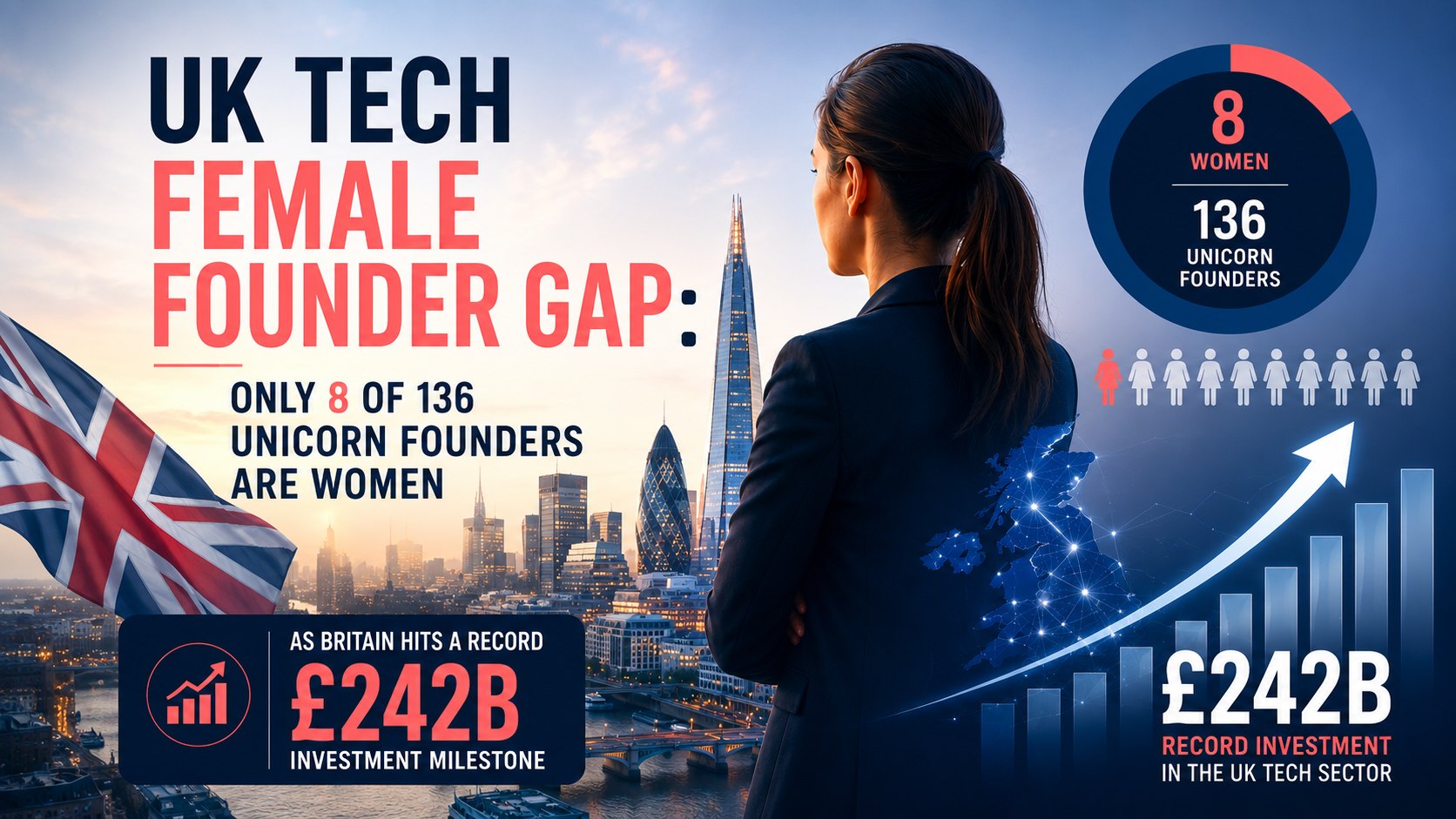
The Hurun Research Institute’s UK Unicorn Index 2026 found a record 80 unicorns in the United Kingdom, worth a combined £242.4 billion — a 47% increase year-on-year. That is a staggering headline. But buried inside the same report is a far less celebratory stat — one that exposes the UK tech female founder gap in stark, uncomfortable terms. Hurun’s analysis of the 136 founders behind the UK’s largest private technology companies found only eight are women, prompting the firm to warn that “the UK is failing to capture the full potential of its female entrepreneurial talent.” That’s 6%. In a trillion-pound innovation economy.
Britain’s Unicorn Boom: The Numbers Behind the Britain Tech Unicorn Record 2026
The Britain tech unicorn record 2026 is genuinely historic. The UK has overtaken India’s 61 unicorns to claim third place globally, sitting behind only the United States with 806 and China with 381. With 23 new unicorns minted over the past 12 months, Hurun concluded that Britain had reinforced its “position as Europe’s undisputed start-up capital,” noting it now has more unicorns than Germany, France, the Netherlands and Sweden combined.
Revolut, the financial services group, remains the UK’s most valuable unicorn with a £57.8 billion valuation, followed by Nscale, the AI data centre business, worth £11.6 billion at its last funding round. Fintech remains the bedrock of the UK unicorn ecosystem, accounting for 33% of all unicorns and 53% of total value, led by Revolut, Checkout.com, SumUp, XTX Markets, Monzo, OakNorth, and Starling Bank.
Artificial intelligence was the fastest-growing sector for UK unicorns, with nine such companies worth a combined £40.6 billion, quadrupling in value in a single year. UK AI startups alone raised £8.2 billion in the first half of 2026. It’s a breathtaking trajectory. Yet that very AI surge is making the UK tech unicorns gender disparity measurably worse — because AI is also the sector most starved of female founders.
The UK Tech Unicorns Gender Disparity: A Crisis in Plain Sight
Let’s be direct. The UK reached a record 80 tech unicorns in 2026, but only 6% are built by female founders. The UK tech unicorns gender disparity isn’t new — it has just never been so visible against such a glittering backdrop.
The average UK unicorn founder was 35 when they started their company, and 90% of the entrepreneurs went to university, with 27% attending Oxford or Cambridge. The pipeline is clearly drawing from a narrow pool. And gender is the narrowest filter of all. The UK’s unicorns have an average valuation of £3.2 billion and took an average of 3.6 years to reach the $1 billion mark — meaning these are not slow-burn accidental successes. They are intentional, capital-intensive ventures built by people with serious access to networks and funding. And that access, overwhelmingly, goes to men.
A report released by the House of Commons Women and Equalities Committee in 2025 found that just 2% of equity investment went to female founders in 2024, while all-male teams received over 80% of capital allocated. The UK tech startup gender funding gap, in short, has barely budged in a decade. Female founders in the UK receive less than 2% of all venture capital, and that figure has barely shifted in a decade.
UK Venture Capital Gender Bias 2026: Who Controls the Money?
The UK venture capital gender bias 2026 runs deep — and it starts at the top of the investment pyramid. Only 13% of senior teams in UK venture capital firms are made up of women, while 48% of firms have no women at all. When the gatekeepers are overwhelmingly male, female-founded tech unicorns UK become a near-statistical impossibility.
Female-led startups in the UK continue to receive a much smaller proportion of VC funding relative to male-led startups: only 3% of VC funding goes to all-female teams, and male founders receive on average 5.9x the amount of early-stage VC funding. That multiplier is brutal. It means a male founder with an identical idea, in an identical sector, can access roughly six times more early-stage capital than his female counterpart.
Out of 53,910 angel investments tracked in 2026, only 2,934 are for female-led businesses — a tiny 5.44%. Even at the earliest, supposedly most accessible stage of startup funding, women are being filtered out. Thanks to factors like affinity bias, men tend to invest in other men, but this can work both ways — female investors are twice as likely to invest in female founders. Yet female investors remain scarce.
When the UK’s Invest in Women Taskforce announced its £250 million fund, the ambition was clear: increase capital flow to female-founded businesses. Yet, by 2026, no investments have been made. The infrastructure of change is being built on sand.
The “Gender Experience Gap”: What Female Founders Are Up Against
The barriers aren’t just financial. They’re structural, psychological, and systemic. Successful female tech founders need to have twice as much experience in tech as male founders to secure VC funding. In advanced tech and AI sectors, the average industry experience required among female founders is 18 years — compared to just nine years for men.
VC culture has historically been built on male-dominated relationships — “in universities, golf courses, and private clubs — places women have traditionally been excluded from.” Research also found that women pitching for investment are frequently asked how they plan to manage childcare, regardless of whether they have children.
A UK report found that 86% of female entrepreneurs said they had trouble accessing finance to grow their business, compared with 76% of men. Barriers cited included finding suitable investors (36%), lack of networks (31%), and uncertainty about the right funding options (31%).
Female Founded Tech Unicorns UK: The Women Who Made It Anyway
Despite all this, some women have broken through. Anne Boden, born in Wales, is the founder of Starling Bank and the first woman to found a British bank. Her path was not smooth. Reflecting on launching Starling, she recounted a journey fraught with scepticism: “My entrepreneurial journey began when I was 54. I’d spent my whole career working as a corporate executive in a big bank and I decided to quit my job and start one of my own. Some people patronised me, some people laughed at me, but I knew I had to do it. It took me two years and 300 meetings before I managed to raise the capital I needed.”
Other female-founded unicorns include Catherine Wines of Zepz and Marcia Kilgore of Beauty Pie. These women are exceptional. They should be the norm.
Female founders deliver 2.5x better returns than male-founded startups, and women-founded companies generate 78 cents of revenue per dollar invested compared to 31 cents for male-founded companies. The UK tech female founder gap isn’t just a diversity problem — it’s an economic one.
The AI Boom Is Widening the UK Tech Startup Gender Funding Gap
Here’s the uncomfortable truth: the AI gold rush is actively making things worse. In addition to the funding gap itself, structural barriers in AI adoption compound the problem. An April 2026 report found that despite AI use doubling among women entrepreneurs from 38% to 82%, AI adoption “remains strongly gendered.”
The Sovereign AI Fund recently announced the first cohort of companies to receive support from its £500 million fund and included just two startups with female founders. Half a billion pounds deployed. Two women in the room.
AI has overtaken fintech as Britain’s fastest-growing area of private firm creation, even as questions mount over whether the UK can keep its most valuable startups independent long enough to reach the public markets. As billions chase AI startups — disproportionately founded by men — the UK tech startup gender funding gap is being turbocharged by the very trend everyone is celebrating.
What Needs to Change: Closing the UK Tech Female Founder Gap
The solutions are known. They are not being implemented at scale. Here is what the data points to:
- Mandate gender-split reporting. The Investing in Women Code, created in 2019, has signatories committing to collecting data and adopting internal practices to improve women entrepreneurs’ access to finance. More firms must sign — and be held accountable.
- Put women on investment committees. Venture capital firms must do more to challenge themselves into providing investment on a more equitable basis, including by increasing the proportion of women on investment committees as a priority.
- Leverage the returns argument. Female investors are twice as likely to invest in female founders. Positive externalities of having more female investors in the VC space could lead to female founders receiving fairer valuations, as well as more mentorship opportunities.
- Close the pipeline. Generational trends show that younger founders are slightly more likely to be women, with female representation among Gen Z-led businesses rising from 18.7% in 2024 to 20.28% in 2026. The pipeline is improving — but it needs urgent acceleration at the funding stage.
The Barclays-estimated cost of the gender entrepreneurship gap is a £310 billion opportunity for the UK economy. As one commentator put it, “We’re not just failing women founders, we’re failing ourselves economically.”
Conclusion: Britain Can’t Afford to Keep Ignoring This
Hurun estimates Britain could host around 120 unicorns worth more than £460 billion within a decade if it maintains policies that continue to attract international talent, encourage venture capital investment, and support founders through to IPO. That future is genuinely attainable. But only if all of Britain’s talent is actually in the room.
Right now, the UK tech female founder gap is costing the country billions in unlocked value. The record-breaking unicorn count is something to celebrate. The 6% female founder rate is something to fix — urgently, structurally, and without further delay.
If you’re a founder, investor, or policymaker: the data is in. The cost of inaction is quantified. What’s missing is the will to act.
Frequently Asked Questions
How many of the UK’s 136 unicorn founders are women?
Only 8 of the 136 founders behind the UK’s 80 unicorn companies are women, representing just 6% of total founders, according to the Hurun UK Unicorn Index 2026.
How many unicorns does the UK have in 2026 and what are they worth?
The UK has a record 80 unicorns in 2026, worth a combined £242.4 billion. This represents a 47% increase year-on-year and makes the UK the third-largest unicorn nation globally, behind only the United States and China.
What percentage of UK venture capital goes to female founders?
Female founders in the UK receive less than 2% of all venture capital funding. This figure has barely shifted in a decade. All-male founder teams, by contrast, received over 80% of equity capital in 2024.
Which sectors dominate the UK’s unicorn ecosystem?
Fintech is the largest sector, accounting for 33% of all UK unicorns and 53% of their total value. Artificial intelligence is the fastest-growing sector, with nine AI unicorns collectively worth £40.6 billion — a figure that quadrupled in a single year.
Who are some notable female founders of UK unicorns?
Notable examples include Anne Boden, the founder of Starling Bank and the first woman to found a British bank, as well as Catherine Wines, co-founder of Zepz (formerly WorldRemit), and Marcia Kilgore, founder of Beauty Pie.
Why do female founders receive so little VC funding in the UK?
Multiple structural barriers contribute, including the fact that 48% of UK VC firms have no women on their senior teams. Research also shows female founders must demonstrate roughly twice the industry experience of male founders to secure funding. Unconscious bias, lack of networks, and gendered questioning during pitching processes are additional documented factors.
Do female-founded startups perform well financially?
Yes. Research from Boston Consulting Group found that women-founded companies generate 78 cents of revenue per dollar invested, compared to 31 cents for male-founded companies. Female founders also deliver approximately 2.5 times better returns than male-founded startups — making the persistent funding gap not just a fairness issue but a significant economic inefficiency.