
Why B2B SaaS Founders Must Transition from Chatbots to Agentic AI Workflows in 2026

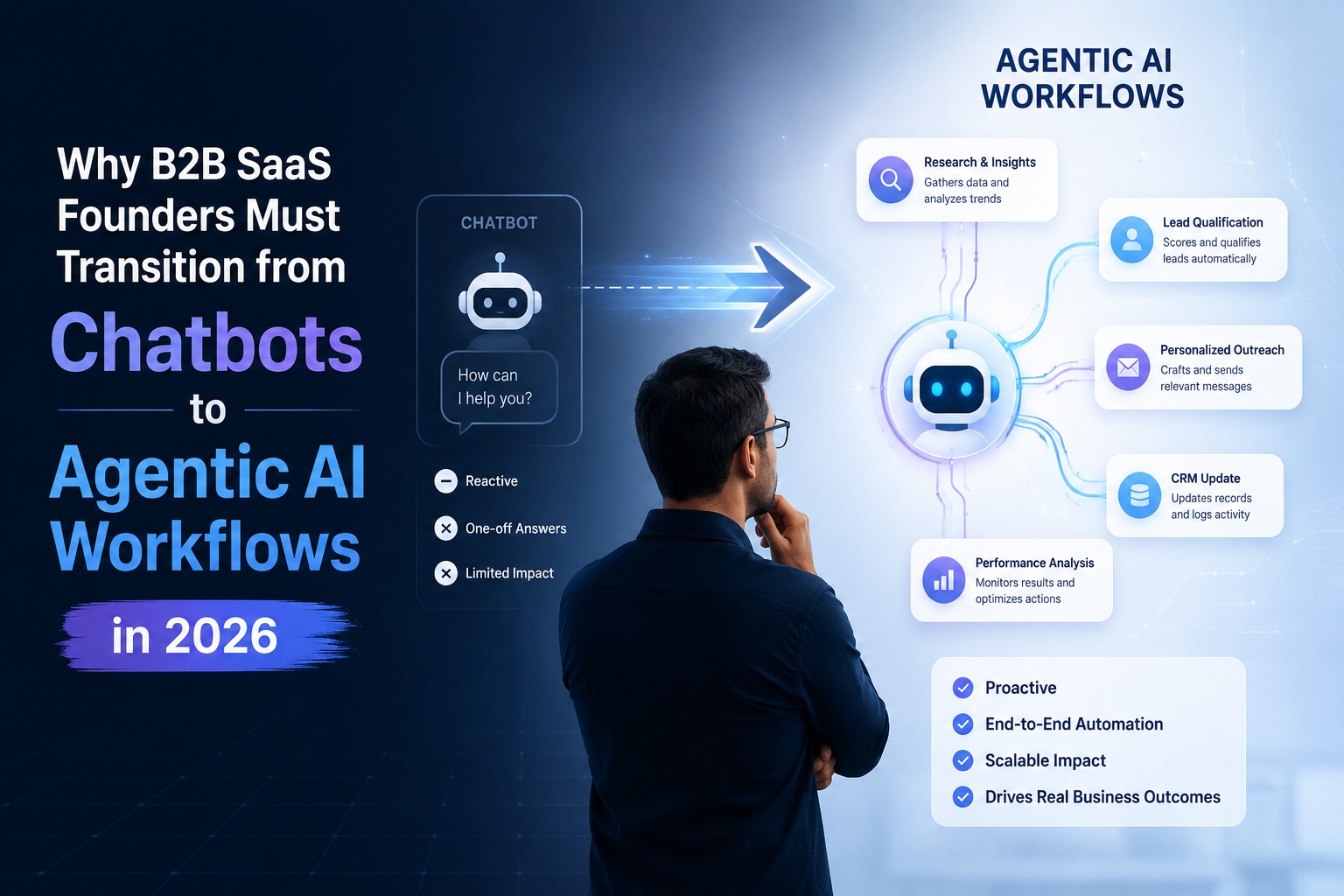
Industry analysts project the AI agents market will surge from $7.8 billion today to over $52 billion by 2030, while Gartner predicts that 40% of enterprise applications will embed AI agents by the end of 2026, up from less than 5% in 2025. That’s an 8× shift in a single year — and for B2B SaaS founders still banking on chatbot-first architectures, the window to adapt is narrowing fast. The era of reactive, prompt-response AI is over. Agentic AI workflows are the new competitive baseline.
This isn’t hype. It’s infrastructure-level disruption.
What Agentic AI Workflows Actually Are — And Why Chatbots Can’t Compete
The distinction matters enormously. Most founders conflate the two, and that mistake is costing them deals.
Unlike traditional chatbots that simply respond to prompts, agentic AI systems are autonomous, goal-driven, and capable of executing complex, multi-step tasks without constant human oversight. A chatbot is fundamentally read-only: it interprets, generates, and stops. An agent reads, decides, acts, evaluates the result, and loops until the job is done.
A feature takes structured input, applies a model, and returns output — the user initiates and manages each step. An agent has a reasoning loop: perceive the situation, form a plan, execute an action, observe the result, adapt, and repeat until the goal is achieved. This loop is what makes agents capable of completing multi-step workflows without human approval at every decision point.
The practical gap between AI agents vs chatbots becomes crystal clear in enterprise contexts. Chatbots handle FAQs and menu trees. Agents handle onboarding flows, compliance checks, CRM updates, cross-department approvals, and contract routing — all in a single orchestrated execution. Insufficient context engineering and memory management expose the architectural ceiling of chatbot-centric AI. Chatbots respond transaction by transaction. Agents operate with awareness of broader objectives across time.
For B2B SaaS founders, that’s the existential problem: every workflow your platform can’t automate faster is a workflow your competitor’s agent will. AI SaaS founders are selling features when enterprise buyers are now buying outcomes.
The Market Has Moved — And It’s Not Waiting for You
As of 2025, 79% of organizations report some level of agentic AI adoption, with 96% planning to expand their usage. That’s not experimentation. That’s a market in full-scale transition.
McKinsey’s State of AI report shows that 23% of enterprises are scaling agentic AI systems across parts of their operations, while 62% are actively experimenting with them. More than half of your enterprise prospects are no longer treating autonomous AI as a pilot concept — they’re actively testing how it executes real work. And their patience for SaaS tools that still require humans to manage every step is thinning.
The investment curve reinforces this urgency. Deloitte projects this market will grow at a CAGR of around 53%, going from $8.5 billion in 2026 to $45 billion by 2030. Meanwhile, AI infrastructure software is projected to reach approximately $230 billion in 2026, up from $60 billion in 2024. Capital doesn’t lie about direction.
As agentic AI capabilities mature and enterprise SaaS vendors build out their platforms to create, integrate, and orchestrate AI agents, how organizations purchase and use software could shift dramatically. In 2026, SaaS applications will likely become more intelligent, personalized, adaptive, and autonomous, evolving towards a federation of real-time workflow services that can learn from their experiences.
The pricing model is changing too. Gartner says that “by 2030, at least 40% of enterprise SaaS spend will shift toward usage-, agent-, or outcome-based pricing.” Founders still optimizing for seat counts are building a product for a market that’s actively moving away from them.
The Real ROI Case: What Agentic AI in SaaS Delivers
Skeptics want numbers. Here they are.
AI-powered workflows can accelerate business processes by 30% to 50% in areas ranging from finance and procurement to customer operations. Early adopters are seeing 20% to 30% faster workflow cycles and significant reductions in back-office costs. These aren’t projected gains — these are documented results from enterprise deployments already in production.
The ROI picture deepens when you look at specific deployments. One B2B SaaS firm experienced a 25% increase in lead conversion after implementing agentic campaign routing. A Fortune 500 enterprise used Agentforce to reduce reporting time from 15 days to 35 minutes while dropping the cost per report from $2,200 to $9. Those aren’t incremental improvements. They’re order-of-magnitude shifts in operational efficiency.
Companies report average returns on investment (ROI) of 171%, with U.S. enterprises achieving around 192%, which exceeds traditional automation ROI by 3 times. For SaaS founders making the case to their boards or investors, that statistic is a strategic anchor.
What about SaaS workflow automation specifically? Companies adopting AI triage and response report up to 30 to 50 percent deflection of tier one support tickets. Zendesk documented 40 percent deflection rates after agentic rollouts in 2025. Customer support teams get dramatically lighter. And NPS goes up, not down. In insurance, AI agents handling claims end-to-end cut claim handling time by 40% and net promoter scores increased by 15 points.
The productivity gains are similarly compelling. Organizations have seen a 34% increase in productivity for low-skilled workers using AI tools, helping them get more done in less time. And for revenue teams specifically, sales organizations using AI agents see a 25-47% productivity increase from time savings on repetitive tasks, allowing teams to focus on selling activities.
Multi Agent Systems: The Architecture That Changes Everything
Single-agent deployments are a starting point, not a destination. The real competitive moat in agentic AI in SaaS comes from multi agent systems — coordinated networks of specialized AI workers that execute complex workflows together.
Just as monolithic applications gave way to distributed service architectures, single all-purpose agents are being replaced by orchestrated teams of specialized agents. Gartner reported a staggering 1,445% surge in multi-agent system inquiries from Q1 2024 to Q2 2025, signaling a shift in how systems are designed.
Multi agent systems let organizations rethink and redesign complex processes, products, and experiences by breaking workflows into manageable steps. Each step is handled by the best-suited agent, expediting innovative automation and improving efficiency. Proven agents can be reused across workflows, boosting reliability and scalability while reducing errors that plague monolithic AI.
The architecture looks like this in practice: multi-agent systems combine individual strengths — one agent plans, another researches, a third executes, while a “critic” monitors quality and feedback loops. That design mirrors how high-performing human teams actually operate, and it scales in ways that human teams simply can’t.
A payroll provider resolved anomalies automatically through a supervisor agent supported by specialized worker agents, improving processing speed by more than 50%. That’s what happens when you move from AI workflow optimization as a feature to AI workflow optimization as a foundational architecture.
The 2026 shift is toward multi-agent systems where specialized agents coordinate with each other. For B2B SaaS founders, building with this in mind from the start — rather than bolting agents onto existing product logic — is the difference between market leadership and technical debt.
The Autonomous AI Agents Advantage: Why B2B SaaS Founders Can’t Wait
Here’s the hard truth about timing. While 30% of organizations are exploring agentic options and 38% are piloting solutions, only 14% have solutions ready to be deployed and a mere 11% are actively using these systems in production. That gap represents your opportunity window — but it won’t last long.
If your product’s AI strategy is adding generative content features to existing workflows, you are solving for 2024. The 2026 question is whether your product can execute a goal — not assist a user.
Autonomous AI agents give B2B SaaS products a structural advantage that no feature update can replicate. They work 24/7. They don’t scale linearly with headcount. AI agents can drive cost reductions of 60% or more, but only if processes are redesigned end-to-end. That last clause is the founder’s challenge: it’s not enough to add an agent layer on top of legacy product logic. The workflow has to be reimagined, not patched.
Architect your product so the outcome is impossible to achieve without you. When your agents are woven into a customer’s core business logic, the switching cost becomes existential for them. That’s retention by architecture, not by contract.
This is precisely what separates AI-native SaaS companies from incumbents adding AI features. AI-native companies like Cursor demonstrate 300 percent year-over-year growth by slashing response times to milliseconds and enabling users to focus on higher-level strategic goals rather than manual task management.
How to Actually Transition: A Practical Framework for Founders
Moving from chatbot-first to agentic isn’t a sprint. Here’s how to do it without torching your current product.
1. Identify your highest-value repetitive workflows. Start with processes that are high-volume, well-defined, and currently requiring human handoffs. Customer onboarding, support triage, contract review, and lead qualification are proven starting points. Customer service, eCommerce, finance automation, and software engineering are the proven ROI areas in 2026. These should be the initial deployment targets before expanding to more complex use cases.
2. Build for AI workflow optimization, not task automation. There’s a critical distinction here. Copilot-style tools that add a speed boost to human workflows achieve only modest results. The only way to transformative change is AI-driven execution with agents executing tasks end-to-end. Design for the full loop, not for assist-and-hand-off.
3. Fix your data architecture first. This is where most agentic projects stall. Current enterprise data architectures create friction for agent deployment. The fundamental issue is that most organizational data isn’t positioned to be consumed by agents that need to understand business context and make decisions. Don’t skip this step.
4. Deploy multi-agent systems progressively. Research from BCG suggests that the best way to deploy agents is through a few high-value workflows with clear implementation plans and workforce training, rather than in a massive roll-out of agents everywhere at once.
5. Price for outcomes, not seats. Outcome-based pricing aligns your revenue directly with customer ROI — which means every time the agent delivers more value, you expand naturally, without a sales conversation. Charge per workflow completed, per SLA attained, per compliance event avoided.
6. Embed governance from day one. Over 40% of agentic AI projects are at risk of cancellation by 2027, and only 21% of organizations have a mature governance model for autonomous AI agents. Founders who build with auditability, kill switches, and human-in-the-loop controls from the start will dramatically outperform those who treat governance as an afterthought.
The Competitive Danger of Standing Still
AI is a $3 trillion-plus opportunity for software companies. To seize it, CEOs must put aside the SaaS playbook and return to a startup mentality. That’s not a motivational tagline — it’s a structural warning.
If incumbents don’t build great AI products, their customers will quickly shift loyalty — and migrate data and workflows — to more innovative startups. The switching cost dynamic is inverting. In the old SaaS model, deeply embedded data kept customers locked in. In the agentic model, deeply embedded AI workflows — built by your competitor — will keep customers locked out of your product forever.
Bain’s Technology Report 2025 identified workflow automation potential as the primary disruption vector for incumbent SaaS companies: workflows with high user automation potential are “growth gold mines” for new entrants and existential threats for incumbents still selling seats and features.
The founders who win the next five years won’t be the ones who added the most AI buttons to their UI. They’ll be the ones who made their product’s core value delivery impossible without the agent layer running underneath.
Conclusion: Your Product’s Job Is to Execute Goals, Not Assist Users
The B2B SaaS market in 2026 is drawing a hard line between products that assist and products that act. More than 80% of organizations believe “AI agents are the new enterprise apps, triggering a reconsideration of our investments in packaged apps.” Your buyers are already thinking this way.
Agentic AI workflows are not a roadmap item for 2027. They’re the architectural baseline for competitive SaaS products right now. The data on multi agent systems, the ROI benchmarks from autonomous AI agents, and the acceleration of enterprise spending on AI workflow optimization all point the same direction: the transition isn’t coming. It’s here.
Run the audit. Identify your three highest-volume workflows. Pick one, build the agent architecture with governance from the start, and measure the loop. Then scale what works.
The competitive advantage in 2026 won’t go to the team with the best chatbot. It’ll go to the team that replaced the chatbot with a system that actually does the work.
Frequently Asked Questions
What is the difference between agentic AI and a traditional chatbot?
A traditional chatbot is a scripted or generative system that responds to user prompts one interaction at a time — it requires human initiation and management at every step. Agentic AI, by contrast, operates with a reasoning loop: it perceives its environment, forms a plan, executes an action, evaluates the result, and repeats autonomously until a goal is achieved. Agents can trigger API calls, update CRM records, route documents, and complete multi-step workflows without waiting for human input at each stage.
Why is 2026 specifically the pivotal year for this transition?
Multiple converging factors make 2026 the inflection point. Gartner forecasts that 40% of enterprise applications will include task-specific AI agents by end of 2026, up from less than 5% in 2025. Standardization protocols like Anthropic’s Model Context Protocol (MCP) and Google’s Agent-to-Agent Protocol (A2A) have matured to the point where agents can communicate across platforms. Enterprise buyers are now actively expecting agentic capabilities from their SaaS vendors, not treating them as optional upgrades.
What ROI can B2B SaaS companies realistically expect from agentic AI workflows?
BCG research shows that effective AI agents can accelerate business processes by 30% to 50%, with early adopters seeing 20% to 30% faster workflow cycles. Companies across industries report average ROI of 171% on agentic deployments, with U.S. enterprises averaging around 192% — approximately three times the ROI of traditional automation. Median payback time across agent deployments is around 5.1 months, with sales development agent deployments paying back in as little as 3.4 months.
What are multi-agent systems and why do they matter for SaaS?
Multi-agent systems (MAS) are architectures where multiple specialized AI agents coordinate to complete complex workflows together — one agent plans, another executes, a third validates. Gartner reported a 1,445% surge in MAS inquiries from
What are the biggest risks when transitioning from chatbots to agentic AI?
The top challenges are data quality, governance, and scoping. Deloitte’s 2025 Emerging Technology Trends study found that while many organizations are exploring or piloting agentic solutions, only 11% are actively using them in production — primarily because data architectures aren’t agent-ready, and governance frameworks are underdeveloped. Gartner estimates that over 40% of agentic AI projects could be canceled by 2027 due to unclear value, rising costs, and weak governance. Founders should fix their data infrastructure, define clear ROI metrics, and embed audit trails and human-in-the-loop controls from day one.
How should B2B SaaS founders approach pricing in an agentic AI world?
Traditional per-seat pricing is increasingly misaligned with the value agentic AI delivers. Gartner projects that by 2030, at least 40% of enterprise SaaS spend will shift toward usage-, agent-, or outcome-based pricing models. Founders should consider pricing per workflow completed, per SLA met, or per business outcome achieved. This aligns revenue with customer ROI and creates a natural expansion motion — as agents deliver more measurable value, customers naturally increase usage and spend without requiring a traditional upsell conversation.