
Skyroot Hits $160M in Funding Ahead of India’s First Private Orbital Rocket Launch

📌 Key Takeaways
- Skyroot Aerospace closed a $60 million Series C on May 7, 2026, hitting $160 million in total funding
- The round values Skyroot at $1.1 billion — making it India’s first space-tech unicorn
- Vikram-1, India’s first private orbital rocket, is targeting a June 2026 launch from Sriharikota
- The cap table now spans 33 investors — 25 institutions and 8 angels — led by GIC and Sherpalo Ventures
- A global launch market worth $30 billion is the commercial prize on the line
Skyroot Aerospace became India’s first space-tech unicorn on May 7, 2026, closing a $60 million Series C that pushed its total funding to $160 million and valued the Hyderabad startup at $1.1 billion. The timing is not coincidental. India’s first private orbital rocket launch — aboard Vikram-1 — is now weeks away from Sriharikota. A rocket. A billion-dollar valuation. An eight-year bet on a country’s space potential. All of it converges at that launchpad in June.
This is the moment India’s commercial space industry has been building toward since regulatory liberalisation began in 2020. One successful launch changes everything.
Skyroot’s Eight-Year Race to India’s First Private Orbital Rocket Launch
Skyroot was founded in 2018 by Pawan Kumar Chandana and Naga Bharath Daka — both former engineers at ISRO. They didn’t merely resign from prestigious government positions. Both walked away from one of the most coveted scientific roles in Asia to build orbital rockets with private capital, in a regulatory environment that barely accommodated private players at the time.
Their first public proof of concept arrived in November 2022. Skyroot launched Vikram-S, a suborbital prototype that became the first privately developed Indian rocket to reach space. Historic — but suborbital and orbital are entirely different engineering challenges, separated by orders of magnitude in velocity, thermal loads, and system complexity. The real test was always Vikram-1.
In the years that followed, Skyroot built quickly and credibly. Prime Minister Narendra Modi inaugurated the company’s Infinity Campus rocket manufacturing facility in November 2025, and the government allotted 300 acres near Tirupati for a ₹400-crore production complex. By June 2025, former ISRO chairman S. Somanath had joined as honorary Chief Technical Advisor — a signal that India’s state space establishment is now actively aligned with private-sector success. Skyroot’s valuation then went from $519 million in a 2023 Series B to $1.1 billion in May 2026. More than doubled. In roughly 30 months. That is a trajectory seasoned deeptech investors call striking.
Skyroot $60 Million Funding 2026: The Capital Structure and Who Wrote the Checks
GIC and Sherpalo Ventures co-led the Series C, with participation from funds managed by BlackRock, Arkam Ventures, Playbook Partners, Shanghvi Family Office, and the founders of Greenko Group. Approximately $50 million came in as primary equity, with the remaining $10 million structured as debt — a layered capital structure that reflects both the scale of ambition and the long lead times of orbital rocketry.
Ram Shriram — Sherpalo’s founder, an early Google investor, and a sitting Alphabet board member — will join Skyroot’s board. His presence is not merely financial. Among Silicon Valley’s most credible deeptech validators, that commitment sends a signal well beyond the dollar figure. Shriram described the team as building “the foundational infrastructure” for orbital launches with the most competitive cost-to-performance ratio in the industry.
Across nine rounds since its 2018 founding, Skyroot now counts 33 investors on its cap table — 25 institutions and 8 angels. The Skyroot $60 million funding 2026 round is earmarked specifically for scaling Vikram-1 launch cadence, expanding manufacturing at the Infinity Campus, and accelerating Vikram-2 development. This is execution capital, not balance-sheet padding. The company is now the fourth Indian startup to achieve unicorn status in 2026, joining AI firm Neysa and fintechs KreditBee and Juspay.
Inside Vikram-1: The Rocket Behind India’s First Private Orbital Rocket Launch
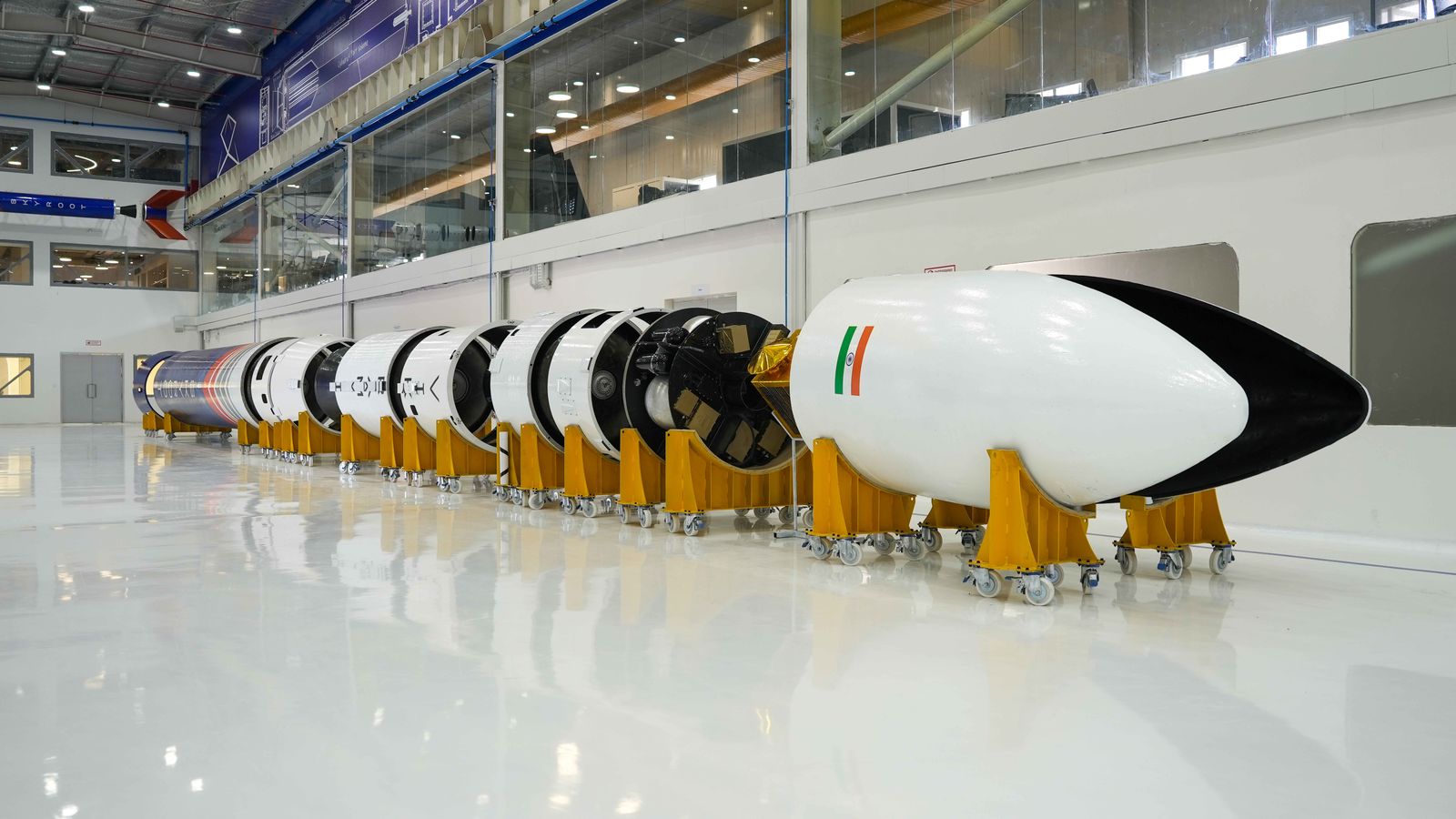
Vikram-1 stands 23 metres tall — the height of a seven-storey building — and is built entirely from carbon composite materials, making it lighter and faster to manufacture than traditional steel-framed vehicles.
Three solid-fuel stages plus a liquid-fuel kick stage give it the ability to place up to 350 kilograms into low Earth orbit. Propulsion comes from Skyroot’s own Kalam (solid), Raman (liquid), and Dhawan (cryogenic) engine series — all developed in-house, all featuring 3D-printed components. More than 90% of parts are manufactured domestically, which keeps per-kilogram costs competitive in a market currently dominated by American launch providers.
Skyroot positions Vikram-1 as a dedicated “space taxi,” giving satellite operators the ability to choose their orbit, schedule, and payload configuration rather than waiting for shared-ride manifests dictated by larger vehicles. For small satellite operators racing to deploy LEO constellations on predictable timelines, that flexibility is commercially significant. It’s also rare at this price point.
What IN-SPACe Means for the Vikram-1 Sriharikota Launch
Before the Skyroot Vikram-1 Sriharikota launch can proceed, it requires authorisation through a body many international observers overlook. IN-SPACe — the Indian National Space Promotion and Authorisation Centre — was established in June 2020 as a single-window autonomous agency under India’s Department of Space, with a mandate to promote, authorise, and supervise space activities for non-government entities. In practice, it is the regulatory gateway between ISRO’s infrastructure and India’s private space ambitions. IN-SPACe already authorised India’s first private rocket launch — Skyroot’s Vikram-S — in November 2022, and it will grant the mission authorisation for Vikram-1’s orbital attempt as well.
The Vikram-1 launch date India has been anticipating is targeted for June 2026. The rocket was officially flagged off from Skyroot’s Max-Q campus in Hyderabad on April 25, 2026 and dispatched to the Satish Dhawan Space Centre at Sriharikota for final assembly, payload integration, and flight qualification. For the maiden mission, Skyroot will carry a smaller payload than the vehicle’s full capacity — a deliberate, disciplined approach to gather critical first-flight data before fully commercial operations begin.
India Space Unicorn Latest News: Skyroot vs. Agnikul and the Global Benchmark
Skyroot is not the only Indian private rocket company pushing toward orbit. Chennai-based Agnikul Cosmos — which successfully launched India’s first sub-orbital rocket from a private launchpad in May 2024 — has designated its own first orbital attempt as “Flight 02,” targeting 2026 and planning to attempt first-stage recovery in the process. Two Indian private companies. One orbital milestone. The race is genuine.
The difference right now is concrete: Vikram-1 is at the launchpad. Agnikul is in engine qualification testing. Skyroot holds a meaningful head start on the most consequential private space milestone in Indian history.
Against global competitors, Skyroot currently ranks second among 204 companies tracked in the small-payload launch vehicle segment, behind incumbents including SpaceX, Rocket Lab, and Firefly Aerospace. The Rocket Lab parallel is instructive. Rocket Lab disclosed total pre-public venture funding of $288 million across its funding rounds before its SPAC listing in 2021 — and today operates as the most prolific small-lift launch vehicle globally with over 75 missions completed. Skyroot, at $160 million heading into its first orbital attempt, is tracking at a comparable funding depth for a company at a structurally similar inflection point. The India space unicorn latest news framing is telling investors something: these bets are now coming due.
India Private Space Startup Funding and the $44B National Ambition
Skyroot’s unicorn milestone arrives at a convergence of policy reform and investor appetite. India’s space economy currently sits at approximately $8.4 billion and is projected to reach $44 billion by 2033, per a FICCI-EY report. The government has set a specific market share target: 8% of the global space economy within the decade.
“$8.4 billion today. $44 billion by 2033. India’s space economy target is ambitious — and structurally impossible without private orbital launch capability.”
The Indian Space Policy 2023 formally opened the country’s launch and satellite-services sectors to private operators, repositioning ISRO from monopoly provider to technical enabler. IN-SPACe handles authorisation. Private companies like Skyroot build and fly. The results: India now counts nearly 400 space-tech startups as of early 2026, spanning launch vehicles, Earth observation, and propulsion. Among these, companies like Agnikul Cosmos, Pixxel, Bellatrix Aerospace, and Dhruva Space are all racing to build commercially viable space capabilities.
India private space startup funding is no longer speculative capital — it’s institutional conviction. GIC has backed Skyroot across multiple rounds. Temasek led the 2023 Series B. Capital-disciplined sovereign funds from Singapore do not make multi-year deeptech commitments unless regulatory frameworks have crossed a credibility threshold. That threshold has been crossed. The global launch market that Skyroot targets is worth $30 billion — and dedicated small satellite launch capacity is one of its fastest-growing sub-sectors.
The High Stakes: What Happens If Vikram-1 Succeeds — Or Fails?
Orbital rocketry has a historically brutal maiden-flight failure rate. Balanced coverage demands the risk framing that promotional coverage routinely omits.
If Vikram-1 reaches orbit on schedule, Skyroot’s $1.1 billion valuation will, on its own logic, look conservative. Commercial contracts will accelerate. Vikram-2 development gets a political and financial tailwind. Every global small satellite operator looking for a cost-competitive, geopolitically neutral launch provider will have a new name on its shortlist. A successful private orbital rocket launch from Indian soil would be a generational proof point for the country’s entire commercial space hypothesis.
If the launch faces a technical setback, Skyroot has sufficient runway to investigate, iterate, and return to the pad. But the political-economic narrative around India’s commercial space sector — one that has been building steadily since 2020 and is now a stated government priority — would absorb a meaningful blow. Investors in the unicorn round have priced in successful execution. That is the explicit bet. Skyroot’s team has roughly six weeks to deliver on it.
What Comes Next: Vikram-2, Four to Six Launches, and a Rocket-Per-Month Ambition
A successful orbital debut would accelerate Skyroot’s roadmap significantly. CEO Chandana has publicly stated the company is targeting four to six Vikram-1 launches in the current financial year. Beyond Vikram-1, the new capital funds Vikram-2 — a one-tonne-class vehicle with a cryogenic upper stage capable of placing 900 kilograms into LEO and 600 kilograms into SSO — with a first launch targeted for 2027. Vikram-2 is being engineered to serve more complex satellite missions and broaden Skyroot’s addressable market. Eventually, the company has set a cadence target of one rocket produced per month — the threshold that separates a demonstration project from a genuine commercial launch business.
Skyroot has already signed partnerships with Axiom Space and Exolaunch, extending its reach into international commercial satellite deployment. The Vikram-1 launch date India has marked on its calendar isn’t only a technology test. It is a commercial inflection point that will set the tone for India’s private space decade.
Conclusion: The Countdown Has Already Changed India’s Space Story
Skyroot’s eight-year arc — from a two-engineer startup in 2018 to India’s first space-tech unicorn with $160 million in total funding — stands as one of the most compressed hardware deeptech journeys in recent memory. The capital is secured. The rocket is at Sriharikota. The Vikram-1 launch date is officially weeks away. Whether India’s first private orbital rocket launch succeeds or encounters delays, the commercial space landscape here has already changed shape permanently.
Frequently Asked Questions
How much total funding has Skyroot Aerospace raised?
Skyroot has raised $160 million across nine rounds since its 2018 founding. Its most recent raise was a $60 million Series C on May 7, 2026, which pushed the company’s valuation to $1.1 billion and made it India’s first space-tech unicorn.
What is the Vikram-1 launch date in India?
Vikram-1 is targeting a June 2026 launch from the Satish Dhawan Space Centre at Sriharikota. The rocket departed Skyroot’s Hyderabad campus on April 25, 2026, and is currently undergoing final integration, payload fitting, and qualification testing at the launch site.
Who are the lead investors in Skyroot’s Series C round?
The round was co-led by GIC (Singapore’s sovereign wealth fund) and Sherpalo Ventures, with participation from BlackRock-managed funds, Arkam Ventures, Playbook Partners, Shanghvi Family Office, and the founders of Greenko Group. Ram Shriram of Sherpalo will join Skyroot’s board. In total, Skyroot now has 33 investors — 25 institutions and 8 angels — across its cap table.
What makes Vikram-1 technically different from other rockets?
Vikram-1 is a 23-metre, three-stage, carbon-composite rocket powered by in-house solid, liquid, and cryogenic propulsion systems featuring 3D-printed engines. It can carry up to 350 kg into LEO, with over 90% domestic components. Skyroot markets it as a dedicated “space taxi” — customisable scheduling and orbit selection for each client rather than shared-ride manifests.
Is Skyroot the only Indian company targeting an orbital launch?
No. Chennai-based Agnikul Cosmos is also preparing for its first orbital launch, designated “Flight 02,” targeting 2026 with a reusable first-stage Agnibaan rocket. Vikram-1 is currently further advanced in its launch preparation, with hardware already at Sriharikota.
What is India’s space economy projected to be worth?
Per the FICCI-EY report, India’s space economy is projected to grow from $8.4 billion today to $44 billion by 2033, targeting an 8% share of the global space market. The broader global space economy is projected to exceed $1.8 trillion by 2035.
What is Skyroot’s roadmap after Vikram-1?
Vikram-2 — a one-tonne-class vehicle with a cryogenic upper stage and 900 kg LEO capacity — is targeted for a first launch in 2027. CEO Pawan Kumar Chandana has stated a goal of four to six Vikram-1 launches in the current financial year, with a longer-term ambition to produce one rocket per month at commercial cadence.
