
How an Udhampur Farmer Turned Organic Strawberries into a Rural Startup Model

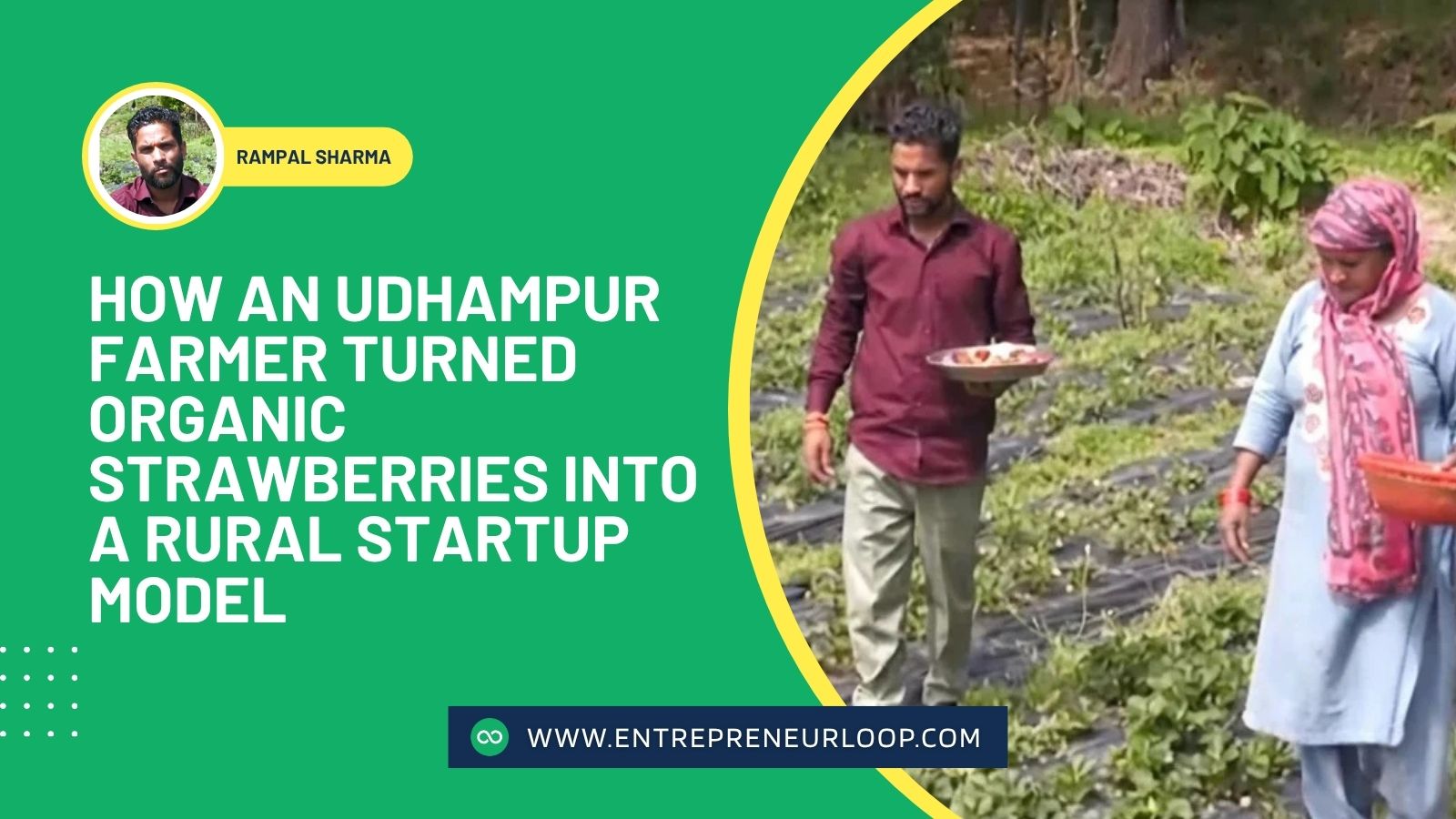
A Master’s degree in Sociology, a plot of ancestral land in Kambal Danga, and zero job prospects in sight—most young people in that situation would have kept refreshing their inboxes. Rampal Sharma chose the soil instead.
His decision to pivot toward organic strawberry farming wasn’t impulsive. Calculated. Deliberate. Profitable. It was driven by a conviction that rural land, when managed intelligently, can outperform a government salary. Today, Sharma stands as one of Udhampur’s most inspiring examples of agricultural self-reliance—a symbol that the ground beneath your feet is often your best career opportunity.
From Sociology Graduate to Organic Strawberry Farmer
Kambal Danga sits within Udhampur district of Jammu and Kashmir, a region where most farmers traditionally grow rainfed wheat and maize. Rampal Sharma grew up watching this cycle. Then he walked away from it.
Armed with an MSc in Sociology and facing the bleak reality of rural unemployment, Sharma refused the conventional script. Migrating to a city in search of desk work held no appeal. Instead, he turned his ancestral plot into a laboratory for modern organic strawberry farming. Soil conditions, market dynamics, and government support schemes—he studied all of them before planting a single runner.
That groundwork paid off. Starting in 2019 with just four kanals of land, Sharma now cultivates strawberries using purely organic farming inputs—farmyard compost, bio-based pest management, and drip irrigation—on land that once produced subsistence-level returns. By 2021, his venture turned profitable. Today it has transformed not only his own livelihood but also his standing as a role model in the community.
The journey wasn’t without obstacles. Early fungal infections threatened his first crop before he switched to neem-based organic fungicides. Market access proved difficult initially—wholesale buyers in Udhampur were unfamiliar with organic certification and unwilling to pay premiums. Sharma solved this by establishing direct relationships with hotels in Jammu and Srinagar, bypassing middlemen entirely.
Why Organic Strawberry Farming Makes Sense in Udhampur
Udhampur’s geography fits organic strawberry farming perfectly. The National Horticulture Board (NHB) specifically identifies sub-tropical areas in Jammu as having strong potential for strawberry cultivation under irrigated conditions. Cool winters and moderate summers create a natural growing window that expensive climate-controlled setups try to replicate elsewhere.
Strawberry farming in India has evolved from a niche activity into a profitable horticultural enterprise, driven by rising consumer demand and improved cultivation techniques. Choosing organic over conventional amplifies the profit margin further—organic produce commands premium prices in urban retail, hospitality, and export channels. In Udhampur’s local markets, organic strawberries fetch Rs. 450–500 per kilogram compared to Rs. 250–300 for conventional produce. Sharma understood this positioning advantage early, which is precisely what makes his model more startup than subsistence farm.
Organic Strawberry Cultivation in Udhampur: The Method Behind the Success
Organic strawberry cultivation in Udhampur requires more planning than conventional farming—but the returns justify every step. Sharma’s approach rests on a few non-negotiable practices.
Planting happens during the September–October window, aligning with the region’s natural cool-season growth cycle. Raised beds with well-draining sandy loam soil and black polythene mulching conserve moisture and suppress weeds without chemical inputs. Drip irrigation saves up to 30% of water and energy compared to flood irrigation methods, a critical advantage on hilly terrain where water sources are limited. Natural compost and farmyard manure replace synthetic fertilizers, reducing input costs over time while improving soil health.
Here’s the thing most people miss: organic certification isn’t just paperwork. Sharma obtained his through the Participatory Guarantee System (PGS), a locally relevant certification process managed by groups of farmers and inspectors. The process took eight months but opened doors to premium buyers and government procurement channels that conventional farmers cannot access.
The result? High-quality, chemical-free berries that fetch premium rates—and a farm that improves season after season rather than degrading under chemical overload. Sharma now harvests approximately 1,200 kilograms per season from his four kanals, with yields improving annually as soil quality builds.
Strawberry Farming Profit Per Kanal: The Financial Case
Numbers matter. Rural startup ideas in agriculture live or die by the economics, and organic strawberry farming holds up strongly.
The average strawberry farming profit per acre can reach Rs. 4,75,000 under good management conditions, with gross revenues between Rs. 9–10 lakh before costs. Since eight kanals roughly equal one acre in J&K, even a three-kanal holding can generate meaningful income. Strawberry farming profit per kanal works out favorably when farmers combine organic positioning with direct-to-buyer selling—bypassing middlemen who erode margins in traditional mandis.
Farmers like Rashpal Singh from Udhampur’s Kooh village have demonstrated this vividly. He went from earning Rs. 1,000 per wheat harvest to Rs. 40,000 from organic strawberries—a 40-fold increase. When broken down by land unit, Singh’s strawberry farming profit per kanal significantly outperformed conventional crops even in the first harvest year. Rampal Sharma is building on the same financial logic, with the added advantage of an organic premium and no synthetic input costs.
Horticulture Department Subsidy for Strawberries: Sharma’s Financial Foundation
No rural startup runs without seed funding—and the horticulture department subsidy for strawberries is exactly that.
The Udhampur Horticulture Department offers up to 50% subsidy for small and marginal farmers under area expansion programs, covering protective nets, packing infrastructure, bore wells, and plant protection materials. Beyond the local department, national schemes like the Mission for Integrated Development of Horticulture (MIDH) and NHB provide support for protected cultivation, micro-irrigation systems, and cold storage infrastructure.
The numbers are tangible. Strawberry farmers in the district receive Rs. 13,000 per kanal in direct subsidy, amounting to over Rs. 1.17 lakh on a nine-kanal farm—plus additional infrastructure support. A retired army veteran in neighboring Reasi who adopted strawberry cultivation reported that horticulture department support and subsidies directly stabilized his finances and inspired others in his village to follow suit.
Rampal Sharma accessed this ecosystem intelligently. Applications were filed early, every available scheme was leveraged, and government infrastructure support reduced his initial capital burden without compromising on quality. Arguably, this is the best government scheme available for small farmers in J&K today—if you know how to navigate it.
Strawberry Cultivation in Jammu and Kashmir: A Region in Transformation
Sharma isn’t an outlier—he’s part of a larger regional shift. Strawberry cultivation in Jammu and Kashmir is accelerating across multiple districts, with Udhampur leading the charge.
The district is fast emerging as a strawberry-producing centre, with increasing numbers of farmers opting for cultivation with remarkable success. The Chief Horticulture Officer of Udhampur has publicly laid out an ambitious goal: 62 farmers currently cultivate strawberries in the district, and the department aims to scale that number to 500. The phrase “Strawberry Hub” is no longer aspirational—it’s becoming administrative policy.
Government schemes across J&K are turning out to be key drivers in encouraging youth toward horticulture, with high-return potential serving as the prime motivator. Rampal Sharma’s story fits squarely within this movement—only he arrived there through personal vision, not policy nudging. His farm now operates more like a tech startup than a traditional kheti—lean, iterative, customer-obsessed.
Rampal Sharma’s Three-Part Startup Blueprint
What separates Sharma from a regular farmer is how deliberately he structured his agricultural venture. Three pillars define his model:
High Value Crops for Small Farmers: Strategic Crop Selection
Strawberry farming delivers far superior returns compared to staple crops like wheat. As one of the most profitable high value crops for small farmers in temperate and sub-tropical India, strawberries offer short harvest cycles, high per-unit value, and growing domestic demand. With organic strawberry farming, margins expand even further due to premium market positioning. Sharma identified this before the regional trend made it obvious.
Smart subsidy capture. Accessing the horticulture department subsidy for strawberries early and completely gave Sharma infrastructure that would have otherwise consumed years of profit. Every farmer-entrepreneur in J&K should map available schemes before spending a single rupee of personal capital. This isn’t paperwork—it’s strategic finance.
Organic positioning for margin expansion. Committing to fully organic methods isn’t just an ethical stance; it’s a pricing strategy. India leads the world in number of organic producers, yet certified organic strawberries remain scarce in local markets. Sharma fills a premium gap that conventional farmers cannot. Certification opens government procurement contracts and export opportunities unavailable to non-certified growers.
A Lesson for Rural Youth: The Land Is the Startup
Youth who introduce organic farming practices and digital marketing into agriculture can dramatically enhance both productivity and market reach. Rampal Sharma’s sociology degree gave him exactly the community literacy and market empathy that a farmer-entrepreneur needs. He reads people as well as soil. That combination is rare—and powerful.
His message to peers is unambiguous: rural startup ideas in agriculture are not a consolation prize. They are a first-choice career path for anyone willing to combine knowledge with labor and patience with ambition. The land you inherit is not a burden. It is seed capital.
Conclusion: One Village, One Farmer, One Blueprint Worth Replicating
Rampal Sharma turned a personal crisis—unemployment after an MSc—into a community asset. His venture in Kambal Danga is proof that high value crops for small farmers, combined with disciplined organic strawberry farming practices and smart use of horticulture department subsidies, can deliver livelihood security that a conventional job often cannot.
Organic strawberry farming is no longer a niche experiment in Udhampur; it is becoming a replicable model—one that works for educated youth, small landholders, and anyone willing to commit to the long game of building soil, building quality, and building market relationships. Sharma’s four-kanal plot now generates annual income comparable to mid-level government employment, with the added advantages of autonomy, asset ownership, and scalability.