

Union Minister for Electronics and Information Technology Ashwini Vaishnaw recently informed Rajya Sabha that 1,706 startups have been supported under the Technology Incubation and Development of Entrepreneurs 2.0 (TIDE 2.0) scheme. This milestone announcement signals the profound impact of India’s strategic government initiatives. The achievement comes at a time when India houses one of the most vibrant startup ecosystems with close to 30,000+ tech startups, making it the 3rd largest startup ecosystem in the world.
TIDE 2.0 scheme startups represent a transformative force in India’s entrepreneurial landscape. These ventures receive comprehensive support through innovative government frameworks. The scheme promotes technology-based entrepreneurship by providing financial & technical support to incubators. This holistic approach distinguishes India’s startup development strategy from conventional business support models.
Understanding the TIDE 2.0 Framework and Its Impact
The Technology Incubation and Development of Entrepreneurs 2.0 scheme launched in 2019 with ambitious objectives. Government of India started the “Technology Incubation and Development of Entrepreneurs 2.0 (TIDE 2.0)” Scheme in the year 2019. Unlike traditional funding programs, this initiative embraces a comprehensive ecosystem approach.
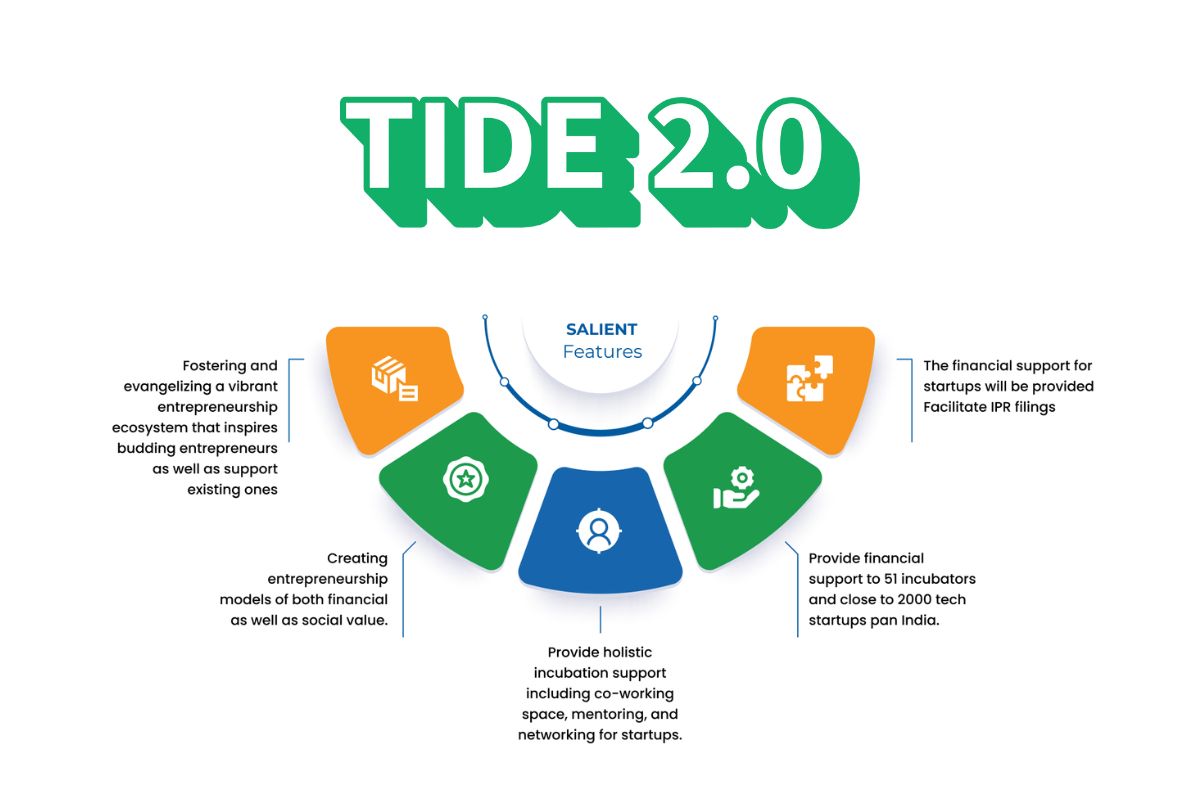
Startups are supported through 51 selected incubators located in the Institutes of Higher Learning and premier R&D organizations across the country. These strategically positioned incubators ensure nationwide coverage and accessibility. The geographical distribution creates multiple innovation hubs throughout India.
The scheme’s financial structure offers substantial support for emerging entrepreneurs. Under this scheme, eligible startups get up to Rs. 4 Lacs as grant or Rs. 7 Lacs in Entrepreneur-In-Residence (EIR) category, for working on building cutting-edge technology and solutions. These funding levels enable startups to develop viable prototypes and market-ready products.
Technology Focus Areas and Emerging Innovations
TIDE 2.0 scheme startups concentrate on cutting-edge technologies with societal relevance. TIDE 2.0 will promote tech entrepreneurship through financial and technical support to incubators engaged in supporting ICT startups primarily engaged in using emerging technologies such as IoT, AI, Block-chain, Robotics etc. This technological emphasis positions India at the forefront of global innovation trends.
The scheme targets specific sectors crucial for national development. Healthcare, Education, Agriculture, Financial inclusion including digital payments, Infrastructure and transportation, Environment and clean tech, Clean energy and other emerging areas. This sectoral focus ensures technology addresses real-world challenges facing Indian society.
Artificial intelligence integration has become particularly prominent among supported startups. Over 70% of startups were integrating artificial intelligence into their business operations. Sectors such as healthcare, edtech, and beauty were leading in AI maturity, leveraging automation for customer service, predictive analytics, and personalisation.
Intellectual Property Development and Innovation Metrics
The TIDE 2.0 scheme has generated remarkable intellectual property outcomes. A total of 1672 IP/patents have been filed by 638 startups. This statistic demonstrates the innovation quality emerging from supported ventures. Patents serve as crucial indicators of technological advancement and commercial viability.
Under TIDE 2.0, Centres of Excellence in Intellectual Property Rights (CoE-IP) are also established to encourage or support Startups/SMEs/academia/inventors in Electronics and IT domain. These CoE provide various IP related services, awareness creation and training. This comprehensive IP support infrastructure strengthens startup competitive advantages.
The intellectual property development extends beyond mere filing numbers. Startups receive guidance on patent strategy, trademark protection, and commercialization pathways. This holistic IP support ensures entrepreneurs understand and leverage their innovations effectively.
Global Expansion and International Partnerships
TIDE 2.0 scheme startups increasingly pursue international markets and partnerships. TIDE 2.0 centres have helped more than 150 incubated startups go global for scaling their business. This global expansion demonstrates the commercial viability and competitiveness of Indian technology startups.
International market entry requires sophisticated support systems and strategic guidance. The scheme provides startups with export promotion assistance, international partnership facilitation, and global market intelligence. These services enable ventures to compete effectively in worldwide markets.
Cross-border collaborations have become particularly important for technology transfer and knowledge sharing. Indian government startup funding through TIDE 2.0 facilitates partnerships with international universities, research institutions, and corporate entities.
Financial Sustainability and Revenue Models
TIDE 2.0 centres adopt multiple revenue models including equity exits to enhance long-term sustainability. This diversified approach ensures incubators maintain financial viability while supporting emerging ventures. Sustainability remains crucial for program continuity and impact.
The revenue model diversity includes fee-for-service arrangements, equity participation, and licensing agreements. These varied income streams reduce dependence on government funding while maintaining support quality. Successful equity exits provide reinvestment capital for additional startup support.
The overall performance of the supported startups remains encouraging, with many startups demonstrating revenue growth, increased valuations, raised external funding and IP filings. These positive metrics validate the scheme’s effectiveness in creating commercially viable ventures.
Integration with Broader Government Initiatives
MeitY TIDE 2.0 scheme operates within a comprehensive startup support ecosystem. Overall, TIDE 2.0 complements other Government initiatives such as GENESIS, SAMRIDH, Startup India and sector-specific innovation programmes. Together, these initiatives reflect a whole-of-the government effort to build a strong startup ecosystem in the country.
This integration creates synergies between different government programs and reduces duplication. Startups can access multiple support mechanisms throughout their development lifecycle. The coordinated approach maximizes resource utilization and impact.
The broader ecosystem includes funding schemes, tax incentives, regulatory reforms, and market access programs. The MeitY Startup Hub (MSH) aims to foster a vibrant innovation and startup ecosystem by uniting technology innovation stakeholders and promoting economic growth through innovation and technological advancement. It serves as a central hub, ensuring synergies among incubation centres, Centres of Excellence on Emerging Technologies, and other platforms supported by the Ministry of Electronics and Information Technology. MSH facilitates the sharing of resources, best practices, and ideas across the entire innovation and startup ecosystem.
Lifecycle Support and Entrepreneurship Development
Government schemes for tech startups in India emphasize comprehensive lifecycle support. The Government of India follows a lifecycle-based approach to support the startup ecosystem. The startups are supported across the entire journey – from idea and proof of concept to prototype development, product development and testing.
This cradle-to-market approach addresses critical gaps in traditional support systems. Many startups struggle during specific development phases, particularly the transition from prototype to commercial product. TIDE 2.0 provides targeted assistance during these crucial periods.
The lifecycle support includes mentorship programs, technical assistance, market validation support, and scaling guidance. In many cases, incubators have facilitated quick idea validation and effective pivoting for the startups, helping entrepreneurs shift to more viable ideas. This adaptive support helps entrepreneurs navigate market uncertainties and business model challenges.
Impact on India’s Technology Ecosystem
The success of TIDE 2.0 scheme startups contributes significantly to India’s technological advancement. The TIDE 2.0 scheme is expected to have a significant impact on the Indian startup ecosystem. It is expected to help create a more conducive environment for startups to thrive and to accelerate the growth of the Indian startup industry.
Technology startups supported through the scheme often become catalysts for broader industry transformation. Their innovations frequently find applications across multiple sectors and inspire additional entrepreneurial ventures. This multiplier effect amplifies the program’s overall impact.
The scheme’s focus on emerging technologies positions India advantageously in global technology competitions. The Indian tech startup ecosystem, in particular, has demonstrated robust growth, with over 950 tech startups established in 2023 alone, contributing to a total of more than 31,000 tech startups in the last decade. Despite global economic and regulatory challenges, Indian tech startups have attracted more than US$ 70 billion in cumulative funding from 2019 to 2023.
Regional Distribution and Inclusive Growth
TIDE 2.0 scheme promotes inclusive growth across Indian regions and demographics. The 51 incubator network ensures geographical representation beyond traditional startup hubs. This distribution strategy brings entrepreneurship opportunities to smaller cities and underserved regions.
Major hubs like Bengaluru, Hyderabad, Mumbai, and Delhi-NCR have been at the forefront of this transformation, while smaller cities are increasingly contributing to the momentum with over 51% of the startups emerging from Tier II/ III cities. This trend reflects the scheme’s success in democratizing entrepreneurship access.
Regional distribution creates local employment opportunities and reduces urban migration pressures. Technology startups often require skilled workers and generate additional economic activity in their locations. The dispersed approach ensures benefits reach diverse communities throughout India.
Future Prospects and Scaling Opportunities
The TIDE 2.0 scheme’s future prospects appear promising given current performance metrics and market trends. The Scheme will be implemented through empowering 51 incubators in India and handholding close to 2000 tech start-ups over a period of 5 years. This ambitious target suggests continued expansion and impact.
Technology trends favor continued growth in sectors emphasized by the scheme. Artificial intelligence, blockchain, robotics, and Internet of Things applications continue expanding across industries. TIDE 2.0 scheme startups are well-positioned to capitalize on these growing markets.
Union Minister of Commerce and Industry expressed concerns over the limited innovation in Indian startups, urging them to shift focus from low-tech sectors like grocery delivery to high-tech industries. This policy direction aligns perfectly with TIDE 2.0’s technology-focused approach.
Challenges and Strategic Adaptations
Despite remarkable success, TIDE 2.0 scheme startups face ongoing challenges requiring strategic adaptations. As startups eventually operate in a competitive market, their engagement with incubators also evolve based on business realities. These include, inter alia, achieving product-market fit, specialised laboratory requirements, technological challenges, fundraising needs, strategic pivots by founders, and overall financial sustainability.
Market competition intensifies as more startups enter similar sectors. Differentiation becomes increasingly important for commercial success. The scheme continues evolving its support mechanisms to address these competitive pressures.
Access to growth capital remains a persistent challenge for many technology startups. While TIDE 2.0 provides initial funding, scaling ventures often require substantial additional investment. The scheme works to connect startups with private investors and venture capital firms to address this funding gap.
Technology Incubation and Development of Entrepreneurs 2.0 represents a watershed moment in India’s entrepreneurship development. The scheme’s comprehensive approach, technology focus, and integration with broader government initiatives creates a powerful platform for innovation. With 1,706 startups supported and growing, TIDE 2.0 demonstrates government investment’s transformative potential in building India’s technology economy. The program’s continued evolution and expansion promise sustained impact on India’s position in the global innovation landscape.
Frequently Asked Questions
What is the TIDE 2.0 scheme and how does it support startups?
TIDE 2.0 (Technology Incubation and Development of Entrepreneurs 2.0) is a government scheme launched in 2019 that supports technology-based startups through 51 selected incubators. It provides financial support (up to Rs. 4 lakh grants or Rs. 7 lakh for EIR category), technical assistance, and comprehensive ecosystem support for emerging technology ventures.
How many startups have been supported under the TIDE 2.0 scheme?
As of December 2024, 1,706 startups have been supported under the TIDE 2.0 scheme, according to Union Minister Ashwini Vaishnaw’s announcement in Rajya Sabha. The scheme aims to support close to 2,000 tech startups over a five-year period.
What technologies and sectors does TIDE 2.0 focus on?
TIDE 2.0 promotes startups using emerging technologies like IoT, AI, blockchain, and robotics in sectors including healthcare, education, agriculture, financial inclusion, infrastructure, transportation, environment, clean tech, and clean energy.
What intellectual property support does TIDE 2.0 provide?
The scheme has established Centres of Excellence in Intellectual Property Rights (CoE-IP) that provide IP-related services, awareness creation, and training. Supported startups have filed 1,672 IP/patents, demonstrating strong innovation outcomes.
How does TIDE 2.0 help startups expand globally?
TIDE 2.0 centres have helped more than 150 incubated startups go global for scaling their business by providing export assistance, international partnership facilitation, and global market intelligence to compete in worldwide markets.
What is the geographical distribution of TIDE 2.0 incubators?
The scheme operates through 51 selected incubators located in Institutes of Higher Learning and premier R&D organizations across the country, ensuring nationwide coverage and bringing entrepreneurship opportunities to various regions including Tier II and III cities.
How does TIDE 2.0 integrate with other government startup initiatives?
TIDE 2.0 complements other government initiatives such as GENESIS, SAMRIDH, Startup India, and sector-specific innovation programs, creating a comprehensive ecosystem that maximizes resource utilization and impact through the MeitY Startup Hub coordination.