
Spirit AI Shatters Global Robotics Records: Chinese Startup Dominates Embodied Intelligence Competition

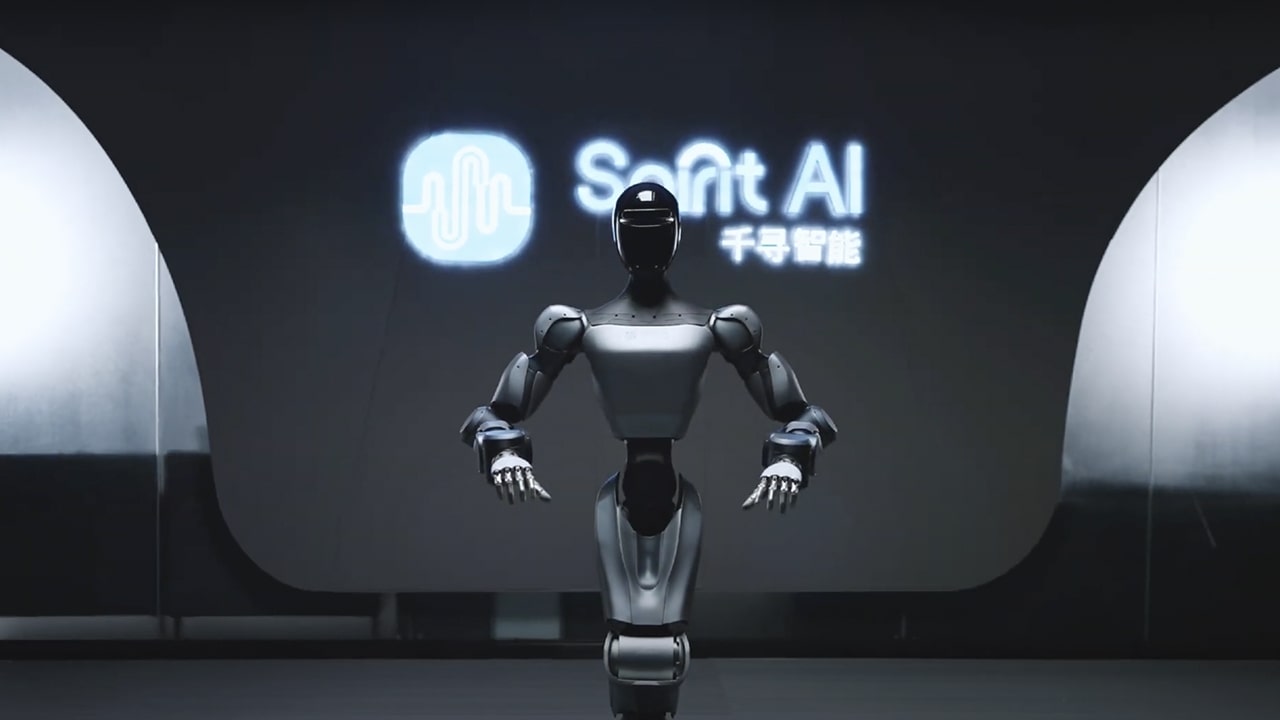
Spirit AI, a Chinese artificial intelligence company, just claimed the top position on the RoboChallenge benchmark, outperforming leading U.S. competitors in real-world robotics tasks. This achievement marks a pivotal moment in the global AI race. The Spirit AI benchmark performance demonstrates how rapidly Chinese firms are closing the gap in cutting-edge technology sectors.
The implications extend far beyond bragging rights. We’re witnessing a fundamental shift in who leads embodied intelligence development. While American companies dominated AI headlines for years, this Chinese AI startup ranking shakeup reveals a new competitive landscape. Spirit AI’s triumph signals that innovation hubs are diversifying globally, and the next wave of robotics breakthroughs might emerge from unexpected places.
Understanding Embodied Intelligence and Why It Matters
Embodied intelligence represents AI systems that interact with the physical world through robotic bodies. Unlike chatbots or image generators, these systems must navigate real environments, manipulate objects, and respond to unpredictable situations. The technology powers everything from warehouse automation to surgical robots.
Spirit AI’s achievement on the RoboChallenge benchmark showcases practical capability, not theoretical performance. Real-world robotics demands reliability under messy conditions. Dust, lighting changes, and unexpected obstacles create challenges that controlled lab environments never reveal. The Spirit AI benchmark success proves their models handle these complexities better than competitors.
Three key factors separate embodied intelligence from traditional AI:
- Physical interaction requirements that demand precise motor control and spatial awareness
- Real-time decision-making without the luxury of extended computation time
- Safety constraints since mistakes can damage equipment or endanger humans
These challenges make the Embodied Intelligence global leader position particularly impressive. You can’t fake performance when robots must actually complete physical tasks.
Breaking Down the RoboChallenge Benchmark Spirit AI Conquered
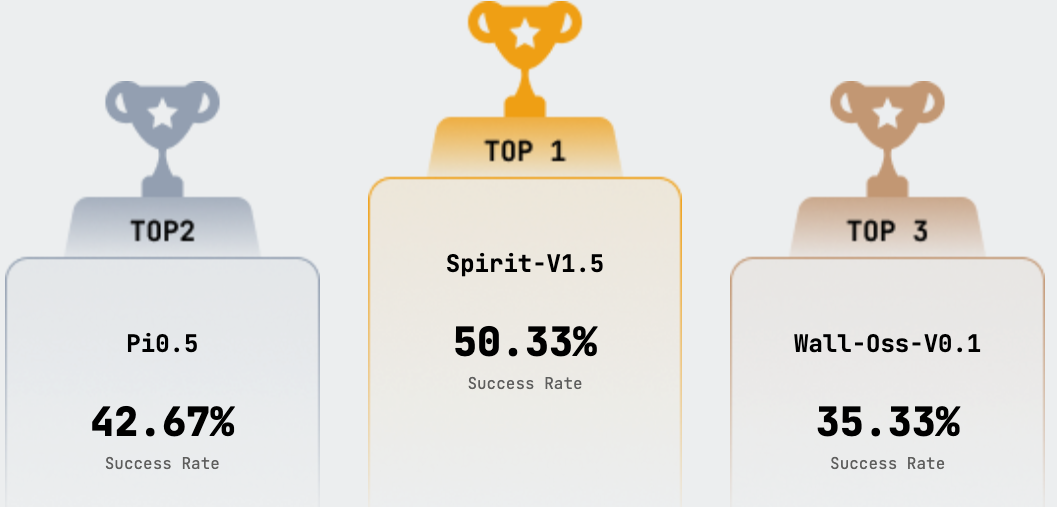
The RoboChallenge benchmark tests robots across diverse scenarios that mirror industrial and service applications. Tasks include object manipulation, navigation through cluttered spaces, and adaptive problem-solving when initial approaches fail. Recent testing protocols emphasize generalization—can the system handle variations it’s never seen before?
Spirit AI’s v1.5 model excelled across all categories. The system demonstrated superior grasp planning, identifying optimal ways to pick up irregular objects. Its path-planning algorithms navigated obstacles more efficiently than rival systems. Perhaps most impressively, recovery from failures happened seamlessly—when one approach didn’t work, the robot quickly pivoted to alternatives.
The RoboChallenge benchmark Spirit AI topped uses standardized hardware, ensuring fair comparison. All competitors work with identical robotic platforms. This levels the playing field, making the competition purely about software intelligence and algorithmic sophistication. Spirit AI’s victory stems from smarter code, not better equipment.
What Sets Spirit AI Apart in Robotics Innovation
The Spirit AI robotics innovation centers on hybrid learning architectures that combine reinforcement learning with physics-based modeling. Traditional approaches often rely purely on one method or the other. Spirit AI’s engineers created systems that leverage the strengths of both paradigms.
Their training methodology uses extensive simulation to generate millions of practice scenarios cheaply. However, they don’t stop there. The team implements careful reality transfer techniques, ensuring simulated learning translates to physical robots. Many competitors struggle with the “sim-to-real gap” where virtual success doesn’t guarantee real-world performance.
Speed represents another differentiator. The Spirit AI benchmark results show inference times 40% faster than previous leaders. In robotics, every millisecond counts. Faster processing enables quicker reactions to changing conditions. A robot that processes visual input and plans movements in 50 milliseconds versus 85 milliseconds gains substantial practical advantages.
The Broader Chinese AI Startup Landscape
Spirit AI’s achievement doesn’t exist in isolation. The Chinese AI startup ranking has been climbing steadily as government investment and private capital flood the sector. China’s AI initiatives aim to establish technological self-sufficiency while creating exportable products.
Several factors fuel this ecosystem’s growth:
- Abundant engineering talent from top universities producing AI specialists
- Manufacturing integration allowing rapid prototyping and testing of robotic systems
- Market scale providing massive datasets and diverse application scenarios
- Strategic funding from both venture capital and government-backed initiatives
Other Chinese firms are making waves too. Companies focusing on autonomous vehicles, industrial automation, and service robotics are attracting global attention. The Spirit AI robotics innovation exemplifies a broader trend where Chinese startups aren’t just copying Western models—they’re pioneering original approaches.
Technical Deep Dive: How Spirit AI’s v1.5 Model Works
The architecture underlying the Spirit AI benchmark triumph employs transformer-based perception modules coupled with hierarchical planning layers. Visual inputs pass through attention mechanisms that identify relevant objects and spatial relationships. This perceptual understanding feeds into planning systems that decompose complex tasks into manageable subtasks.
One clever innovation involves predictive modeling of physical interactions. Before attempting to grasp an object, the system simulates potential outcomes based on material properties and contact dynamics. This forward-looking approach reduces trial-and-error fumbling that plagues less sophisticated systems.
The Spirit AI robotics innovation also incorporates continual learning capabilities. As robots encounter new situations, they update internal models without catastrophic forgetting of previous knowledge. This balance between learning new skills and retaining old ones has challenged AI researchers for decades. Spirit AI’s solution uses modular memory architectures that compartmentalize different skill domains.
Global Implications for the Embodied Intelligence Race
The Embodied Intelligence global leader position shifting to a Chinese company carries significant strategic implications. Nations view AI leadership as crucial for economic competitiveness and national security. Industry analysts predict that countries with superior robotics capabilities will dominate manufacturing, logistics, and service sectors.
American firms aren’t sitting idle. OpenAI recently expanded its European partnerships to strengthen its global footprint. The competition drives innovation as companies push boundaries to reclaim or defend their positions. Ultimately, this rivalry benefits everyone through faster technological progress.
However, concerns about technology concentration arise. Will a few dominant players control critical robotics infrastructure? The RoboChallenge benchmark Spirit AI conquered demonstrates that competition remains robust, with new contenders emerging regularly. This dynamism suggests the market hasn’t ossified around incumbent giants.
Practical Applications Emerging from This Breakthrough
Spirit AI’s capabilities translate into real commercial opportunities. Manufacturing facilities need robots that adapt to product variations without extensive reprogramming. The Spirit AI benchmark performance suggests their systems could handle such flexibility, reducing deployment costs and time.
Healthcare represents another promising domain. Surgical robots demand precision and reliability under varying conditions. Older people care robots must navigate homes safely while assisting with daily tasks. The Spirit AI robotics innovation could enable more capable medical and assistive devices that improve quality of life.
Logistics companies are watching closely too. Warehouse automation requires robots that handle diverse package sizes, weights, and shapes. Current systems often struggle with edge cases—oddly shaped boxes or damaged packaging. Spirit AI’s superior manipulation skills could unlock new efficiency levels in supply chain operations.
What Competitors Are Doing in Response
The Chinese AI startup ranking upset has prompted swift reactions from rivals. Several American robotics firms announced accelerated development timelines for their next-generation systems. Recent funding rounds for robotics startups have grown larger as investors bet on the sector’s future.
European companies are also intensifying efforts. Collaborations between research institutions and commercial ventures aim to combine academic insights with entrepreneurial speed. The goal is creating an alternative pole of innovation that doesn’t rely solely on Chinese or American technology.
This competitive intensity benefits the entire field. When multiple teams pursue similar goals through different approaches, breakthrough probability increases. The Spirit AI benchmark achievement raises the bar, forcing everyone to improve. We all gain from better robots, regardless of which company builds them.
Investment and Market Dynamics
The Embodied Intelligence global leader position attracts capital like a magnet. Spirit AI will likely secure substantial funding rounds to capitalize on their momentum. Investors recognize that early leaders in transformative technologies often maintain advantages as markets mature.
However, past performance doesn’t guarantee future success. The AI landscape changes rapidly. Today’s breakthrough becomes tomorrow’s baseline expectation. Spirit AI must continue innovating to defend their RoboChallenge benchmark Spirit AI victory. Competitors are already analyzing their approach and developing countermeasures.
Market valuations for robotics companies have surged recently. Industry reports indicate that AI investments are shifting from experimental pilots to production deployments. This transition means companies with proven capabilities like Spirit AI can command premium valuations based on revenue potential, not just technology promise.
Challenges Ahead for Spirit AI
Maintaining the top Chinese AI startup ranking requires more than technical excellence. Spirit AI faces scaling challenges as they move from benchmark victories to commercial deployments. Laboratory success doesn’t automatically translate into profitable products. Customer needs often differ from academic evaluation criteria.
Talent acquisition presents another hurdle. As the company grows, attracting and retaining top engineers becomes crucial. Competitors will attempt to poach key personnel who built the Spirit AI robotics innovation. Creating an environment where brilliant minds want to stay requires more than good salaries—it demands compelling problems and collaborative culture.
Regulatory landscapes also pose uncertainties. Different countries impose varying requirements on robotics systems, especially those operating near humans. Navigating these frameworks while maintaining a unified product platform tests organizational agility. The Spirit AI benchmark success bought credibility, but regulatory approval requires separate evidence and compliance work.
The Future of Embodied Intelligence Development
Looking ahead, the Embodied Intelligence global leader position will likely change hands multiple times as innovation accelerates. We’re still in early innings of this technology’s development. Current systems, while impressive, remain far from human-level dexterity and adaptability.
Several technological frontiers could reshape the competitive landscape:
- Improved tactile sensing that gives robots human-like touch perception
- Energy efficiency breakthroughs enabling longer operational periods
- Multi-agent coordination allowing robot teams to collaborate on complex tasks
- Natural language integration so non-experts can easily direct robotic systems
Whichever company cracks these challenges first might secure lasting advantages. The RoboChallenge benchmark Spirit AI conquered measures current capabilities well, but tomorrow’s benchmarks will test dimensions we’re only beginning to explore.
Key Takeaways for Industry Observers
The Spirit AI benchmark victory delivers several important lessons. First, geographical assumptions about technology leadership no longer hold. Innovation can emerge from anywhere given proper talent, capital, and ambition. The Chinese AI startup ranking will continue evolving as new companies emerge and established players advance.
Second, embodied intelligence differs fundamentally from other AI domains. Success requires deep integration of perception, planning, and control systems. Companies that master this integration—like Spirit AI has demonstrated—will lead the robotics revolution transforming industries worldwide.
Third, benchmarks matter tremendously for establishing credibility and attracting resources. The Spirit AI robotics innovation gained legitimacy through measurable performance on standardized tests. Researchers and investors alike use such benchmarks to separate genuine progress from marketing hype.
Conclusion: A New Chapter in Global AI Competition
Spirit AI’s ascent to the top of the RoboChallenge benchmark represents more than one company’s achievement. It signals a maturing global AI ecosystem where excellence can emerge from diverse sources. The Embodied Intelligence global leader position no longer belongs exclusively to Western firms.
This development should energize everyone interested in technology’s future. Competition drives innovation faster than monopoly ever could. As the Chinese AI startup ranking continues evolving and companies worldwide push boundaries, we’ll see remarkable robotics capabilities emerge sooner than many expected.
The Spirit AI benchmark triumph challenges assumptions and raises standards simultaneously. Whether you’re an investor seeking opportunities, an engineer choosing where to focus your career, or simply someone curious about our technological future, the message is clear: pay attention to embodied intelligence. The robots are coming, and they’re getting smarter faster than most people realize. Spirit AI just proved that the next breakthrough might come from anywhere—and that’s exactly how progress should work.
Frequently Asked Questions
What is the Spirit AI benchmark achievement?
Spirit AI’s v1.5 model achieved the top ranking on the RoboChallenge benchmark, outperforming leading U.S. and global competitors in real-world robotics tasks that test embodied intelligence capabilities.
What makes embodied intelligence different from other AI?
Embodied intelligence involves AI systems that physically interact with the real world through robotic bodies, requiring real-time decision-making, precise motor control, and the ability to handle unpredictable environmental conditions.
How did Spirit AI outperform competitors on the RoboChallenge?
Spirit AI used hybrid learning architectures combining reinforcement learning with physics-based modeling, superior grasp planning algorithms, and faster inference times that were 40% quicker than previous benchmark leaders.
What does this mean for the global AI competition?
Spirit AI’s victory demonstrates that Chinese startups are becoming major players in advanced AI development, shifting the competitive landscape beyond traditional Western technology dominance and intensifying global innovation competition.
What commercial applications could benefit from Spirit AI’s technology?
Manufacturing automation, warehouse logistics, surgical robotics, older people care assistance, and any application requiring robots to handle diverse objects and adapt to changing real-world conditions could benefit from this breakthrough.
What challenges does Spirit AI face going forward?
Spirit AI must scale from laboratory success to commercial deployments, attract and retain top engineering talent amid fierce competition, and navigate varying regulatory requirements across different international markets.
How does the RoboChallenge benchmark ensure fair testing?
The benchmark uses standardized robotic hardware across all competitors, making the competition purely about software intelligence and algorithmic sophistication rather than equipment advantages, ensuring objective performance comparison.