

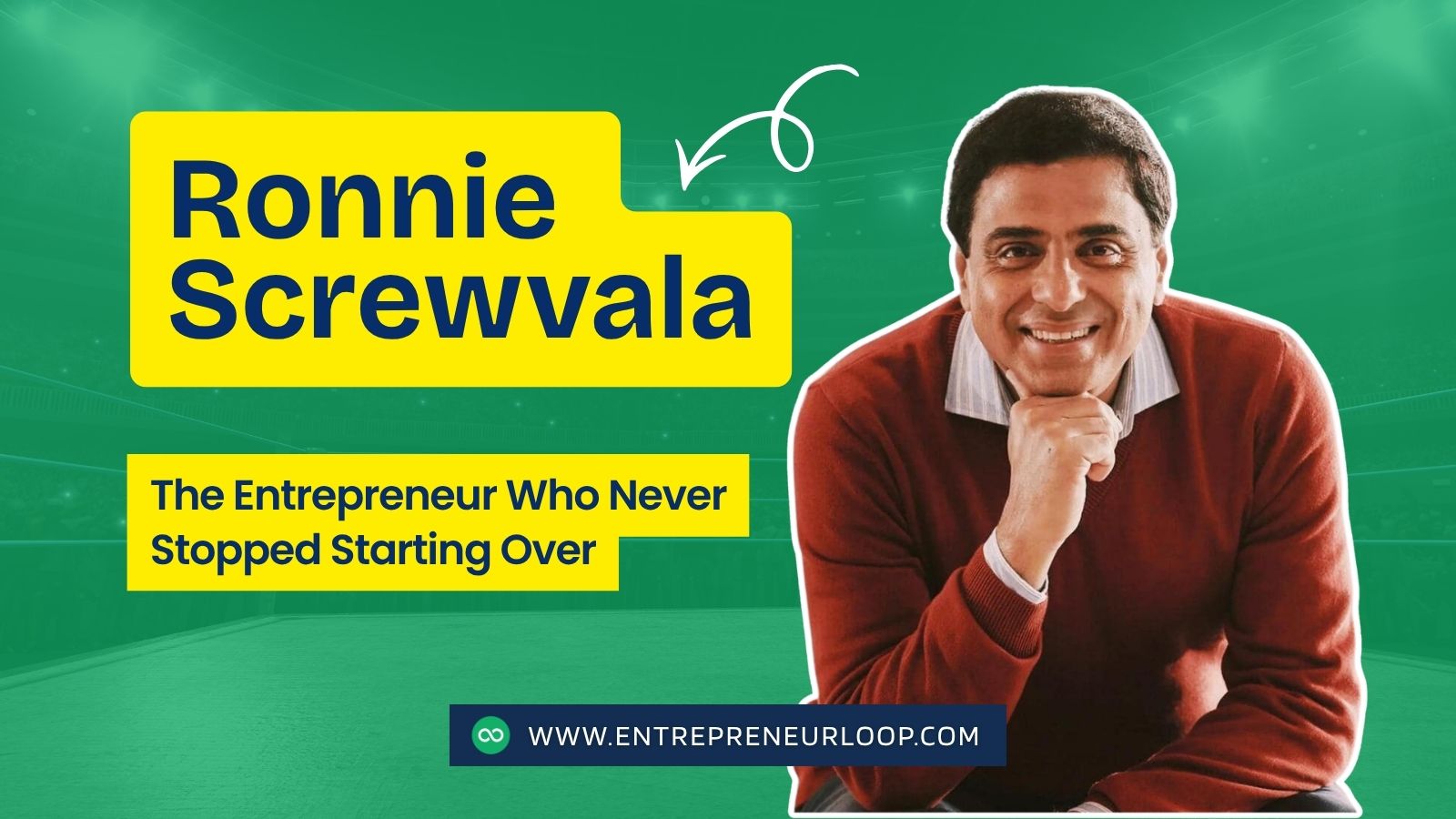
Bollywood’s only billionaire didn’t start in film, television, or education — he started by selling toothbrushes. Today, Ronnie Screwvala’s net worth stands at $1.5 billion, a figure that has quietly overtaken the combined fortunes of some of Hindi cinema’s biggest stars. The ronnie screwvala success story isn’t a single triumphant leap — it’s a decades-long pattern of building, selling, and rebuilding, again and again, across industries that had nothing to do with each other on paper but everything to do with each other in spirit.
What makes this story worth studying isn’t just the money. It’s the sheer refusal to sit still after winning. Most entrepreneurs chase one great exit and call it a career. Screwvala treated his biggest exit as a comma, not a period.
The Ronnie Screwvala Success Story Begins With a Toothbrush Empire
Long before anyone called him a media mogul, Rohinton Soli Screwvala was a Parsi kid from Mumbai who grew up in a household that valued discipline over glamour. He attended Cathedral and John Connon School before earning a degree from Sydenham College of Commerce, hardly the pedigree you’d associate with future billion-dollar bets. His first serious business venture wasn’t glamorous either. He built one of the country’s largest toothbrush manufacturing operations, a company that eventually produced over 6 million brushes a month for some of India’s best-known personal care brands.
It’s an odd footnote in most retellings of the ronnie screwvala success story, but it matters. That toothbrush business taught him supply chains, distribution, and margins — unglamorous skills that would later underpin far flashier ventures. He wasn’t dreaming of Bollywood yet. He was learning how to run a tight operation, and that discipline never really left him.
Pioneering Cable TV in India: The First Big Bet
The real pivot came in 1981, a year most Indians associate only with Doordarshan’s monopoly over television. While the rest of the country watched a single state-run channel, Screwvala launched Network, India’s very first cable TV company, offering a three-hour video channel to homes in Mumbai’s Cuffe Parade neighborhood. Subscribers paid roughly Rs 200 a month, and within a short stretch, thousands of households had signed up.
This is the moment people mean when they talk about pioneering cable tv in india — a genuinely first-mover bet in a market that didn’t yet have the infrastructure, regulation, or audience habits to support it. Doordarshan had no competition until Screwvala essentially invented the category himself. He also dabbled in home shopping through the Tele-Shopping Network around the same period, further cementing his reputation as someone who liked entering markets nobody else had bothered to test.
From Network to UTV: Building a Media Empire
By 1990, Screwvala had incorporated UTV, launching it with roughly Rs 37,000 in initial capital — a laughably small sum for what would eventually become a billion-dollar exit. UTV started in television, producing shows that became household names, before expanding aggressively into film production. The studio backed titles like Swades, Jodhaa Akbar, Rang De Basanti, and Barfi, movies that reshaped what mainstream Hindi cinema could look like creatively while still performing commercially.
UTV wasn’t just a production house. It grew into a genuine conglomerate spanning broadcasting, gaming, animation, and digital content, eventually going public and listing on Indian stock exchanges in 2005. By the early 2000s, the company’s children’s channel Hungama TV had become one of the country’s top-ranked networks in its category, proof that Screwvala’s instincts for audience behavior extended well beyond adult entertainment.
The Disney Acquisition of UTV: A Career-Defining Exit
The disney acquisition of utv didn’t happen overnight — it unfolded in stages over roughly six years. Disney first bought a stake in UTV back in 2006, then steadily increased its position until, by 2011, Disney held more than 50 percent of UTV’s stock, even as Screwvala retained operational control. That July, Disney made its move public, offering to buy out the remaining stake for a sum that valued the two-decade-old media company at more than $900 million — a ninefold increase from its valuation five years earlier.
The final numbers varied depending on how you sliced them. Regulatory filings pegged the deal at around Rs 2,000 crore for the remaining shareholder stakes, while the overall transaction gave UTV an enterprise value of roughly $1.4 billion. Disney structured the acquisition through a delisting offer, fixing an exit price of Rs 1,100 per share for departing shareholders, and India’s Cabinet Committee on Economic Affairs signed off on the increased foreign shareholding by December 2011.
What’s often missed is that Screwvala didn’t simply cash out and disappear. As part of the arrangement, he was appointed Managing Director of The Walt Disney Company India, continuing to run the combined entertainment business even after relinquishing his ownership stake. One media analyst summed up the entire deal with a line that’s stuck around in industry retellings ever since: Disney “didn’t just buy UTV,” he said, “they bought Ronnie.” It was, by Disney’s own account, its largest-ever acquisition outside the United States at the time, and it enhanced Disney’s presence across six television channels distributed to over 100 million viewers weekly in Indian households.
Richest Man in Bollywood: How the Numbers Stack Up
Fast forward to 2025, and the same entrepreneur who once ran a toothbrush factory now tops every Bollywood rich list that matters. Forbes’ billionaire rankings placed his personal fortune at $1.5 billion, a number that, when compared to individual film stars, tells its own story: his wealth surpasses the combined fortunes of Shah Rukh Khan, Salman Khan, and Aamir Khan, whose individual net worths were estimated at $770 million, $390 million, and $220 million respectively.
That makes him, by a wide margin, the richest man in bollywood — not through acting royalties or brand endorsements, but through building and selling companies. Some estimates place his net worth closer to Rs 13,000 crore, depending on currency conversion and valuation timing, but every version of the number lands him firmly at the top. In 2024, he even made a rare public-facing move, stepping onto Shark Tank India as an investor, a decision that cemented his reputation as a mentor to emerging entrepreneurs rather than just a behind-the-scenes dealmaker.
RSVP Movies Founder: Act Two in Entertainment
Most people who sell a company for over a billion dollars take the money and step back. Screwvala did the opposite. In 2017, he launched RSVP Movies, an independent production and distribution company built specifically to avoid recreating the sprawling conglomerate he’d just sold. As rsvp movies founder, he was explicit about the intent: this wasn’t going to be UTV 2.0.
RSVP’s first release, Love Per Square Foot, became one of India’s early Netflix original films, and the slate that followed leaned hard into original storytelling rather than formula. The anthology Lust Stories became an early Netflix breakout hit in India, while Uri: The Surgical Strike turned into a genuine box-office phenomenon, crossing Rs 100 crore domestically and sweeping several National Film Awards including Best Director. By late 2024, the studio had maintained a prolific output of 39 films and series since its founding, a pace that would exhaust most production houses twice its size.
Screwvala has been candid about how he thinks about creative risk at RSVP. As he put it in a 2024 interview, when he failed, he failed on a 1x, but when he went counterintuitive, the success was 10x. He also noted that his instincts remain shaped by his business background more than his film credentials, describing himself as an entrepreneur first, a media person second, and a film person third. Roughly 30 percent of RSVP’s greenlit projects had been passed on by other producers before finding a home under his banner — a statistic that fits the broader pattern of betting on ideas everyone else walked away from.
upGrad Co-Founder Ronnie Screwvala: Disrupting Education
While RSVP was building its slate, Screwvala was quietly assembling an entirely different kind of company. In 2015, alongside Mayank Kumar and Phalgun Kompalli, he co-founded upGrad, an online higher-education platform aimed at professionals seeking to upskill rather than traditional degree-seekers. As upgrad co founder ronnie screwvala, he brought the same appetite for scale that had defined UTV, just aimed at a completely different problem: India’s mismatch between what universities taught and what employers actually needed.
The bet paid off. By April 2021, upGrad had raised roughly $120 million at a valuation of over $600 million, and by August of that same year, a fresh round from Temasek, the International Finance Corporation, and IIFL pushed the company to unicorn status, raising $185 million at a $1.2 billion valuation. That made upGrad the third edtech unicorn in India, joining Byju’s and Unacademy in a crowded but fast-growing category.
Screwvala hasn’t been shy about criticizing that same sector’s excesses either. As India’s edtech funding boom cooled, he became a vocal critic of what he called the bloated fundraises and valuations that eventually contributed to several competitors’ struggles. In late 2025, reports surfaced that upGrad was exploring an acquisition of SoftBank-backed Unacademy, with sources suggesting a valuation range of $300 to $400 million for the deal — a fraction of Unacademy’s earlier peak, underscoring how dramatically the edtech landscape had shifted since upGrad’s own unicorn moment.
Swades Foundation Rural Upliftment: Giving Back at Scale
Perhaps the least publicized but most personally significant chapter is the couple’s philanthropic work. Around 2011, what began as SHARE — a small water-conservation nonprofit tied to UTV’s CSR arm — formalized in 2013 into the Swades Foundation, co-run by Ronnie and his wife, Zarina Screwvala. The mission was audacious from day one: lift a million rural Indians out of poverty every five years through a holistic model spanning water, sanitation, health, education, and livelihoods.
More than a decade later, the numbers behind swades foundation rural upliftment are substantial. The organization now operates with over 11,000 community volunteers and 270-plus full-time staff, the vast majority drawn from the very communities they serve. By late 2025, Swades had reached 1.1 million people across Raigad and Nashik districts, directly benefiting more than 600,000 individuals through interventions in health, education, and clean water access. Its livelihood programs alone have contributed an estimated Rs 1.26 billion to India’s national GDP.
The foundation’s flagship concept, the “Dream Village,” requires communities to hit more than 40 development parameters covering cleanliness, sanitation, health access, and literacy before earning the designation. By early 2025, Swades had established 200 Dream Villages across Maharashtra, with plans to scale toward 1,000. In December 2025, the foundation announced expansion into five new blocks across Palghar, Thane, and Nandurbar districts, extending its reach toward an estimated 2.33 lakh rural households and nearly 1.2 million people.
Lessons From the Ronnie Screwvala Success Story
Pulling the whole arc together, a few patterns stand out that any founder can borrow from:
- Start unglamorous. A toothbrush factory funded the confidence and capital to bet on cable television when nobody else would.
- Move first, even into uncertain markets. Pioneering cable tv in india meant operating without a playbook, regulation, or guaranteed demand.
- Know when to let go. The disney acquisition of utv wasn’t a forced sale; it was a calculated exit at peak value.
- Refuse the comfortable second act. Instead of coasting, he built RSVP, upGrad, and Unilazer Ventures almost simultaneously.
- Treat philanthropy like a business problem. Swades Foundation runs on measurable five-year targets, not vague goodwill.
- Stay opinionated publicly. Whether criticizing edtech excess or denying acquisition rumors on stage, he keeps a visible, credible voice in every industry he touches.
Final Thoughts
The ronnie screwvala success story resists the usual founder mythology of one lucky break followed by permanent retirement. It’s closer to a pattern of controlled reinvention — media, then education, then storytelling, then rural development, often overlapping rather than sequential. If there’s a single takeaway for entrepreneurs and investors watching his next move, it’s this: the exit isn’t the finish line. It’s just funding for whatever comes next. Anyone building a company, a fund, or a career would do well to study how deliberately he’s treated every ending as a new starting point.
Frequently Asked Questions
What is Ronnie Screwvala’s net worth?
Ronnie Screwvala’s net worth is estimated at approximately 1.5 billion dollars, making him the richest individual associated with the Hindi film industry, according to recent Forbes billionaire rankings.
How did Ronnie Screwvala become the richest man in Bollywood?
He built his fortune primarily through founding and eventually selling UTV Software Communications to Disney, along with later ventures in film production through RSVP Movies, co-founding the edtech company upGrad, and various investments through Unilazer Ventures.
What was the Disney acquisition of UTV worth?
Disney’s acquisition of UTV unfolded in stages between 2006 and 2012, with the final transaction giving UTV an enterprise value of roughly 1.4 billion dollars, while specific shareholder buyout filings valued the deal at around 2,000 crore rupees.
Did Ronnie Screwvala really pioneer cable television in India?
Yes, in 1981 he launched Network, widely recognized as India’s first cable television company, at a time when Doordarshan was the only broadcaster available to Indian households.
What is RSVP Movies known for?
RSVP Movies, founded by Ronnie Screwvala in 2017, is known for producing acclaimed and commercially successful films and series including Uri: The Surgical Strike, Lust Stories, Kedarnath, and Sam Bahadur.
What role does Ronnie Screwvala play at upGrad?
Ronnie Screwvala is a co-founder and chairperson of upGrad, an online higher education and upskilling platform he helped launch in 2015 alongside Mayank Kumar and Phalgun Kompalli.
What does the Swades Foundation actually do?
The Swades Foundation, co-founded by Ronnie and Zarina Screwvala, works to lift rural Indian communities out of poverty through an integrated approach covering water and sanitation, healthcare, education, and livelihood development, primarily across Maharashtra’s Raigad and Nashik districts.