
SkyReaper Takes Flight: How Jammu Based Startup MachFly Aerospace Is Building India’s Most Ambitious Combat Drone

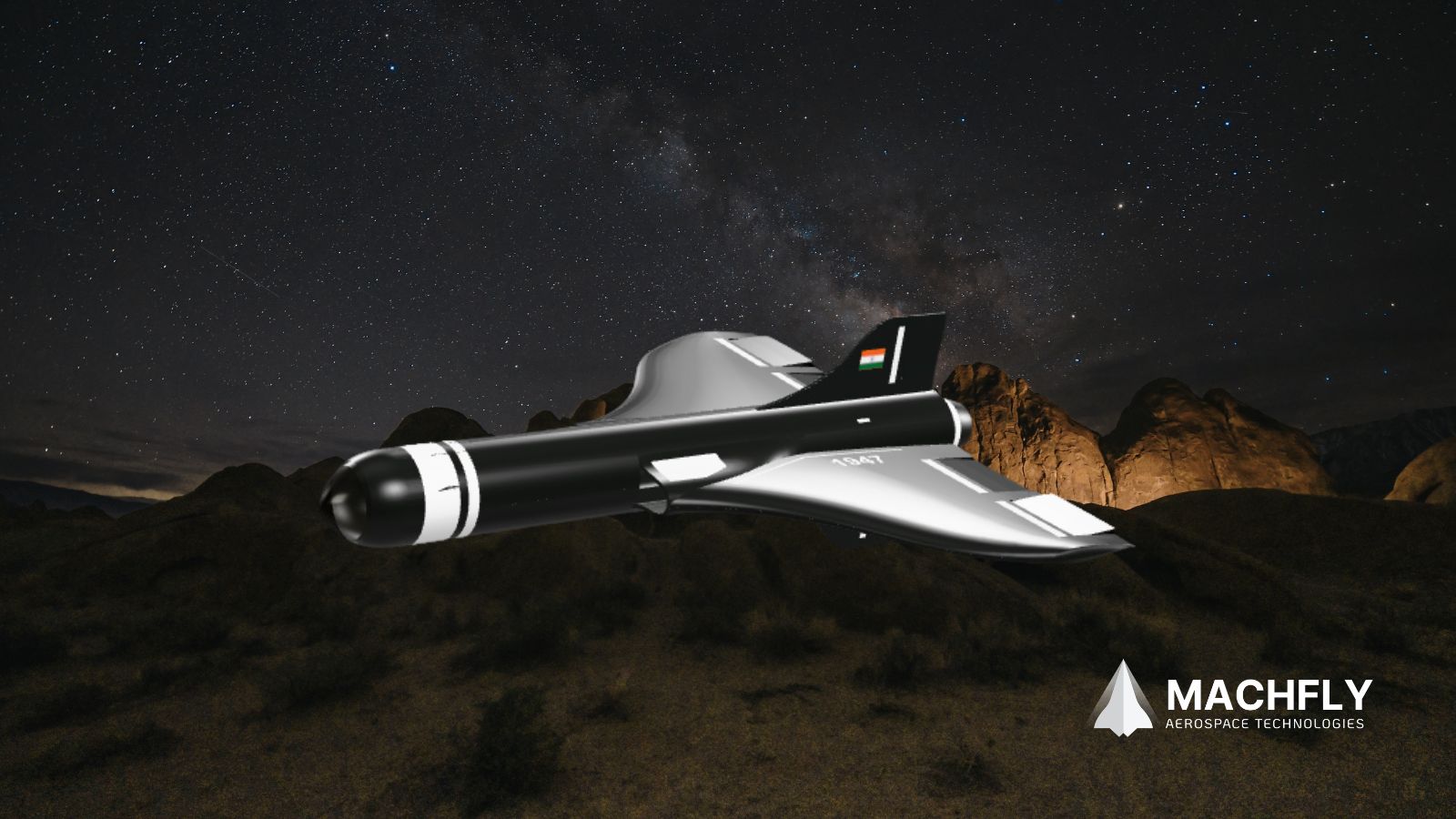
Founded in 2024 and headquartered at the Innovation and Incubation Centre (I3C) of IIT Jammu, Jammu based startup MachFly Aerospace has already briefed senior military commanders, collected a national technology award, and captured the attention of institutional investors — all before most people had heard of it. Its flagship project, SkyReaper, is a reusable unmanned combat aerial vehicle engineered for high-speed, high-altitude, long-range deep-strike missions in contested environments. It can penetrate deep into enemy territory, fly at altitudes of up to 10 km, and reach speeds above 550 km/h. This is not a side-project prototype. It’s a direct challenge to India’s longstanding dependence on imported unmanned combat systems — and a signal that the country’s defence-tech startup wave is maturing fast.
What SkyReaper Really Is: A Jammu Based Startup MachFly Aerospace UCAV Built to Penetrate and Return
SkyReaper is, above all, a recoverable deep strike UAV. That single design choice sets it apart from the crowded field of expendable platforms. Unlike expendable loitering munitions, SkyReaper is a reusable system enabling multiple mission cycles and reducing long-term operational costs. The platform is designed with payload flexibility, allowing it to carry either ISR systems or a warhead payload depending on mission requirements.
The propulsion choice is equally deliberate. The use of a turbojet propulsion system offers higher thrust and speed compared to piston or turboprop engines commonly used in UAVs, enabling rapid ingress and egress from target zones and reducing exposure time to enemy air defences. Speed complicates interception. Operating at higher speeds complicates interception by conventional counter-UAS systems, enhancing survivability in environments where electronic warfare and layered air defences are prevalent.
The platform is designed to reach operational altitudes of up to 10 kilometres, placing it above many short-range air defence threats while maintaining the ability to penetrate contested airspace. That altitude ceiling positions SkyReaper squarely in the domain of high altitude surveillance drones — but with a punch attached. SkyReaper integrates a modular airframe with interchangeable payload bays, enabling operators to configure the platform for surveillance, precision strike, or electronic support missions while reusing the same vehicle across multiple sorties.
Terrain adaptability is baked in. SkyReaper is being designed with a strong emphasis on mission adaptability, allowing it to operate across diverse terrains — from mountainous regions to maritime zones — and under varying threat conditions. For a country with India’s geographic complexity, that flexibility is operationally priceless.
The Engine Behind the Machine: Jammu Based Startup MachFly’s SonicJet and Reusable Military Drone Technology
No serious jet powered combat drone exists without serious propulsion. MachFly Aerospace is developing the MF-100 ‘SonicJet’ engine, a compact 1 kN thrust jet engine designed for drones, missiles, and UCAVs — a significant step in India’s push for indigenous propulsion systems, reducing reliance on imports and enabling advanced unmanned platforms.
A defining feature of the MF-100 programme is its reliance on additive manufacturing — 3D printing — for core components. This slashes lead times and drives down unit costs. MachFly Aerospace also designs fuel-flexible turbojet engines that operate on gaseous fuels like hydrogen and methane as well as conventional jet fuels to align propulsion performance with logistics availability. In field conditions, that flexibility matters enormously. The engine is designed to operate effectively at altitudes of up to 10 kilometres, balancing speed, endurance, and compactness for tactical missions.
This engine-first approach is the backbone of MachFly’s reusable military drone technology philosophy. The company operates from the Propulsion & Energy Research Laboratory (PERL) at IIT Jammu, a 20,000 sq. ft. facility equipped with advanced test rigs and infrastructure for R&D, prototyping, and validation. Its researchers also work through the National Centre for Combustion Research and Development (NCCRD) at IIT Madras — an academic depth that few startups of this age can claim. The result is an indigenous propulsion stack built from first principles, not assembled from imported components.
India’s Drone Arms Race: Why Indigenous Military Drone Development Is No Longer Optional
India’s unmanned systems sector has reached an inflection point. As of 2025, more than 600 firms in India, including private and public sector companies, manufacture drones and associated equipment. The government’s push through programmes such as Drone Shakti, Production-Linked Incentives (PLI), and the Aatmanirbhar Bharat initiative is creating a favourable environment for indigenous military drone development. The government allocated $78.7 billion for defence in 2025-26, representing a substantial 9.5% increase from the previous year.
The iDEX framework supercharged startup participation. Defence Minister Rajnath Singh described iDEX and ADITI as transformative programmes, and since iDEX’s launch in 2018, around 676 startups and innovators have joined the ecosystem, leading to the signing of over 500 contracts. Machfly Aerospace, a participant in the DST-GDC I-NCUBATE Cohort 02, is working on the development of long-range, turbojet-powered unmanned aerial platforms for defence applications.
Hands-on discovery helped the team understand that getting a product adopted by the defence forces is not solely a matter of technical performance — it requires building trust, co-developing solutions in line with user needs, and aligning with procurement protocols and policy frameworks. That realisation shaped Jammu based startup MachFly’s go-to-market strategy, pushing it from a product-first startup toward a co-development partner for India’s armed forces.
The demand signal is unmistakable. The Army has inducted loitering munitions, kamikaze and surveillance drones for over Rs 5,000 crore post-Operation Sindoor from domestic firms. Additional drone procurements with a budget of Rs 3,000 crore were approved by the Defence Acquisition Council in late 2025, and a larger Rs 20,000 crore Fast Track Procurement for drones is likely in 2026. The market pull for indigenous platforms with real combat capability has never been stronger.
Beyond SkyReaper: Jammu Based Startup MachFly, Rudra, and Next Generation Loitering Munitions
SkyReaper may be the headline, but Jammu based startup MachFly Aerospace is building an entire unmanned strike ecosystem. The company also builds Rudra, a barrel-launched loitering munition that utilises a rocket booster for launch and a compact turbojet engine for sustained flight, allowing extended loitering over target areas and controlled engagement instead of single-use ballistic profiles.
Rudra is engineered to deliver several-fold range enhancement without a corresponding increase in cost, and supports salvo launches optimised for deep, BVLOS strike missions in contested environments. Next generation loitering munitions like Rudra represent a strategic evolution: persistent, adaptable, and far harder to defend against than a conventional projectile. Paired with SkyReaper’s recoverable deep strike UAV capability, the two platforms together offer military planners a layered unmanned strike option — high altitude surveillance drones gather intelligence, SkyReaper executes a precise strike, and Rudra provides saturation fire if needed.
Institutional recognition has followed. MachFly Aerospace received the Promising Technology Award from Union Education Minister Dharmendra Pradhan at the Tri-Service Symposium. MachFly Aerospace also briefed its ongoing UCAV and engine technology development to Lt. Gen. N.S. Sarna, Commandant of the School of Artillery, Nashik at IIT Jammu. MachFly Aerospace additionally showcased its full-scale UCAV model to the Minister of Science & Technology, Jitendra Singh. These are not courtesy meetings — they are the precursors to procurement discussions.
Boeing University Innovation Leadership Development and the Institute Incubation and Innovation Council have invested in MachFly Aerospace Technologies — international aerospace credibility lending weight to what a small Jammu-based team has built.
The Bigger Picture: SkyReaper in India’s Evolving UCAV Doctrine
India’s institutional UCAV track runs through DRDO’s Ghatak programme — a stealth flying-wing unmanned combat aerial vehicle that cleared the Defence Procurement Board in March 2026, with recommendations to acquire 60 units. The Technology Perspective and Capability Roadmap cited the possible acquisition of up to 100 stealth UCAVs for the Indian Air Force and up to 50 for the Indian Army. SkyReaper doesn’t compete with Ghatak — it complements it. Ghatak represents the heavy stealth track; SkyReaper is a faster-to-field, cost-effective jet powered combat drone suited for a broader operational envelope.
SkyReaper is intended to be a part of India’s growing push for indigenous defence technologies. It is being developed as a high-altitude, long-range platform for surveillance, reconnaissance, and combat missions, with developers targeting speeds of up to 550 km/h. It could provide the Indian defence ecosystem with a domestically developed reusable combat drone capable of addressing operational requirements traditionally met through imported systems.
The global UAV market is projected to exceed $45 billion by 2030, with persistent platforms gaining prominence. The number of UAV units deployed in India is expected to nearly double during 2025-2030, showcasing strong penetration across industries. Reusable military drone technology with indigenous propulsion, exactly what Jammu based startup MachFly offers, is precisely the value proposition India’s armed forces — and potentially export partners — will prioritize through this decade.
Conclusion
Jammu based startup MachFly Aerospace is proof that India’s defence innovation no longer flows exclusively through legacy institutions. In under two years, a compact IIT Jammu team built a credible jet powered combat drone, a 1 kN indigenous jet engine, and a barrel-launched loitering munition — and placed all of it in front of the military commanders who matter. SkyReaper’s identity as a recoverable deep strike UAV that merges high altitude surveillance drone capability with precision strike roles addresses a gap India has historically filled with costly imports.
The question is no longer whether startups can build serious unmanned combat aerial vehicle systems. Jammu based startup MachFly has answered that. The urgent next question is how quickly India’s procurement machinery will move to match their momentum.
Frequently Asked Questions
What is SkyReaper and who is building it?
Jammu-based defence-tech startup MachFly Aerospace is developing SkyReaper, a reusable jet-powered unmanned combat aerial vehicle (UCAV).Built for speed, altitude, and range, it is designed for long-range, high-altitude, and heavy-payload missions, optimised for deep-strike operations in contested environments.
Who founded MachFly Aerospace and when?
Founded in 2024 and headquartered at the Innovation and Incubation Centre (I3C) of IIT Jammu, MachFly Aerospace was established by Shanmugadas K.P., Ayush Divyansh, Preetam Jamod, and Lal Mohammad Khan.
What makes SkyReaper different from other Indian drones?
SkyReaper is being engineered as a recoverable UCAV powered by a turbojet engine, allowing it to operate at significantly higher speeds compared to conventional propeller-driven drones. The platform is designed to reach operational altitudes of up to 10 kilometres, placing it above many short-range air defence threats. Its reusable architecture also drives down cost per mission across multiple sorties.
What is the MF-100 SonicJet engine?
Jammu-based MachFly Aerospace, in collaboration with IIT Jammu laboratories, is developing the MF-100 ‘SonicJet’ engine — a small-class propulsion system engineered to deliver approximately 1 kN of thrust, making it suitable for high-speed unmanned aerial vehicles, lightweight missile platforms, and loitering munitions.
What is Rudra, and how does it relate to SkyReaper?
Rudra is a barrel-launched loitering munition engineered to deliver several-fold range enhancement without a corresponding increase in cost. It supports salvo launches and is optimised for deep, BVLOS strike missions in contested environments.Together with SkyReaper, it forms a layered unmanned strike ecosystem under the MachFly portfolio.
Has MachFly Aerospace received any institutional recognition?
MachFly Aerospace received the Promising Technology Award from Union Education Minister Dharmendra Pradhan at the Tri-Service Symposium.Boeing University Innovation Leadership Development and the Institute Incubation and Innovation Council have also invested in the company.
Where does MachFly Aerospace conduct its R&D?
The company operates from the Propulsion & Energy Research Laboratory (PERL) at IIT Jammu, a 20,000 sq. ft. facility equipped with advanced test rigs and infrastructure for R&D, prototyping, and validation. It also has research ties to IIT Madras through the National Centre for Combustion Research and Development.