
India’s Revolutionary Labour Codes Transform MSME Operations with Streamlined Compliance and Worker Protection

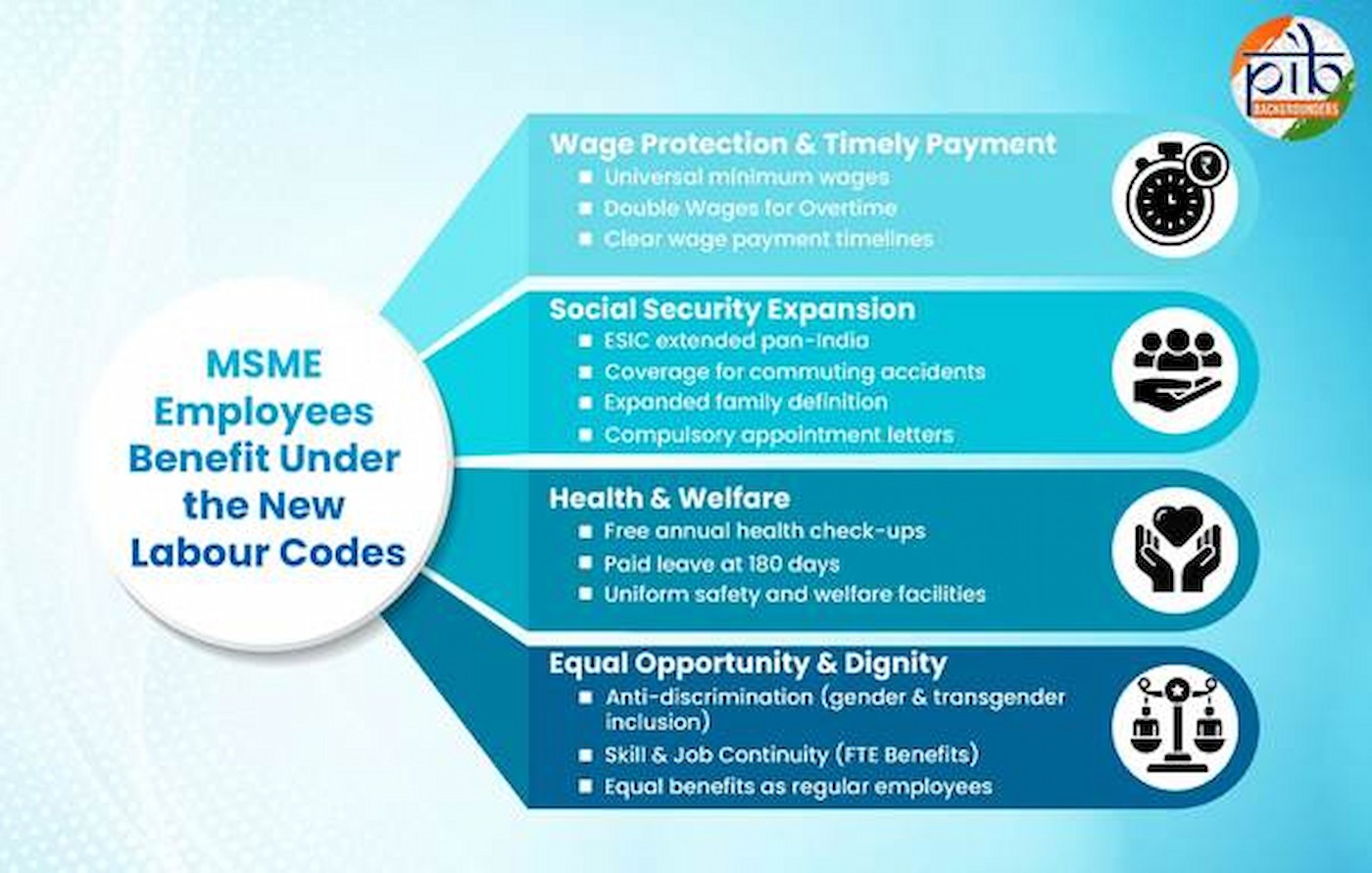
The Government of India has implemented comprehensive labour reforms through new Labour Codes that promise to revolutionize the operational landscape for Micro, Small and Medium Enterprises (MSMEs), which contribute 30.1% to the nation’s GDP and employ 280 million people across 65 million units. These transformative regulations introduce digital-first compliance mechanisms, raise operational thresholds, and establish uniform national standards while significantly enhancing worker welfare and social security provisions.
The new legislative framework addresses decades-old regulatory bottlenecks that have historically burdened small and medium enterprises with complex compliance requirements. Under the reformed system, factory licensing thresholds have doubled from 10 to 20 workers for establishments using power, and from 20 to 40 workers for those operating without power. Additionally, the contract labour licensing requirement now applies only to establishments employing 50 or more workers, up from the previous threshold of 20 workers.
These changes represent a fundamental shift from India’s traditional labour governance model, moving away from punitive enforcement toward facilitative compliance mechanisms. The reforms introduce electronic single registration systems, reduce approval timelines from 90 to 30 days, and implement inspector-cum-facilitator models that replace traditional inspection regimes. Manufacturing output from MSMEs accounts for 35.4% of India’s total production, while the sector generates 45.73% of overall exports, demonstrating the critical importance of these regulatory modernization efforts.
Streamlined Regulatory Framework Reduces Administrative Burden
The new Labour Codes establish a dramatically simplified regulatory environment designed to reduce administrative overhead for small and medium enterprises. Factory licensing procedures now operate under strict 30-day approval timelines, with provisions for deemed permission if authorities fail to respond within prescribed periods. Site appraisal committees must provide recommendations for initial location or expansion of factories involving hazardous processes within 30 days, eliminating previous delays that often extended approval processes by months.
Electronic single registration systems replace multiple licensing requirements, allowing businesses to obtain single all-India licenses valid for five years. This digital transformation eliminates the need for separate registrations across different states and reduces paperwork significantly. The introduction of single return systems further simplifies compliance reporting, enabling businesses to submit unified documentation rather than maintaining multiple regulatory filings.
Contract labour regulations now exempt establishments employing fewer than 50 workers from licensing requirements, providing substantial relief to smaller operations. Previously, businesses with just 20 contract workers faced complex licensing procedures that often proved disproportionately burdensome relative to their operational scale. Third-party audit provisions allow startup establishments and specific business categories to assess health and safety compliance without direct government intervention, promoting self-regulation and reducing inspection frequencies.
Uniform National Standards Replace State-Wise Variations
The establishment of uniform national standards represents a significant advancement for businesses operating across multiple states. A single national tripartite board now advises the Central Government on standards and regulations, replacing six separate boards that previously operated under existing laws. This consolidation eliminates inconsistencies between state-specific requirements that previously forced businesses to navigate different regulatory frameworks in different locations.
Government notifications will establish standardized occupational safety and health requirements for MSME workplaces across India, ensuring consistent application of protective measures regardless of location. This standardization particularly benefits manufacturers and service providers operating multi-state operations, as they can now implement uniform safety protocols and training programs across all facilities.
The inspector-cum-facilitator model introduces randomized, web-based inspection systems designed to reduce traditional “inspector raj” practices. These reformed inspection procedures focus on facilitation rather than punishment, helping establishments improve compliance while raising worker awareness about safety and rights. Inspections become educational opportunities rather than adversarial encounters, promoting voluntary compliance and reducing enforcement-related disputes.
Enhanced Operational Flexibility Through Higher Thresholds
Operational flexibility has increased substantially through revised thresholds for various regulatory requirements. The threshold for layoff, retrenchment, and closure procedures has risen to 300 workers, allowing smaller industrial establishments to restructure operations based on business requirements without complex government approvals. This change provides crucial agility for businesses facing market fluctuations or economic uncertainties.
Standing Orders applicability thresholds have similarly increased from 100 to 300 workers, exempting smaller establishments from certification requirements for workplace rules and procedures. This exemption reduces compliance burdens while allowing businesses to maintain appropriate workplace standards without formal certification processes. Establishments can adapt their operational procedures more quickly to changing business conditions without waiting for government approvals.
Fixed-term employment provisions offer additional operational flexibility by allowing businesses to hire workers for seasonal or project-based requirements without long-term employment commitments. This arrangement benefits both employers and workers by providing formal employment contracts with legal protections while maintaining employment duration predictability. Recent employment data indicates that formal employment arrangements improve worker security and reduce informal labour dependencies.
Decriminalization and Compliance-Oriented Enforcement
The new framework emphasizes compliance over punishment through comprehensive decriminalization of various offences. First-time violations punishable only by fines become compoundable through payment of 50% of maximum penalties, while offences involving potential imprisonment become compoundable at 75% of maximum fines. Criminal penalties have largely been replaced with civil monetary penalties, reducing litigation risks for businesses.
Mandatory 30-day compliance notices must be provided before legal action, giving employers opportunities to correct violations before facing penalties. This grace period promotes voluntary compliance and reduces adversarial relationships between regulators and businesses. Several previously criminal offences have been reclassified as civil violations, significantly reducing prosecution fears that often deterred business expansion.
Electronic record-keeping requirements replace extensive paperwork obligations, allowing all registers and documents to be maintained digitally. This digital-first approach reduces administrative burdens while improving record accuracy and accessibility. Businesses can now maintain comprehensive compliance documentation without physical storage requirements or manual filing systems.
Comprehensive Social Security and Worker Welfare Reforms
Worker protection measures have expanded significantly under the new Labour Codes, with universal minimum wage coverage extending to all employees regardless of employment type or sector. Previously, minimum wage protections applied only to scheduled employments, leaving many workers without wage security. The reformed system requires regular wage reviews at intervals not exceeding five years, ensuring wage levels remain aligned with economic conditions.
Floor wage mechanisms will establish minimum living standards considerations, including food and clothing costs, reducing labour migration between states due to wage disparities. Overtime compensation requirements mandate double normal wage rates for work beyond regular hours, providing additional income protection for workers during peak demand periods. Ministry of Labour statistics show that standardized wage structures improve worker retention and productivity.
Bonus provisions now apply to all eligible employees who work at least 30 days annually, with payments ranging from minimum 8.33% to maximum 20% of annual wages. Timely payment requirements have been strengthened with specific deadlines for different employee categories, from end-of-shift payments for daily workers to seven-day limits for monthly employees. The limitation period for filing wage claims has been extended to three years, providing workers with longer periods to seek redress for wage violations.
Employee State Insurance Corporation (ESIC) coverage has been extended nationwide, removing previous geographic restrictions that limited access to medical benefits. Voluntary membership options are now available for establishments with fewer than 10 employees, allowing smaller businesses to provide comprehensive medical coverage for their workers. Family definition expansions now include parents-in-law for female employees, based on prescribed income levels, broadening dependent coverage for medical and other benefits.
Worker Re-skilling and Career Development Initiatives
The establishment of worker re-skilling funds represents a significant advancement in employment transition support. Employers must contribute 15 days’ wages to re-skilling funds within 45 days of worker retrenchment, creating financial resources for skills development and job placement assistance. This provision ensures that employment transitions include support mechanisms for affected workers rather than leaving them without assistance.
Fixed-term employment arrangements provide equal benefits to regular employees, including wages, working hours, allowances, leave entitlements, and social security coverage. These formal contracts replace informal employment relationships with legally protected arrangements that ensure worker rights while providing employment flexibility for businesses. Workers gain access to Provident Fund, Employee State Insurance, and bonus benefits regardless of employment duration.
Skill enhancement opportunities increase through multiple contract engagements across different sectors, allowing workers to gain diverse experience and capabilities. Predictable employment tenure reduces exploitation risks by establishing clear contract terms, duration, and compensation structures upfront. Performance-based absorption into regular employment provides career advancement pathways from fixed-term to permanent positions with enhanced benefits and job security.
Digital Transformation and Process Modernization
Electronic systems integration represents a fundamental shift toward digital-first governance in labour administration. Single registration portals eliminate multiple application requirements, while deemed approval provisions ensure timely processing even when authorities face processing delays. Five-year license validity periods reduce renewal frequencies and associated administrative costs for businesses.
Self-assessment mechanisms for construction cess allow employers to evaluate costs independently and pay applicable charges without extensive bureaucratic procedures. This approach reduces processing delays while ensuring compliance with construction worker welfare fund requirements. Digital record-keeping capabilities enable real-time compliance monitoring and simplified audit procedures.
Third-party certification systems provide alternative compliance verification methods that reduce direct government intervention while maintaining safety and welfare standards. Startup establishments can utilize private certification agencies to demonstrate compliance with health and safety requirements, reducing inspection frequencies and government processing burdens.
Long-term Economic Impact and Growth Prospects
The comprehensive labour reforms are designed to support India’s economic development goals while ensuring worker welfare and protection. By simplifying compliance procedures and reducing regulatory burdens, the new framework enables MSMEs to focus resources on growth and innovation rather than administrative compliance. Uniform national standards facilitate business expansion across state boundaries without navigating different regulatory requirements.
Enhanced worker protections improve employment security and workplace conditions, potentially increasing productivity and reducing turnover rates. Universal minimum wage coverage and expanded social security benefits create more stable employment relationships while ensuring basic living standards for all workers. The balance between operational flexibility and worker protection aims to promote sustainable business growth while maintaining social equity.
Economic research suggests that streamlined regulations and improved worker welfare create positive feedback loops that support both business competitiveness and employment quality. The reforms align with India’s broader economic development strategy, supporting the vision of achieving developed nation status by 2047 through inclusive growth that benefits both entrepreneurs and workers.
Frequently Asked Questions
What are the main benefits of the new Labour Codes for MSMEs?
The new Labour Codes provide MSMEs with streamlined compliance through higher operational thresholds, digital registration systems, reduced approval timelines from 90 to 30 days, and simplified contract labour requirements that now apply only to establishments with 50+ workers.
How do the uniform national standards impact multi-state MSME operations?
Uniform national standards eliminate state-wise regulatory variations, allowing MSMEs to implement consistent safety protocols and compliance procedures across all locations. A single national tripartite board now provides unified guidance, replacing six separate state boards.
What changes have been made to factory licensing requirements?
Factory licensing thresholds have doubled from 10 to 20 workers for establishments using power and from 20 to 40 workers for those without power. Approval timelines are now limited to 30 days with deemed permission provisions if authorities fail to respond timely.
How does fixed-term employment benefit both employers and workers?
Fixed-term employment allows employers operational flexibility for seasonal or project-based hiring while providing workers with formal contracts, equal benefits to regular employees, and access to PF, ESI, and bonus benefits with predictable employment terms.
What worker welfare improvements are included in the new Labour Codes?
Workers now receive universal minimum wage coverage, extended ESIC coverage nationwide, bonus payments for all eligible employees working 30+ days annually, extended claim periods to three years, and mandatory re-skilling fund contributions during retrenchments.
How have inspection procedures changed under the new framework?
Traditional inspectors are replaced with inspector-cum-facilitators using randomized web-based systems. Inspections focus on facilitation rather than punishment, with third-party audit options available for startups and specific establishment categories.
What decriminalization measures reduce business risks under the new Codes?
First-time offences are compoundable at 50% of maximum fines, while imprisonment-eligible offences are compoundable at 75%. Criminal penalties are largely replaced with civil monetary fines, and mandatory 30-day compliance notices must be provided before legal action.