

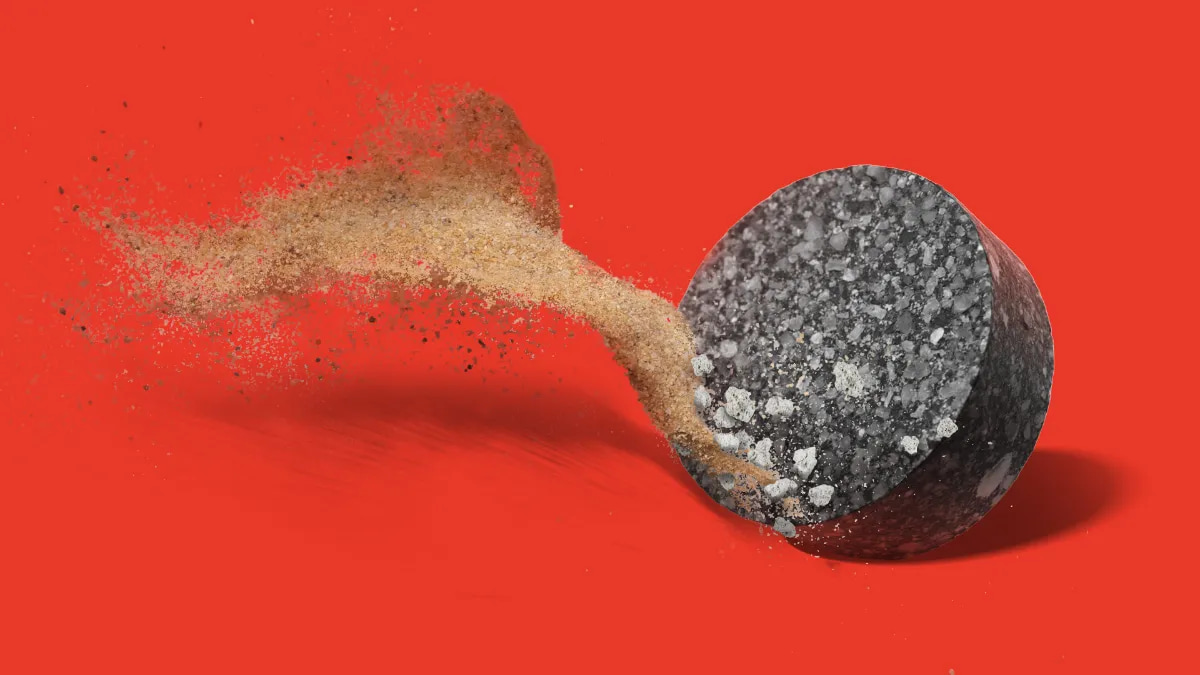
Honda Motor Co., Ltd. announced the establishment of PathAhead Co., Ltd., a startup born directly from Honda’s IGNITION business creation program, with a singular mission: commercializing a road material made from desert sand at industrial scale for the very first time in history. This isn’t a minor materials update. It’s a direct challenge to one of infrastructure’s most stubborn paradoxes — the world has more desert sand than it could ever conceivably use, yet faces a desperate shortage of the specific kind of sand needed to build its roads.
The Grand Paradox: Why Road Material Made from Desert Sand Has Never Been Done
Walk across the Sahara or the Arabian Peninsula and the scale of available sand looks infinite. Yet sand is the second most consumed resource on Earth after water, and construction alone devours roughly 40 to 50 billion tons of it annually. That golden desert sand? Virtually useless to road engineers. The reason comes down to grain shape. Desert sand grains are eroded by wind rather than by water, leaving them too smooth and rounded to interlock into the load-bearing aggregate that asphalt and concrete require. Construction demands angular grains — the kind dug from riverbeds, quarries, and coastlines at significant environmental cost.
Understanding desert sand concrete properties makes this challenge clear. Research confirms that desert sand’s fine, uniform grain structure and low cohesion cause it to fail under repeated traffic stress in standard road applications. Its high silica content keeps it chemically stable, but stability alone doesn’t create structural durability under heavy loads. A 2023 ScienceDirect study found that desert sand requires careful treatment with supplementary cementitious materials before it can function as reliable fine aggregate — and even then, commercially viable road applications have remained frustratingly out of reach. PathAhead is working to break through that ceiling with a proprietary process designed specifically for asphalt-grade aggregate production from raw dune sand.
The Sand Crisis Fueling Demand for Alternative Sand for Construction
The stakes here go far beyond construction costs. The global rate of sand use has tripled over the last two decades, driven by relentless urbanization across Asia and Africa. Rivers are stripped bare. Coastlines erode faster than developers can build. The IMF has documented that roughly half of the estimated 40 billion metric tons of sand and gravel extracted every year will never be naturally replenished — the process of erosion that creates it simply can’t keep pace with demand.
Prices betray the shortage. The price of gravel and sand has more than quintupled since 1978, and construction sand and gravel prices have risen 8.4% year on year since 2020, accumulating to nearly 30% in total. Natural replenishment by river and glacial weathering occurs at roughly 12.6 billion tons per year. The world uses over three times that amount. That math has no sustainable ending.
The hunt for alternative sand for construction has intensified in direct response. Crushed manufactured sand, recycled demolition aggregate, industrial byproducts like fly ash and steel slag — all have been trialled with mixed results. Recycled aggregate in asphalt mixes has gained commercial traction in parts of Europe. But viable desert sand aggregate for road surfaces has stayed frustratingly beyond reach, which is precisely the opening PathAhead is moving through.
How Honda’s IGNITION Program Built a Green Road Building Technology Startup
PathAhead didn’t emerge from a university lab or a traditional VC funding cycle. It comes directly from Honda’s IGNITION program, a new business creation initiative Honda launched in 2017, originally targeting its own R&D associates at Honda R&D Co., Ltd. The program expanded to all Honda employees in Japan by 2021, and in November 2023 opened to outside startups and individuals in Japan at the seed stage — reflecting Honda’s growing commitment to co-creating solutions for large societal challenges beyond its core automotive business.
IGNITION participants who pass the first evaluation round receive structured mentorship from Honda specialists in technology development, design, and business development over a six-month to one-year period. Those who pass the second round and a corporate venturing consultation can choose to establish independent companies. PathAhead cleared those evaluations and incorporated as an independent company on March 31, 2026 — a dedicated green road building technology company carrying Honda’s institutional knowledge and networks into a wide-open commercial frontier.
This model — legacy industrial corporations incubating low carbon infrastructure startups with genuine commercial independence — is gaining global momentum. Holcim, reviewing construction innovations for 2026, noted that the challenge is “no longer proving that sustainable construction is possible, but accelerating its adoption.” PathAhead arrives at exactly that inflection point, backed by the engineering credibility of one of the world’s largest mobility companies.
Road Material Made from Desert Sand: What the Research Foundation Shows
PathAhead isn’t building from scratch. It’s attempting to commercialize what scientists have edged toward for years. Researchers at NTNU and the University of Tokyo published work in early 2026 on a prototype material called botanical sand concrete — combining desert sand with powdered wood under high heat and pressure, using wood’s natural lignin as a binder in place of cement. The experiment demonstrated that desert sand concrete properties can be engineered to meet construction-grade standards. New Atlas covered the same NTNU research, noting the team had developed “a method to transform it into a new construction material that’s perfect for pavements.”
Separately, Finite — a startup from Imperial College London — developed a biodegradable composite from desert sand as an eco friendly paving solution alternative to conventional concrete. It proved commercial appetite for this material category exists. PathAhead’s differentiation appears to lie in targeting asphalt aggregate specifically — using desert sand not as a cement substitute but as the aggregate component inside an asphalt mix. Recycled aggregate in asphalt applications already has commercial precedent using crushed concrete or industrial byproducts; PathAhead would add desert sand as a new source material, potentially far more abundant than any recycled industrial waste stream available today.
Eco Friendly Paving Solutions at Scale: The Global Opportunity
The markets where PathAhead’s technology would have the most impact are, almost by definition, where desert sand is most abundant. Road infrastructure investment is surging across the Middle East, North Africa, and Central Asia — regions that simultaneously possess vast dune sand reserves and face acute shortages of conventional construction-grade aggregate.
Deploying eco friendly paving solutions based on locally available desert aggregate changes the economics of road building fundamentally in these regions:
- Carbon impact: Concrete production currently accounts for around 8% of global CO₂ emissions. Reducing reliance on cement-intensive road construction and long-haul sand logistics cuts that carbon footprint meaningfully.
- Cost: Sourcing alternative sand for construction locally slashes material transport costs in regions where construction-grade sand is scarce, regulated, or controlled by illegal markets.
- Access: In desert-heavy developing nations, this technology could unlock road-building programs that were previously economically prohibitive.
- Environmental relief: Slowing river and coastal sand extraction reduces the erosion, delta sinking, and habitat destruction that UNEP has repeatedly flagged as reaching critical thresholds globally.
Green road building technology rarely targets the problem this upstream. By turning an abundant, underutilized resource into viable aggregate, PathAhead sidesteps most of the supply chain constraints that limit other approaches — recycled aggregate in asphalt depends on existing demolition waste streams; botanical binders depend on plant biomass supply. Desert sand just sits there, waiting.
The Competitive Landscape and PathAhead’s Path Forward
PathAhead enters a growing field of low carbon infrastructure startups, but with a distinctive angle. Y Combinator-backed climate ventures are developing carbon-negative road materials using bio-binders and recycled aggregate in asphalt formulas. StartUs Insights tracks a global cluster of green building materials startups working on cement-free alternatives, circular aggregate systems, and low-carbon concrete variants. PathAhead’s differentiation is the source material: desert sand, the most abundant and least-industrialized granular resource on the planet.
Turning a validated concept into commercially deployed green road building technology requires meeting national road construction standards, proving long-term durability under real traffic loads, and building relationships with road contractors and infrastructure procurement agencies. None of that is quick or simple. The tailwinds are undeniable, though. The construction sector’s annual sand demand is projected to reach 4.6 billion tonnes by 2060, concentrated in Africa and Asia — exactly PathAhead’s target geography.
Honda’s IGNITION program has already produced spinoffs operating independently in mobility and logistics. PathAhead follows that same model, with the ambition to prove a road material made from desert sand can move from startup concept to global supply chain. If it succeeds, it won’t just validate a materials science breakthrough. It will demonstrate that the most abundant resources in the most infrastructure-hungry regions can become the literal foundation of a more sustainable world.
Frequently Asked Questions
What is PathAhead Co., Ltd. and when was it established?
PathAhead Co., Ltd. is a startup established by Honda Motor Co., Ltd. on March 31, 2026. It originated from Honda’s IGNITION business creation program and is focused on commercializing road material made from desert sand — positioning it as a first-of-its-kind solution in sustainable infrastructure.
Why is desert sand normally unsuitable for road construction or concrete?
Desert sand grains are smoothed by wind erosion over time, making them too rounded to interlock and form stable construction materials. Standard asphalt and concrete require angular-grained sand — typically sourced from riverbeds, quarries, or coastlines — that can physically bind together and bear structural loads. Understanding desert sand concrete properties makes clear why this has been such a persistent engineering challenge.
What is Honda’s IGNITION program and how did it produce PathAhead?
Honda launched the IGNITION program in 2017 to help associates develop original ideas into real businesses, with a focus on themes like carbon neutrality and production technology. In 2023, Honda expanded IGNITION eligibility to any individual or startup in Japan at the seed stage. Participants who pass two rounds of evaluation can establish independent companies with Honda’s ongoing support — which is exactly how PathAhead came into existence.
How serious is the global construction sand shortage?
It is a documented and accelerating crisis. The world consumes roughly 40 to 50 billion tons of sand annually for construction, while natural replenishment occurs at approximately 12.6 billion tons per year. This means humanity is using over three times what the Earth replaces. Construction sand and gravel prices have risen around 8.4% per year since 2020, and the IMF has noted that roughly half of all sand and gravel extracted every year will never be replenished.
Are there other startups working on desert sand construction materials?
Yes. Finite, developed by researchers from Imperial College London, created a biodegradable composite from desert sand as a concrete alternative. Researchers at NTNU and the University of Tokyo released prototype work on botanical sand concrete in early 2026, combining desert sand with wood powder under heat and pressure. PathAhead is specifically targeting road-grade asphalt aggregate — a more demanding and commercially impactful application than either of these precursors.
What environmental benefit could commercializing desert sand aggregate provide?
Using desert sand as alternative sand for construction would reduce the need to mine construction-grade sand from riverbeds, coastlines, and ocean floors — activities that cause habitat destruction, coastal erosion, and ecosystem collapse. It would also lower the carbon footprint of road construction, since concrete and asphalt production currently account for a significant share of the roughly 8% of global CO₂ emissions attributed to the construction industry.
Where is PathAhead’s technology most likely to be applied first?
The most likely initial markets are arid regions with both abundant desert sand and urgent road infrastructure needs — the Middle East, North Africa, Sub-Saharan Africa, and Central Asia. These regions face the sharpest constraints around conventional construction aggregate supply and stand to benefit most from locally sourced eco friendly paving solutions based on desert sand.