
Las Vegas Startup Cracks Continuous Blood Pressure Monitoring — Here’s How

Key Takeaways
- The device: A soft, stretchable skin sticker that delivers beat-to-beat blood pressure data wirelessly, without needles or cuffs
- Clinical validation: Tested on over 600 patients across ~8 hospitals; matched arterial line accuracy in operating rooms
- Immediate target: Surgical settings awaiting FDA 510 clearance
- Next frontier: Sleep apnea monitoring and broader home health integration
- Backers: Samsung, Y Combinator, MedTech Innovator, Desert Forge Ventures
- Home base: Roseman Bioventures, Las Vegas — one of the largest life science incubators in the Intermountain West
Cardiovascular diseases are the leading cause of death globally, taking an estimated 19.8 million lives each year — and the root problem behind most of those deaths is a vital sign that modern medicine still struggles to track properly. An estimated 1.4 billion adults aged 30–79 years worldwide had hypertension in 2024, representing 33% of the population in that age range. Yet the tool used to catch it — a squeezing arm cuff — hasn’t meaningfully changed since the 19th century. That’s the gap a Las Vegas-based startup called Vena Vitals is now closing, and clinicians across the country are paying very close attention. Vena Vitals, which launched out of the University of California, Irvine, and is incubating at Roseman Bioventures, makes a wearable device that monitors blood pressure continuously — a previously elusive method in the field of blood pressure monitoring.
What Makes Continuous Blood Pressure Monitoring the “Holy Grail”?
The holy grail of health monitoring is to create a blood pressure monitoring system that is wearable and can give a person an accurate readout of their blood pressure at any time. Doctors have coveted this capability for decades. The problem is simple but ruthless: blood pressure is dynamic. It swings with every heartbeat, every breath, every emotional shift. A single cuff reading at a clinic captures nothing but that one frozen moment.
“This is a massive unmet need in healthcare,” Vena Vitals CEO Ray Liu says. “Our blood pressures are constantly changing, but we only get snapshots in time using uncomfortable cuff compressions, or we need risky invasive procedures to track real-time changes.” That second option — the arterial line — is the current gold standard in ICUs, but it requires a needle inserted directly into an artery. Useful in a hospital. Completely impractical at home.
Instead of the cuff that gives only snapshots in time, Vena Vitals is able to track real-time changes in blood pressure that can be used in a number of different applications. That’s the promise of true non invasive blood pressure measurement — and it’s what the company’s paper-thin sticker delivers.
How the Technology Works: A Sticker That Rivals an ICU
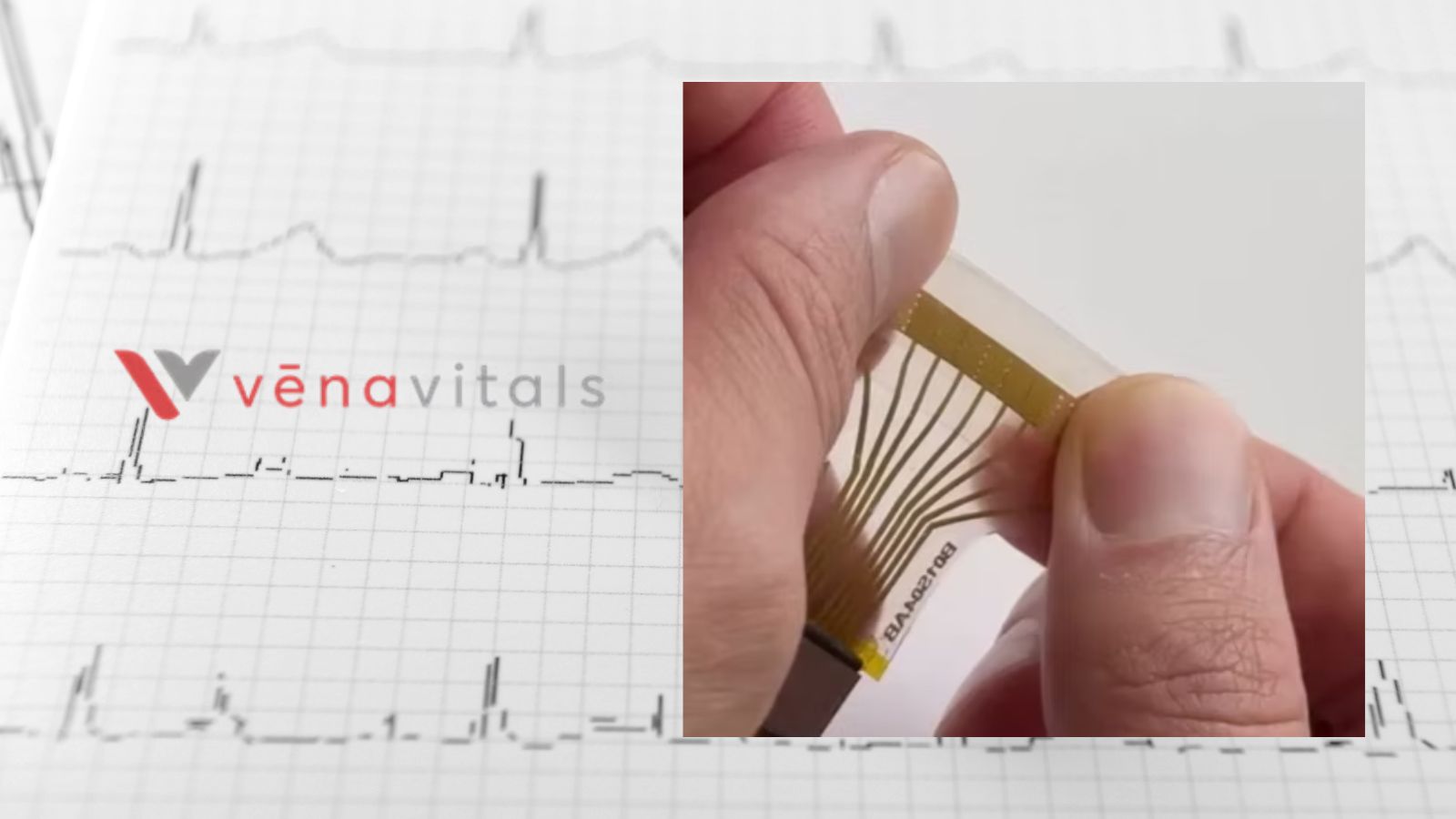
Vena Vitals’ device works by sensing the tiny changes in pressure on the skin caused by blood pulsing through the arteries. As each beat compresses the sensor, it produces a signal. If blood pressure rises, the signal intensifies. If it falls, the signal dampens. Proprietary algorithms interpret this data in real time. The entire package — soft, stretchable, and no bigger than a small bandage — adheres directly over a palpable artery.
The wearable device consists of a soft, stretchable sensor, which is encapsulated in a small sticker. Data travels wirelessly. The electronics module sends data via Bluetooth to your phone or tablet so you’re able to track it. No wires. No cuff. No needle. Just real time blood pressure tracking, transmitted beat by beat.
Vena Vitals began focusing on surgical settings, where continuous blood pressure is essential. In clinical trials, their device was placed on the foot — a location that is out of the surgical field but still over a pulse location — and transmitted data via Bluetooth to a tablet. The results turned heads in operating rooms nationwide.
The results were striking. Side-by-side with arterial lines, the gold standard in the industry, the Vena Vitals device matched rapid blood pressure changes almost perfectly. Anesthesiologists took notice and saw the potential. “They told us this could really change how they manage patients,” says Liu.
The Clinical Stakes: Why Surgery Needs This Now
The consequences of losing blood pressure data mid-surgery aren’t abstract. Let’s say in a surgery a surgeon makes an incision and accidentally hits something and the patient is bleeding out — the blood pressure is tanking. They need to know right away so they can better treat the patient. If they’re only getting a cuff reading every five minutes, a lot can happen in between those five-minute intervals. It makes a big difference to be able to have continuous data.
The tech has already been tested on more than 600 patients in operating rooms across the country and is now moving toward FDA clearance for hospital use. That’s not a proof-of-concept. That’s a clinical track record. Vena Vitals has conducted clinical studies at about eight hospitals nationwide. “We’ve collected a lot of data already, about 600 patients across the country,” Liu said. “We show really, really strong clinical data. That’s one of the key advantages we have.”
As a wearable blood pressure device intended for clinical environments, the Vena Vitals sticker is being evaluated for FDA 510 clearance. On the timeline, Liu acknowledged: “It’s hard to predict because the FDA is backed up quite a lot. But it should be soon. We’re hoping within the next few months.”
From the OR to the Bedroom: Sleep Apnea’s Hidden Blood Pressure Threat
The company’s ambitions extend well beyond the operating room. Sleep apnea affects more than a billion people worldwide, yet most people don’t know they have it. The condition causes the body to stop breathing temporarily during sleep, triggering spikes in blood pressure as the body scrambles to recover lost oxygen. Over time, these repeated surges can put enormous strain on the heart, brain, and kidneys.
Home sleep monitoring is critically important because nearly a billion people worldwide suffer from sleep disorders. It’s actually as prevalent as cardiovascular disease, but the tools for monitoring sleep are very limited and sleep apnea is severely under-diagnosed. One of the things that blood pressure monitoring can bring is the ability to track whenever you have an apneic event.
Cuffless blood pressure monitoring in sleep settings is something no commercially available consumer device has cracked. Vena Vitals claims to be “the first and only technology that can quantify the magnitude of blood pressure spikes immediately after apneic events.” That, Liu says, “gives doctors a whole new way to assess how severe the condition really is.” That’s not just an incremental improvement — it’s an entirely new diagnostic lens.
The company sees this as a technology so game-changing that it’s going to be ubiquitous: every sleep test is going to require it and every surgery may utilize it.
Who’s Backing Vena Vitals — and Why It Matters
This isn’t a garage startup. Vena Vitals, a late seed stage company getting ready for Series A funding, has received investments from Samsung, as well as support from two of the world’s top accelerators: MedTech Innovator and Y Combinator. That combination — a consumer electronics giant and the world’s most selective startup program — signals that the technology has passed serious technical and commercial scrutiny.
Founded by Ray Liu, Michelle Khine, and Josh Kim — veterans in health tech with multiple successful exits — the team has built products that have scaled to over 2 million users. Their innovation has earned them top honors, including the 2020 MedTech Innovator Execution Award and the AdvaMed Accel Virginia Shimer Rybski Memorial Award.
The idea originated from technology developed during a PhD project at the University of California, Irvine, focusing on non invasive blood pressure measurement using soft, stretchable sensors that adhere to the skin over palpable arteries. That academic DNA is still part of the company’s DNA today. Of the company’s 14 employees, nine are UC Irvine alumni, including five Ph.D.s.
Las Vegas: An Unlikely Hub for MedTech Innovation
Why Las Vegas? The company has been working in a lab on Roseman University’s campus in Summerlin for the last two years, after it was recruited to Southern Nevada by the Las Vegas Global Economic Alliance and the Nevada Governor’s Office of Economic Development, and received investment from Desert Forge Ventures.
The facility housing Vena Vitals is itself a landmark. Roseman Bioventures launched with the goal of accelerating the translation of scientific breakthroughs into therapies and technologies that advance health. Located on Roseman’s Summerlin campus, the 120,000-square-foot facility serves as one of the largest dedicated life science incubators in the Intermountain West, providing startups with turnkey laboratories, research infrastructure, regulatory guidance, and connections to investors and industry partners.
“Vena Vitals is exactly what we want to see in our Las Vegas ecosystem,” said Jeff Talbot, Roseman’s vice president for research. “In the space of less than two years, you’re seeing a company that’s attracted to the area, gets investment here in Nevada and now it’s going to be benefiting the lives of Nevada patients.”
The Broader Market: Continuous Cardiovascular Monitoring Goes Mainstream
The timing is no accident. The global remote patient monitoring system market was estimated at $22.03 billion in 2024 and is projected to reach $110.71 billion by 2033. The demand for remote patient monitoring devices — which enable physicians to track vitals outside clinical settings — is surging on the back of aging populations and rising rates of chronic disease.
The number of adults with hypertension increased from 650 million in 1990 to 1.4 billion in 2024, with the increase seen largely in low- and middle-income countries. That explosion in unmanaged hypertension is precisely the environment in which continuous cardiovascular monitoring technology becomes not just useful, but essential. Hypertension is a leading cause of heart attack, stroke, chronic kidney disease, and dementia — and without urgent action, millions of people will continue to die prematurely.
Consumer wearables are already pushing into this space. From their humble beginnings as step counters and notification hubs, smartwatches and wearables have evolved into tech-packed powerhouses with sensors that spot irregular heart rhythms, estimate blood oxygen saturation, and track sleep patterns. Today’s latest hardware now adds the ability to flag potential hypertension risks. But none of those devices deliver the clinical-grade, beat-to-beat accuracy that hospital care demands — which is exactly where Vena Vitals intends to plant its flag first.
What Comes Next for Vena Vitals
The path forward runs through two parallel lanes. On the clinical side, FDA clearance for surgical monitoring is the immediate priority. On the consumer side, the long-term vision is integration of cuffless blood pressure monitoring into everyday life — sleep testing kits, home monitoring patches, and potentially even consumer wearables. With a mission to democratize access to continuous cardiovascular monitoring, Vena Vitals is redefining how we understand and manage blood pressure — one sticker at a time.
The signal from the market is already loud. Physicians who’ve reviewed the clinical data are enthusiastic. Investors from Samsung to Y Combinator have put money behind it. And a city better known for casinos is quietly becoming a credible address for life-saving innovation.
If Vena Vitals clears the FDA and scales commercially, continuous cardiovascular monitoring could shift from a rare ICU privilege to a routine part of surgical care and home health management. That’s a long way from a sticker — but it’s exactly where this technology appears to be headed.
Frequently Asked Questions
What is continuous blood pressure monitoring, and why is it difficult to achieve without a cuff?
Continuous blood pressure monitoring means measuring blood pressure beat by beat without interruption, as opposed to periodic snapshots taken by a traditional arm cuff. It’s difficult to achieve non-invasively because the cardiovascular system produces subtle, highly dynamic signals that require precision sensors and advanced signal processing to interpret accurately. Current clinical alternatives — like arterial lines — are invasive and impractical outside hospitals.
Who founded Vena Vitals and where did the technology originate?
Vena Vitals was founded in 2019 by Ray Liu, Michelle Khine, and Josh Kim. The underlying technology was developed through doctoral research at the University of California, Irvine, where Michelle Khine is a professor in the Department of Biomedical Engineering. Nine of the company’s fourteen employees are UC Irvine alumni.
How does the Vena Vitals wearable blood pressure device work?
The device is a small, flexible sticker placed over a palpable artery. It senses microscopic changes in skin pressure caused by blood pulsing through the arteries with each heartbeat. Proprietary algorithms convert those signals into real-time blood pressure readings, which are transmitted via Bluetooth to a phone or tablet.
Has the device been clinically validated?
Yes. Vena Vitals has completed clinical studies across approximately eight hospitals in the United States, collecting data from more than 600 patients in operating room settings. In those trials, the device’s readings were compared side by side with arterial lines — the gold standard for intraoperative monitoring — and matched their accuracy for tracking rapid blood pressure changes.
What is the current regulatory status of the Vena Vitals device?
As of mid-2026, Vena Vitals is pursuing FDA 510(k) clearance for hospital use, specifically targeting surgical monitoring as its first indication. The company has stated it expects clearance within the coming months, though exact timelines depend on the FDA’s review schedule.
Can this technology help with sleep apnea diagnosis?
Yes, and this is one of the company’s most compelling secondary applications. Blood pressure spikes sharply during apneic events — moments when breathing stops during sleep. Because the Vena Vitals sensor captures beat-to-beat changes, it can detect and quantify those spikes in real time, giving clinicians a new, objective measure of sleep apnea severity that standard sleep studies don’t currently provide.
Why does accurate real-time blood pressure tracking matter for surgery?
Blood pressure during surgery can change extremely rapidly — for example, if a patient starts bleeding internally. A standard cuff reading every five minutes means clinicians may not detect a dangerous drop for several minutes after it occurs. Continuous, real-time data allows surgical teams to respond immediately, potentially preventing life-threatening complications before they escalate.