
Black Forest Labs Secures $300M Series B: How Open-Source AI Startup Reached $3.25B Valuation

The artificial intelligence landscape experienced another seismic shift yesterday. German AI lab Black Forest Labs announced a staggering $300 million Series B funding round that values the company at $3.25 billion. This funding milestone represents more than just another tech success story—it signals the growing dominance of AI image generation in the broader technology ecosystem.
What makes this Black Forest Labs funding particularly remarkable is the company’s trajectory. They’re revolutionizing how we create and manipulate visual content. Black Forest Labs, which makes foundation AI models for generating and editing images, has risen to fame quickly since its launch in August 2024. The speed of their ascent reflects the urgent market demand for sophisticated visual AI technologies.
The Powerhouse Investor Coalition Behind This Black Forest Labs Funding Round
The round was co-led by Salesforce Ventures and Anjney Midha (AMP), and saw participation from a16z, NVIDIA, Northzone, Creandum, Earlybird VC, BroadLight Capital, General Catalyst, Temasek, Bain Capital Ventures, Air Street Capital, Visionaries Club, Canva, and Figma Ventures. Such an impressive lineup of investors demonstrates unprecedented confidence in the visual AI sector.
This Salesforce Ventures AI investment brings significant strategic value beyond capital. Salesforce’s enterprise customer base provides Black Forest Labs with direct pathways to scale their technology across Fortune 500 companies. Meanwhile, NVIDIA’s participation strengthens the hardware-software synergy that’s crucial for AI model development and deployment.
The round brings total capital raised to more than $450 million. However, this represents only the latest chapter in what industry observers describe as an unprecedented funding environment for AI startups.
Understanding the AI Funding Boom of 2025
The broader context surrounding this Black Forest Labs funding reveals staggering industry trends. As we enter near the final month of the year, 2025 has already matched 2024 in terms of companies raising rounds that are $100 million and larger. Furthermore, funding to AI startups totaled $116 billion in the first half of 2025, which was greater than the total investor spend in 2024.
These numbers aren’t just impressive—they’re historically unprecedented. Nearly half — 46% — of startup funding globally in Q3 went to AI companies, with almost a third going to a single company: Anthropic, which raised $13 billion last quarter. This concentration demonstrates how venture capital has shifted dramatically toward AI-first companies.
The mega-round trend continues to accelerate. AI has also skewed investment heavily toward megarounds, with an astonishing 60% of global and 70% of U.S. venture capital going to $100 million-plus rounds. This Black Forest Labs funding sits perfectly within this broader pattern.
What Powers Black Forest Labs: The FLUX Technology Revolution
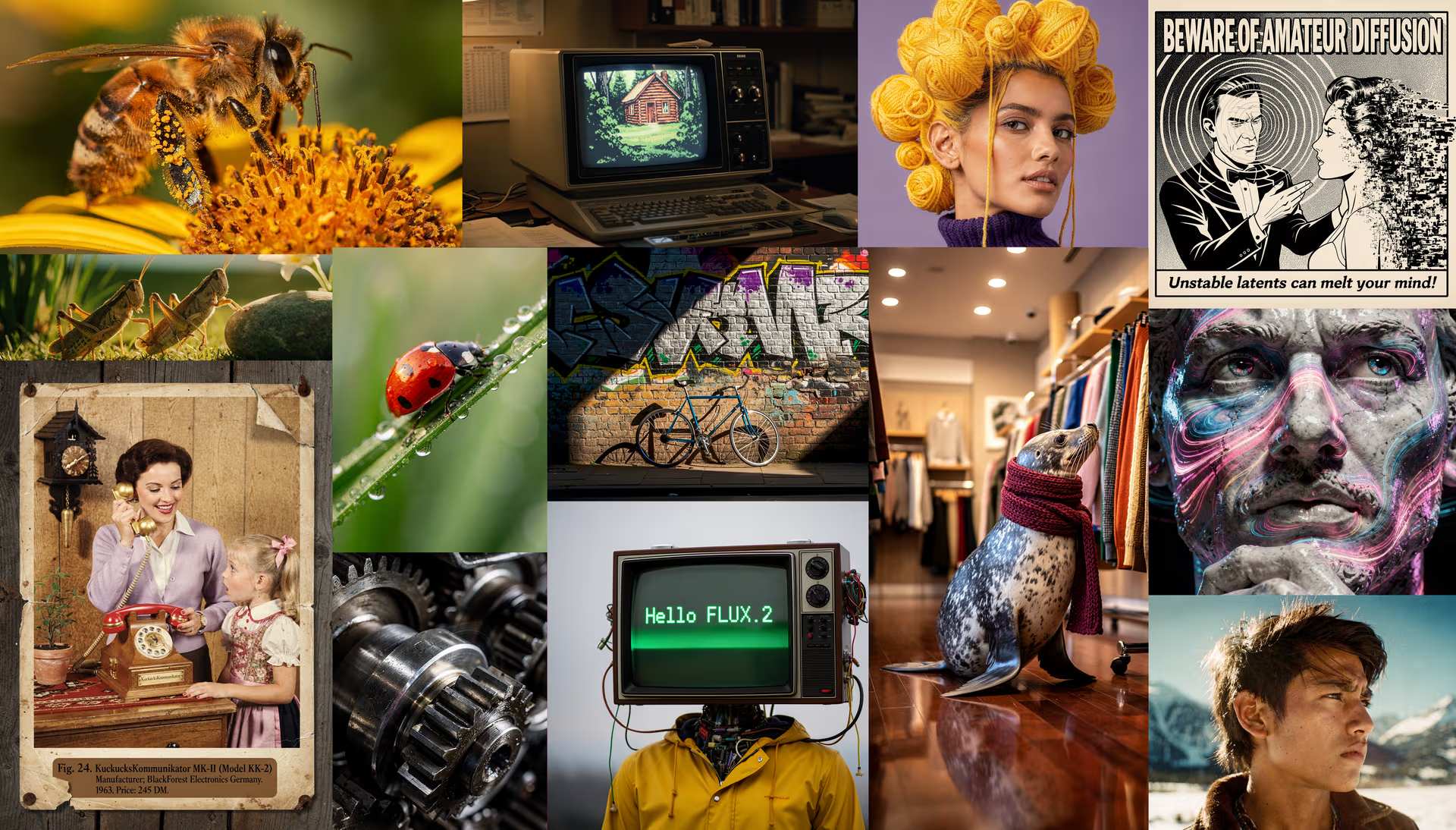
Behind the impressive Black Forest Labs valuation lies their groundbreaking FLUX technology platform. Flux (also known as FLUX.1 and FLUX.2) is a text-to-image model developed by Black Forest Labs (BFL), based in Freiburg im Breisgau, Germany). However, this isn’t just another AI image generator—it represents a fundamental advancement in how machines understand and create visual content.
Unlike existing text-to-image models, the FLUX.1 Kontext family performs in-context image generation, allowing you to prompt with both text and images, and seamlessly extract and modify visual concepts to produce new, coherent renderings. This breakthrough capability has captured the attention of major technology companies worldwide.
The technical sophistication is remarkable. Its architecture integrates a rectified flow transformer with a Mistral-3 (24B) vision-language model, while the retrained latent space improves semantic alignment, learnability, and reconstruction fidelity. Such advanced engineering explains why enterprise customers consistently choose FLUX over competing solutions.
Enterprise Adoption Drives Market Confidence
Its models are being used by a slew of companies, like Adobe, fal.ai, Picsart, ElevenLabs, VSCO, and Vercel. This impressive customer roster demonstrates real market traction beyond investor enthusiasm. Major enterprises don’t adopt new technologies lightly—they require proven performance and reliability.
The enterprise focus becomes even clearer when examining their strategic partnerships. The technology is used in enterprise workflows on platforms like Fal.ai, Replicate, and TogetherAI, and integrated by companies including Adobe, Canva, Meta, and Microsoft. These partnerships provide sustainable revenue streams that justify the Black Forest Labs valuation.
What’s particularly impressive is their open-source approach. Its open-source models rank among the most popular image models on Hugging Face, while its enterprise offerings are widely adopted across platforms. This dual strategy—open-source for developers and premium services for enterprises—creates network effects that strengthen their market position.
The Strategic Use of Black Forest Labs Funding
The startup said it would use the funds for research and development. However, the specific applications reveal ambitious growth plans. Black Forest Labs will use the fresh Series B funding to accelerate its research and development toward next-generation visual-intelligence models, expand the infrastructure needed to train and deploy increasingly large FLUX models, and grow its teams across Freiburg and San Francisco.
This geographical expansion strategy is crucial. Their dual-hub approach positions them at the intersection of European technical excellence and Silicon Valley market dynamics. From its headquarters in Freiburg and San Francisco, the company is hiring and inviting others to help build the future of visual intelligence.
Infrastructure investment remains critical for AI companies. Training and deploying state-of-the-art models requires enormous computational resources. This funding enables Black Forest Labs to scale their infrastructure without compromising on model quality or innovation speed.
Market Position in the Competitive AI Image Generator Series B Landscape
The timing of this Black Forest Labs funding couldn’t be better. According to CB Insights’ State of AI Report, a striking 69% of all venture capital invested in AI startups flowed into “mega-rounds”—financing events of $100 million or more. This trend illustrates a growing winner-take-all dynamic in AI.
Black Forest Labs has positioned themselves effectively within this competitive landscape. It places the start-up among the fastest-rising visual-AI developers in Europe. Their European base provides advantages including strong technical talent, favorable regulatory environment, and growing government support for AI innovation.
The announced valuation places Black Forest Labs firmly among the leading privately held European AI labs currently attracting global investment capital. This capital infusion suggests a sustained belief in the commercial viability of their diffusion-based approach over competing architectures.
Industry Expert Perspectives on This Open Source AI Startup Funding
The investment community’s reaction has been overwhelmingly positive. Investors say the raise shows confidence in the team. They also say it shows growing belief in visual-AI systems. This belief spans both established venture firms and major technology partners.
Market analysts view this Black Forest Labs funding as validation of the broader visual AI market. Reports from groups such as the OECD show rising interest in AI systems built for transparency and creative control. This trend has helped independent labs gain more visibility with global investors.
The competitive dynamics are increasingly favorable for well-funded players. Many AI image models struggle with detailed prompts. Some models generate errors in anatomy. Black Forest Labs’ technical superiority in these areas creates defensive moats that justify premium valuations.
Future Growth Trajectory and Market Implications
Black Forest Labs is positioned to accelerate its timeline for deploying next-generation multimodal AI tools, potentially challenging existing incumbents in both enterprise licensing and direct application usage. Their focus remains squarely on advancing model fidelity and efficiency.
The company’s roadmap extends far beyond image generation. Looking ahead, it envisions models that unify visual perception, generation, memory, and reasoning—laying the groundwork for true visual intelligence. This ambitious vision suggests they’re building toward artificial general intelligence capabilities in the visual domain.
Strategic Implications for the AI Startup Ecosystem
This Black Forest Labs funding represents broader shifts in venture capital allocation. Capital is flowing again, yes, but it’s also more selective, more concentrated, and more risk-averse. For founders, the message is clear: the bar is higher, especially if you’re raising at the seed or early stage. Storytelling alone won’t cut it; investors are looking for signals of validation—revenue, growth, team strength, and clear AI integration.
The concentration of funding in mega-rounds creates challenges for emerging startups. While early-stage AI investments remain numerous, nearly three-quarters of deals in 2024 were seed or Series A rounds, their share of total dollars is shrinking. As funding becomes increasingly skewed toward mega-rounds, the ecosystem risks sidelining the diversity and experimentation that typically fuel long-term innovation.
Looking Ahead: The Future of Black Forest Labs and Visual AI
The success of this Black Forest Labs funding round signals several important trends. First, enterprise adoption of AI tools continues accelerating across industries. Second, open-source strategies can coexist successfully with premium commercial offerings. Third, European AI companies can compete effectively with Silicon Valley counterparts when they combine technical excellence with strategic positioning.
As 2025 concludes, the momentum behind AI startup funding shows no signs of slowing. The increasing number of companies securing multiple mega-rounds within the same year indicates growing investor appetite for established players with proven track records. This trend suggests that while early-stage funding remains strong, later-stage investments are becoming increasingly substantial as companies scale.
Black Forest Labs stands at the forefront of this transformation. Their combination of cutting-edge technology, strategic partnerships, enterprise traction, and now substantial funding positions them to lead the next phase of visual AI development. As businesses across industries seek to integrate AI into their workflows, companies like Black Forest Labs will likely capture an increasingly large share of this expanding market.
The implications extend beyond just one company’s success. This Black Forest Labs funding demonstrates that the AI revolution has moved from experimental to essential. Organizations worldwide are recognizing that visual AI capabilities aren’t luxury add-ons—they’re competitive necessities. For investors, entrepreneurs, and technologists, the message is clear: the future of AI is being written today, and those who understand visual intelligence will shape tomorrow’s digital landscape.
Frequently Asked Questions
What is Black Forest Labs and what do they do?
Black Forest Labs is a German AI startup that develops advanced visual AI models for generating and editing images, including their flagship FLUX technology platform that creates photorealistic images from text descriptions.
How much funding did Black Forest Labs raise and at what valuation?
Black Forest Labs raised $300 million in Series B funding at a $3.25 billion valuation, bringing their total funding to over $450 million since inception.
Who led the Black Forest Labs funding round?
The Series B round was co-led by Salesforce Ventures and Anjney Midha (AMP), with participation from major investors including a16z, NVIDIA, General Catalyst, and Temasek.
What makes FLUX technology different from other AI image generators?
FLUX performs in-context image generation, allowing users to prompt with both text and images while seamlessly extracting and modifying visual concepts to produce new renderings with superior quality and prompt adherence.
Which companies are already using Black Forest Labs’ technology?
Major companies including Adobe, Canva, Meta, Microsoft, ElevenLabs, VSCO, and Vercel have integrated FLUX models into their platforms and workflows.
How will Black Forest Labs use the new funding?
The funds will accelerate research and development for next-generation visual AI models, expand infrastructure for training larger models, and grow their teams across Freiburg and San Francisco offices.