
The Athlete-Owner Era: How Bryson DeChambeau’s Sportsbox AI Acquisition Redefines Athlete Investment in Sportstech

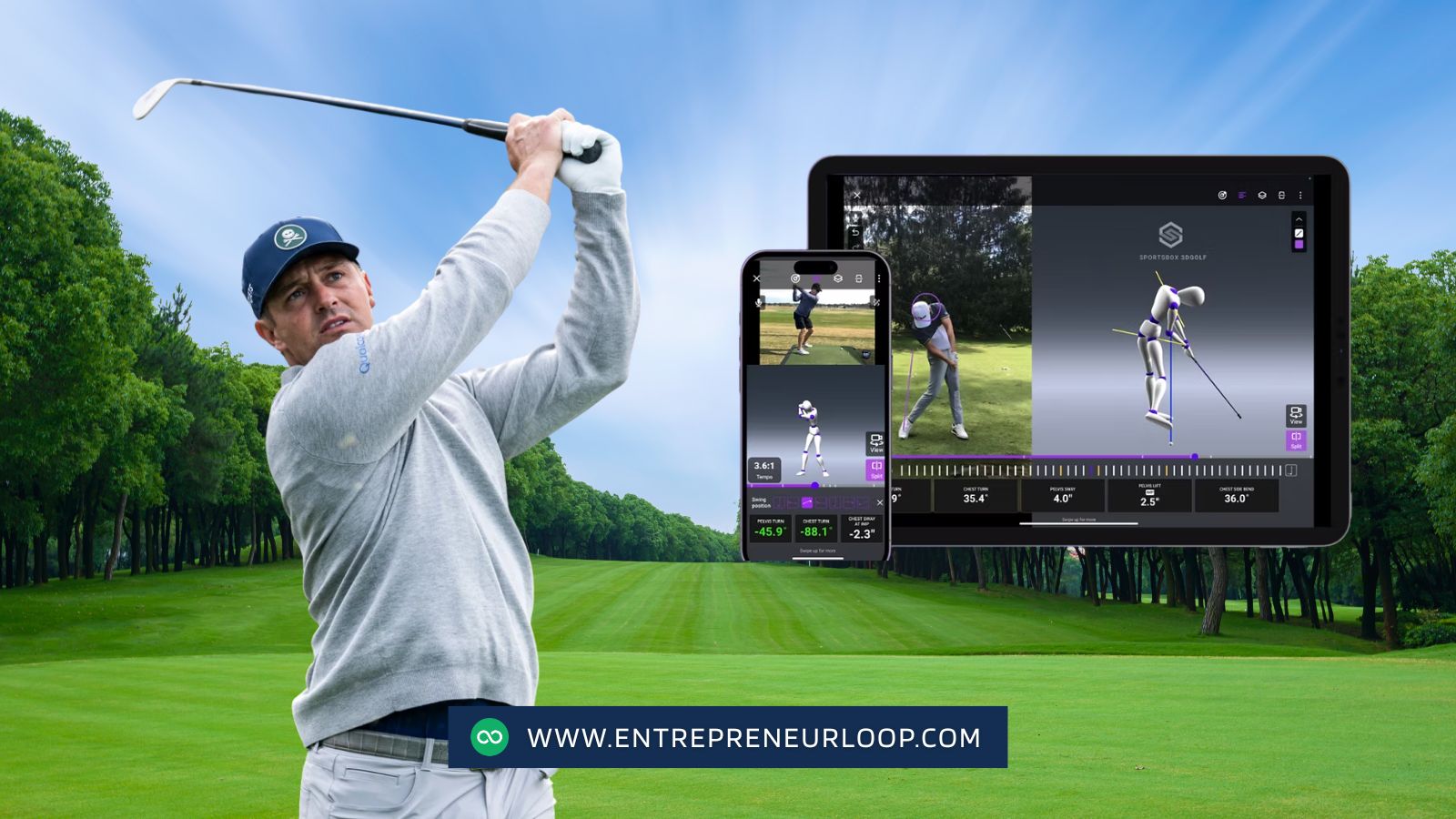
Bryson DeChambeau led an eight-figure investor group to acquire Sportsbox AI on April 7, 2026—four days before competing at the Masters. The deal wasn’t a diversification play. It wasn’t a celebrity name-drop. It was the logical endpoint of something that started on the practice range at Pinehurst two years earlier: a two-time U.S. Open champion used a startup’s technology to win a major, invested in it, and then bought the whole thing. That arc—user to investor to owner—defines athlete investment in sportstech at its most credible, and it signals a structural change in how performance technology gets built, funded, and distributed.
The global AI in sports market was valued at $10.61 billion in 2025 and is projected to reach $49.92 billion by 2033, growing at a compound annual growth rate of 21.6%. Capital is moving decisively into athletic performance technology. Athletes with genuine product knowledge are becoming the most credible buyers in the space. DeChambeau just made that case with a nine-figure-range transaction, and the ripple effects across golf and broader sportstech will take years to fully unfold.
From Champion to CEO: The Bryson DeChambeau Sportsbox AI Acquisition Story
A Win That Changed Everything
In the week leading up to the 2024 U.S. Open at Pinehurst, DeChambeau used Sportsbox to identify and fix a slight miss to the right in his shots. He won. He credited the company publicly at the winner’s press conference. He joined as an investor shortly after. The full Bryson DeChambeau Sportsbox AI acquisition came two years later, completing a progression that no amount of traditional venture strategy could replicate—because it was built on lived experience, not financial modeling.
Founded in 2020 by former LPGA Tour player Jeehae Lee and software engineer Samuel Menaker, who brings over two decades of AI experience to the platform, Sportsbox AI was built on a founding thesis that proved out: give every golfer access to the kind of biomechanical data that only tour players could previously afford. The startup is headquartered in Bellevue, Washington, and its patent-pending 3D motion capture technology became the core of a product that resonated across both professional and recreational markets.
Sportsbox had raised more than $9 million and was last valued at $41 million in a March 2023 seed round, according to PitchBook. The acquisition brought full exits for 19 sellers including Elysian Park Ventures, the PGA of America, Michelle Wie West, David Leadbetter, and Twitch co-founder Kevin Lin. Co-founders Lee and Menaker remain to run the company, and all 30 employees stay on.
Why Domain Expertise Changes Everything
What separates this deal from conventional celebrity investing is precisely what makes it strategically sound. DeChambeau is acquiring a company in a space where he has genuine domain expertise, rather than simply writing a check through a family office or a venture fund. He has used the product at the highest level, contributed product feedback, and built public credibility around it that no marketing budget can manufacture.
That hands-on knowledge eliminates the information asymmetry that kills most celebrity investments. DeChambeau didn’t need a pitch deck. He had reps on the range.
Inside the AI Golf Swing Analysis App That Won a Major
The AI golf swing analysis app at the center of this deal solves a problem that has frustrated golfers and coaches for decades. Getting professional-grade biomechanical swing data previously required expensive multi-camera labs, marker suits, or bulky wearable sensors. Most amateur golfers never had access to any of it.
Sportsbox AI eliminated all of that. The app is a markerless and sensor-free 3D motion analysis studio in the palm of your hands, allowing instructors to access 3D motion data with a single slow-motion swing video—anywhere golfers practice and play. One phone, one angle, a full three-dimensional breakdown. No lab. No equipment beyond what every golfer already carries.
The system measures angular and linear data points including turn, bend, side bend, flexion, sway, and lift—then visualizes the swing from six different angles using just that single video source. Coaches can compare two swings in synchronized 3D animation, set custom goal ranges for individual students, and share detailed analysis remotely between lessons. The consumer pricing is deliberately accessible: $15.99 per month or $110 per year.
The platform has over 150,000 users and is trusted by multiple Golf Digest top 50 instructors. The 3D motion capture for golf this app delivers was previously available only to professional training facilities with six-figure equipment budgets. That accessibility gap is exactly what DeChambeau—and the underlying technology—have closed.
SAMI: The Next Generation of Agentic AI Coaching Features
The acquisition announcement didn’t just close a deal—it opened an entirely new product chapter. Alongside the Bryson DeChambeau Sportsbox AI acquisition, the company unveiled SAMI: Sportsbox AI Motion Intelligence, a next-generation AI coaching assistant built on Google Cloud’s Gemini models.
SAMI is a new AI agent layer in Sportsbox’s mobile app that leverages patented 3D motion technology to transform any smartphone-captured swing into a fully rendered 3D model, analyze thousands of biomechanical data points, and deliver precise personalized coaching insights in seconds. The critical distinction: it doesn’t just present data, it coaches. That shift from dashboard to instructor is what the agentic AI coaching features deliver.
Earlier versions of Sportsbox were passive measurement tools—powerful, but requiring users to interpret the data themselves. SAMI moves the platform to a proactive AI agent that interprets biomechanical patterns, identifies what changed between a good swing and a bad one, and tells you what to do next. For recreational golfers who lack the technical vocabulary to translate “hip sway increased 4 degrees at impact” into a practice drill, that’s a transformative usability leap.
SAMI is currently in beta and rolling out agentic AI features throughout Q2 2026, beginning with AI-generated highlights for 3D Player and 3D Player Plus subscribers on iOS. Google Cloud’s North America Generative AI managing director Granville Valentine called the collaboration “an example of how agentic AI can help democratize elite coaching”—a framing that aligns precisely with DeChambeau’s stated mission of making premium coaching accessible to any golfer, not just tour professionals.
The biomechanics technology in sports powering SAMI has already proven itself at the highest competitive level. That validation matters. Products that win majors before they democratize are credible in a way that pure consumer tech rarely achieves.
Athlete Investment in Sportstech: A Trend Far Bigger Than One Deal
DeChambeau’s move is the most visible recent example of a much broader shift. Athlete investment in sportstech is reshaping how performance companies get built, who controls their direction, and ultimately who benefits from their growth. Athletes are becoming venture investors and media brands, often backing startups that align with their values or performance needs. The DeChambeau acquisition takes that a decisive step further: he’s not just investing—he’s acquiring.
The athlete led venture capital trends underlying this movement have deep precedents. Serena Williams founded Serena Ventures in 2014, building a portfolio of over 85 companies, with 14 achieving unicorn status. Kevin Durant invested in Whoop in 2017 at a $125 million valuation; the fitness tech company is now valued at over $10 billion—an 81-times return. LeBron James built equity in SpringHill Company and Blaze Pizza into assets that dwarf his cumulative endorsement income.
These are the benchmarks DeChambeau is working against. But the athlete led venture capital trends his deal embodies are distinct in one structural way: domain knowledge as due diligence. Williams and Durant wrote smart checks. DeChambeau built a product feedback relationship before writing his. That difference in depth of insight is why this deal carries more conviction than most.
The first half of 2024 alone saw 225 M&A deals totaling $27.3 billion in sports tech, tripling the deal value from the second half of 2023. Capital is consolidating fast. Athletes who can identify winners through lived product experience have an edge that no amount of analyst research replicates.
The Market Opportunity: Why Biomechanics Technology in Sports Is Exploding
Athlete investment in sportstech is structurally compelling right now because the underlying markets are growing aggressively. The global sports technology market is expected to grow at a CAGR of 21.9% from 2025 to 2030, reaching $61.72 billion. Biomechanics technology in sports is one of the fastest-evolving sub-segments within that expansion—AI’s ability to analyze human movement at scale, from a consumer device, is a genuine inflection point.
The Sports Training AI Market is projected to grow from $974.3 million in 2024 to $2.33 billion by 2034, at a CAGR of 9.1%. Integration of AI with biomechanical monitoring enables deeper insights into fatigue, recovery, movement efficiency, and technique—and the shift from expensive lab tools to smartphone-native platforms has opened entirely new customer segments at scale.
Sportsbox AI’s differentiator is its reliance on a single smartphone camera rather than wearables or multiple sensors, which lowers the barrier to entry significantly. In a market crowded with hardware-dependent competitors, that simplicity is a structural advantage with direct implications for customer acquisition cost, churn, and market reach. Every golfer already has the hardware in their pocket.
Sports startups raised nearly $1 billion in 2024, with particularly strong activity in AI-powered analytics. The next phase—athlete-owned platforms with integrated product credibility and media distribution—is precisely what DeChambeau is now piloting. If the model works, expect more athletes to follow the blueprint.
DeChambeau’s Bigger Commercial Ecosystem
The Sportsbox deal doesn’t operate in isolation. It’s one layer of a broader commercial stack DeChambeau is building in parallel. The day before the Sportsbox deal closed, he joined a small group backing Source Golf, a YouTube network with private equity billionaire David Blitzer’s Bolt Ventures as the primary funder. Source Golf aggregates content from top golf creators into a single unified advertising platform.
DeChambeau counts more than 2.6 million YouTube subscribers, a distribution asset that makes him a one-person acquisition channel for any product he controls. Promoting Sportsbox AI to that audience is not a marketing budget line—it’s an owned asset he controls. The integration of media ownership with product ownership is the next evolution of what athlete investment in sportstech can look like when executed with intention.
He also carries the Google Cloud logo on his bag at the Masters and future tournaments—reportedly the first time the Google Cloud brand has appeared on a professional golfer’s bag, adding visible tour-level endorsement to the infrastructure partnership that powers SAMI. His sponsor roster includes Reebok, Qualcomm, Google, and Kalshi, generating an estimated $20 million annually—income that is now being converted, in part, into equity with a longer compounding runway.
Conclusion: Ownership Is the New Endorsement
Bryson DeChambeau’s acquisition of Sportsbox AI is a clean, coherent proof-of-concept for athlete investment in sportstech executed at its highest form. He identified a product he actually needed, used it to win a major, invested in it, acquired it at scale, layered on a cutting-edge AI infrastructure partner, and wired his own media distribution into the commercial machine. Every element of this deal compounds the others.
The athlete-owner era isn’t a trend. It’s a structural reconfiguration of who controls how performance technology gets built and who profits from its growth. Domain expertise matters more than ever—investors and acquirers increasingly want products built alongside people who understand the nuances of the activity itself. Generic platforms built by people who’ve never held a club are losing ground to specialized tools backed by real practitioners.
Whether you’re a recreational golfer, a coach, or a sportstech investor, this deal is worth watching. The Sportsbox AI story is only getting started.
Frequently Asked Questions
What is the Bryson DeChambeau Sportsbox AI acquisition?
On April 7, 2026, a group of investors led by professional golfer and two-time U.S. Open champion Bryson DeChambeau completed an eight-figure acquisition of Sportsbox AI, a Bellevue, Washington-based technology company that uses AI and 3D motion capture to analyze athletic performance through a single smartphone video. DeChambeau confirmed the deal is worth eight figures, though exact terms were not disclosed. Co-founders Jeehae Lee and Samuel Menaker remain to run the company, and all 30 employees stay on.
How does the Sportsbox AI golf swing analysis app work?
The AI golf swing analysis app uses a single slow-motion smartphone video to generate a fully rendered 3D model of a golfer’s swing. It measures biomechanical data points including turn, bend, side bend, flexion, sway, and lift—without any wearable sensors or lab equipment. The app visualizes the swing from six different angles from a single video source. Coaches use it for both live and remote lessons, and consumers access it through subscriptions starting at $15.99 per month or $110 per year.
What is SAMI, and how does it advance the existing Sportsbox product?
SAMI stands for Sportsbox AI Motion Intelligence. It is a next-generation agentic AI coaching assistant built on Google Cloud’s Gemini models. While the existing Sportsbox app provides detailed biomechanical measurements, SAMI introduces a conversational AI layer that interprets that data and delivers personalized coaching recommendations in natural language—moving the platform from a passive measurement tool to a proactive AI coach. SAMI began beta rollout in
Why is DeChambeau’s acquisition considered distinct from typical athlete investments?
Most athlete investments involve writing a check into companies outside their direct area of expertise. DeChambeau’s acquisition is notable because he has verified firsthand experience with the product—he used it to identify and fix a swing flaw before winning the 2024 U.S. Open, provided ongoing product feedback, and acquired the company in a sector where his performance credibility is built-in. That depth of domain knowledge eliminates the information gap that underpins most celebrity investment risk.
What athlete led venture capital trends does this deal reflect?
The DeChambeau acquisition is part of an accelerating movement toward athlete equity ownership rather than endorsement income. Serena Williams has built a portfolio of over 85 companies through Serena Ventures, with 14 achieving unicorn status. Kevin Durant invested in Whoop at a $125 million valuation; it is now worth over $10 billion. The first half of 2024 saw 225 M&A deals totaling $27.3 billion in sports tech alone. The athlete led venture capital trends point toward athletes leveraging domain expertise to identify and acquire winning products before traditional capital does.
How large is the market for AI and biomechanics technology in sports?
The global AI in sports market was valued at $10.61 billion in 2025 and is projected to reach $49.92 billion by 2033 at a CAGR of 21.6%. The Sports Training AI Market specifically is expected to grow from $974.3 million in 2024 to $2.33 billion by 2034. The broader global sports technology market is projected to reach $61.72 billion by 2030. Biomechanics technology in sports and AI-driven coaching platforms are among the highest-growth segments within that overall expansion.
What does Sportsbox AI’s reliance on a single smartphone camera mean for the market?
Most competing platforms for 3D motion capture for golf and biomechanical analysis require expensive multi-camera setups, wearable sensors, or dedicated hardware costing tens of thousands of dollars. Sportsbox AI’s architecture—one smartphone, no sensors, full 3D output—is a structural differentiator. It dramatically lowers the barrier to entry for both coaches and consumers, expands the total addressable market beyond elite players, and eliminates the hardware friction that has historically limited adoption of advanced coaching technology.