

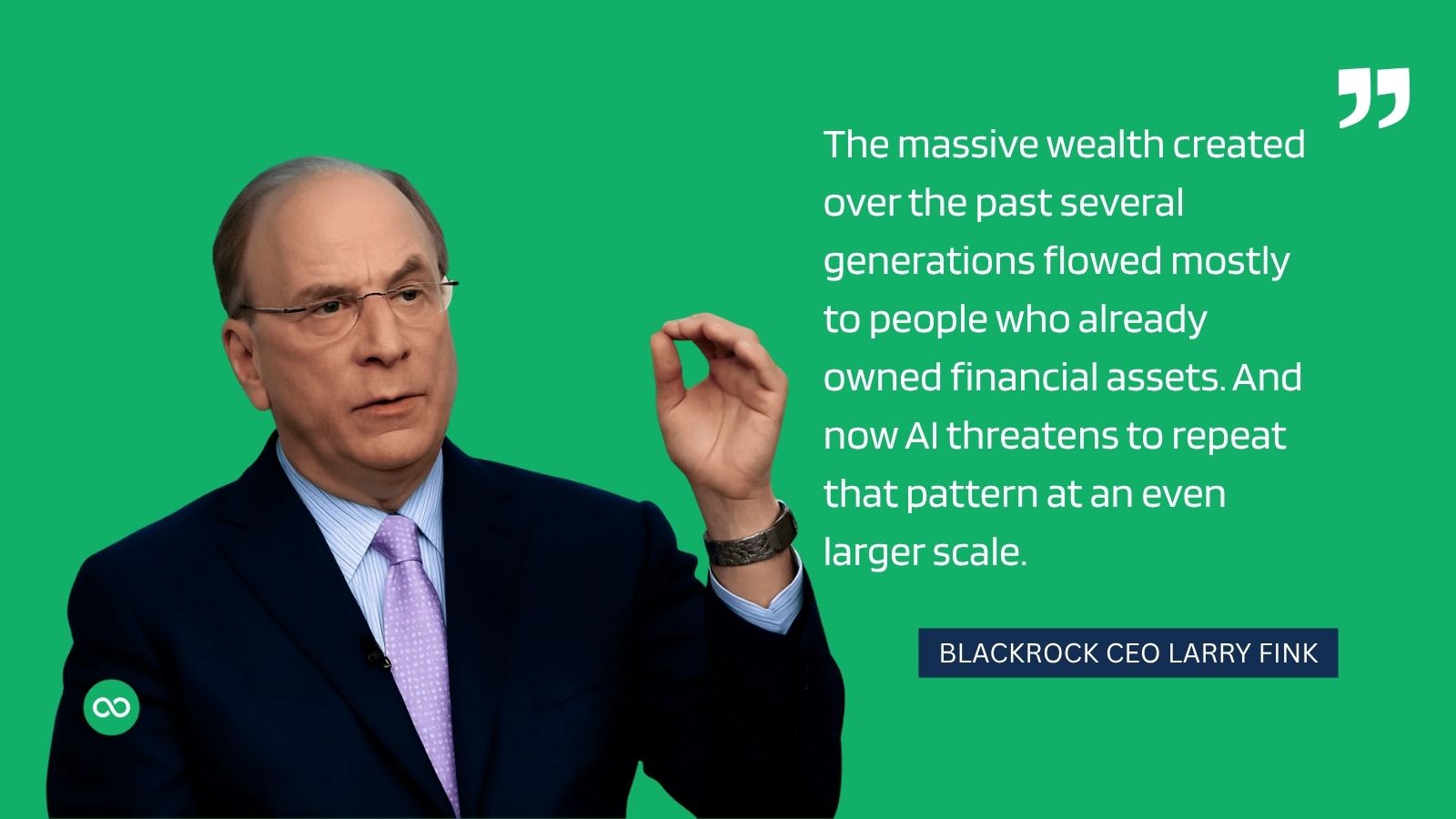
Since 1989, a single dollar invested in the U.S. stock market has grown more than 15 times the value of a dollar tied to median wages — and BlackRock CEO Larry Fink believes artificial intelligence is about to replay that wealth-splitting dynamic at a scale the global economy has never witnessed. In his closely watched 2026 Chairman’s Letter to investors, the head of the world’s largest asset manager issued a direct warning: ai wealth inequality isn’t merely an economic inconvenience. It’s a systemic threat capable of fracturing modern capitalism from the inside out.
Fink’s firm oversees roughly $14 trillion in client assets. When he speaks, markets pay close attention. His message this year cuts to the bone — wealth has long flowed to asset owners rather than wage earners, and AI is on course to accelerate that pattern faster and with far greater force than any previous generation of technology managed.
AI Wealth Inequality and the Historical Cycle Nobody Wants to Confront
The problem Fink identifies isn’t theoretical. It’s structural, and it’s been compounding for decades. Economic inequality has historically tracked technological cycles — those positioned to own the dominant technology of an era capture outsized gains, while workers absorbing the transition bear most of the disruption. AI is the next iteration of that cycle, except this time the technology operates at speed and scale that make previous industrial revolutions look like warm-ups.
AI rewards size. Decisively and disproportionately. The companies best positioned to harvest its gains are those that already own vast data assets, cutting-edge compute infrastructure, and the financial runway to deploy at pace. Amazon, Alphabet, Microsoft, and Meta are expected to collectively spend hundreds of billions on AI infrastructure, with major investment firms co-financing significant portions of that buildout. Gains from this deployment may accrue first — and overwhelmingly — to institutions that already hold enormous balance sheets.
That dynamic is the core engine driving ai wealth inequality today. It isn’t driven by malice. It’s driven by momentum. And momentum, left unchecked, has a way of compounding into monopoly.
AI’s Impact on the Labor Market: White-Collar Jobs Are Now in the Crosshairs
Most early public anxiety about automation centered on factory workers and manual trades. The ai impact on labor market realities in 2026 is proving far more disruptive in surprising places — law offices, content teams, entry-level finance departments, and junior software development roles are bearing the heaviest brunt.
Anthropic CEO Dario Amodei warned that AI could displace half of all entry-level white-collar jobs within one to five years, even as overall productivity and economic growth accelerate. That’s not a fringe prediction from a tech pessimist — it’s a sitting AI CEO looking directly at his own product and saying aloud what others only whisper in boardrooms. The hard numbers support the concern: new college graduates were just 7% of Big Tech hires last year, a drop of over 50% since 2019, and underemployment among recent graduates reached 42.5% in late 2025 — the highest level since 2020.
Fink drew a pointed historical parallel at the World Economic Forum in January 2026: if AI reshapes white-collar work the way globalization reshaped blue-collar work, then confronting that head-on — not with vague reassurances about “jobs of the future” — is the only credible response. That comparison lands hard. Globalization hollowed out manufacturing communities over two difficult decades. The ai impact on labor market could replicate that hollowing-out for accountants, paralegals, customer service specialists, and junior analysts far more quickly than social institutions can adapt.
Who’s Actually Winning Right Now?
The answer is uncomfortable: a remarkably narrow group. AI-native startups are already targeting $100 billion valuations with employee headcounts that fit in a single conference room. Productivity climbs. Corporate profits swell. But those gains concentrate tightly among algorithm owners and asset holders — not among workers whose roles those systems steadily automate away.
Wealth Concentration in Technology: A Hidden Threat to Startup Competition
Here’s an angle that rarely receives sufficient attention: wealth concentration in technology doesn’t only harm workers. It actively suffocates competitive market dynamics. When a small number of mega-cap firms control AI’s foundational infrastructure — the chips, the proprietary models, the hyperscale cloud networks — every startup trying to enter that arena races on a structurally tilted track.
The rapid rise of AI has intensified debate over whether its gains will be broadly distributed or deepen the divide between big tech incumbents and smaller companies struggling to compete. This is wealth concentration in technology functioning as market distortion, not merely a social concern. When entering an industry requires billions in compute spend before shipping a single product, “disruption from below” shifts from a competitive strategy to wishful thinking.
Artificial Intelligence Economic Disruption as a Structural Competitive Barrier
The artificial intelligence economic disruption isn’t only displacing individual workers — it’s displacing the competitive dynamics that historically kept market economies innovative and self-correcting. Incumbent platforms with dominant AI capabilities now hold unprecedented leverage over every downstream market they touch. Entrepreneurs can absolutely build remarkable products within that environment, but rarely challenge the foundational layer itself. That structural concentration deserves far more scrutiny from policymakers and investors than it currently receives. Left unaddressed, artificial intelligence economic disruption at scale risks producing a two-tier innovation economy: one layer owned by a handful of platforms, another layer perpetually dependent on those platforms’ terms, pricing, and goodwill.
AI Automation Job Displacement and AI Wealth Inequality: A Compounding Double Wound
The data is still forming, but the direction is unmistakable. By December 2025, 35.9% of U.S. workers were already using generative AI on the job, according to Federal Reserve labor market analysis. Aggregate employment statistics show no economy-wide collapse yet — but researchers consistently identify concentrated entry-level disruption in highly exposed occupations. Structural labor shifts historically begin precisely this way: quietly, in clusters, before cascading across entire sectors.
Public perception reflects the underlying anxiety. Survey data shows approximately half of Americans believe increased AI use will lead to greater income inequality and a more polarized society. Roughly 46% of young Americans consider it at least somewhat likely that AI will replace their job within five years. Public worry is running slightly ahead of the macroeconomic indicators — but history shows that public perception on technological disruption tends to be prescient rather than paranoid.
AI automation job displacement also compounds ai wealth inequality in a uniquely painful way. The workers most exposed to automation are typically those without the capital reserves to invest in the AI companies benefiting from that very automation. They absorb income losses while simultaneously missing out on the equity upside. That’s a double wound at the individual level, and it’s precisely the mechanism Fink pinpoints when he frames ownership access as the central policy challenge of the AI era.
The Future of Work and AI: Fink’s Prescriptions for Shared Prosperity
To his credit, Fink doesn’t diagnose the problem and quietly exit the stage. His entire framework for the future of work and ai rests on a single thesis: ownership must broaden as AI capabilities expand. Without that expansion, the technology becomes a wealth-concentrating engine for the already-wealthy — not a rising tide. His proposed solutions are structural, not cosmetic.
Several concrete proposals emerge from the 2026 letter:
- Expanding capital markets access so that ordinary workers can invest in AI-era companies, not merely consume their products and absorb their labor disruptions
- A diversified government retirement investment fund designed to complement — not replace — Social Security, with an initial capital deployment of approximately $1.5 trillion, allowing workers’ savings to grow alongside the broader economy rather than sitting solely in low-yield Treasury bonds
- Early wealth-building investment accounts created for children at birth, which evidence indicates raise the statistical likelihood of individuals later earning advanced degrees, founding businesses, and owning homes
- A $100 million BlackRock initiative to expand skilled trades training over five years, targeting roles in physical infrastructure — data centers, power systems, electrical grids — that AI automation cannot readily displace
The future of work and ai, in Fink’s framing, doesn’t have to be a zero-sum outcome where machines accumulate gains and workers fall behind. But avoiding that outcome demands structural intervention at a scale that markets alone won’t deliver. Reskilling talking points and productivity platitudes don’t close the ownership gap. Only genuinely broadened access to capital and assets does.
AI Wealth Gap Risks: From Economic Tension to Democratic Fragility
The ai wealth gap risks extend well beyond quarterly earnings reports and labor statistics. Fink’s letter makes a subtle but urgent argument: concentrated ownership in an AI-driven economy isn’t just a market efficiency problem — it’s a political stability problem. He frames investment ownership as a civic link between citizens and their nations, and warns that breaking that link carries real consequences for democratic institutions.
When large segments of the population feel structurally excluded from prosperity — and current trajectories give those feelings increasing empirical backing — institutional trust erodes fast. History offers no shortage of examples showing where that erosion leads. The ai wealth gap risks feeding cycles of populism, protectionism, and social fragmentation that ultimately undermine the very innovation ecosystems generating AI wealth in the first place.
Peer-reviewed research confirms that AI-driven automation disproportionately affects routine and semi-skilled occupations, while enhancing returns for high-skill workers and the firms controlling data and computational infrastructure. That polarization — the artificial intelligence economic disruption operating as a structural wedge — is a documented source of deepening socioeconomic fracture, not a speculative future risk. Fink’s warning, grounded in decades of watching capital markets shape societies, carries weight precisely because he’s describing a pattern already underway, not a hypothetical scenario.
Navigating AI Wealth Inequality as a Founder, Investor, or Worker
The ai wealth inequality debate isn’t a distant policy conversation reserved for economists and legislators. Founders, investors, and operators face concrete strategic decisions right now. Build for inclusion. Products that genuinely democratize access to AI capabilities — rather than gatekeeping their benefits behind enterprise price points — carry strong market potential, growing ESG tailwinds, and a reputational position that increasingly matters to both talent and institutional capital.
Watch the policy landscape closely. This topic carries real political gravity, and legislative responses tend to follow when the world’s largest asset manager advocates openly for structural reform. Don’t treat ai automation job displacement as an abstraction either. Teams using AI purely as a headcount reduction mechanism may soon face recruitment challenges, regulatory friction, and reputational costs as the public debate intensifies and the ai wealth gap risks become harder to ignore politically.
The window for proactive engagement is open. It will not stay that way indefinitely.
Conclusion: The Pattern Is Established — the Response Is Still Ours to Write
Larry Fink has built his career reading how capital flows and who it ultimately serves. His 2026 warning about ai wealth inequality isn’t pessimism — it’s pattern recognition from someone who has watched capitalism create, concentrate, and occasionally distribute wealth across four decades at the highest levels. The same structural dynamics that made the post-1989 asset boom transformative for investors are now running on AI’s engine: faster, more concentrated, and structurally harder to reverse without deliberate, large-scale intervention.
The future of work and ai depends not on the technology itself but on the governance frameworks, ownership structures, and policy choices built around it. Every founder, investor, policymaker, and worker holds a real stake in getting those choices right. The gap is widening. Engaging with it seriously — rather than waiting for someone else to solve it — starts today.
Frequently Asked Questions
What does Larry Fink mean when he warns about ai wealth inequality?
Fink argues that AI is accelerating a long-standing structural trend: wealth flowing predominantly to those who own assets rather than those who earn wages. As AI creates enormous economic value, the bulk of that value is likely to concentrate among the companies building AI infrastructure and the investors who own them — deepening the divide between asset holders and the broader working population.
How is the ai impact on labor market different from previous waves of automation?
Unlike earlier automation waves that primarily displaced manual and physical labor, today’s ai impact on labor market is targeting knowledge work — entry-level white-collar roles in law, finance, content creation, software, and customer support. Speed is the key difference. This transition is occurring significantly faster than historical technological shifts, leaving less time for workers and institutions to adapt.
Why does wealth concentration in technology threaten startup competition?
Wealth concentration in technology raises the barrier to market entry to levels that exclude most new players. When a handful of mega-cap firms control the AI chips, foundational models, and cloud infrastructure that startups depend on, those startups become structurally dependent on incumbents rather than genuine competitors. That dynamic stifles the innovation and disruption that healthy market economies require to function well.
What specific solutions did Larry Fink propose to address ai wealth gap risks?
Fink proposed expanding access to capital markets for ordinary workers, creating a roughly $1.5 trillion government retirement investment fund alongside — not replacing — Social Security, establishing early wealth-building accounts for children, and investing $100 million through BlackRock to support skilled trades development. Each solution targets the ownership gap that drives ai wealth gap risks at a structural level.
Is ai automation job displacement already happening, or is it still theoretical?
The aggregate economy hasn’t shown a broad employment collapse yet, but concentrated entry-level disruption in AI-exposed occupations is already measurable. By December 2025, nearly 36% of U.S. workers were using generative AI on the job. New graduate hires at Big Tech dropped more than 50% since 2019. Underemployment among recent college graduates hit 42.5%, the highest since 2020. The early signals are visible even if the full impact is still developing.
How does the future of work and ai connect to political and democratic stability?
Fink argues that when large numbers of people feel structurally excluded from economic prosperity — which concentrated AI ownership would cause at scale — institutional trust erodes and political instability grows. The future of work and ai is therefore not purely an economic question. It’s a democratic one, requiring solutions that ensure citizens maintain a meaningful stake in their country’s economic growth rather than becoming spectators to it.
What can startup founders do practically to address artificial intelligence economic disruption?
Founders can build AI products that democratize access rather than concentrate benefits, monitor policy developments as regulatory frameworks catch up to AI’s labor and ownership impacts, and develop thoughtful workforce practices that address ai automation job displacement rather than purely optimizing for headcount reduction. Proactively engaging with the structural challenges of artificial intelligence economic disruption is increasingly both a competitive advantage and a reputational imperative.