
AI Impact Summit India 2026: How AI Will Transform India’s Economy, Jobs & Global Influence

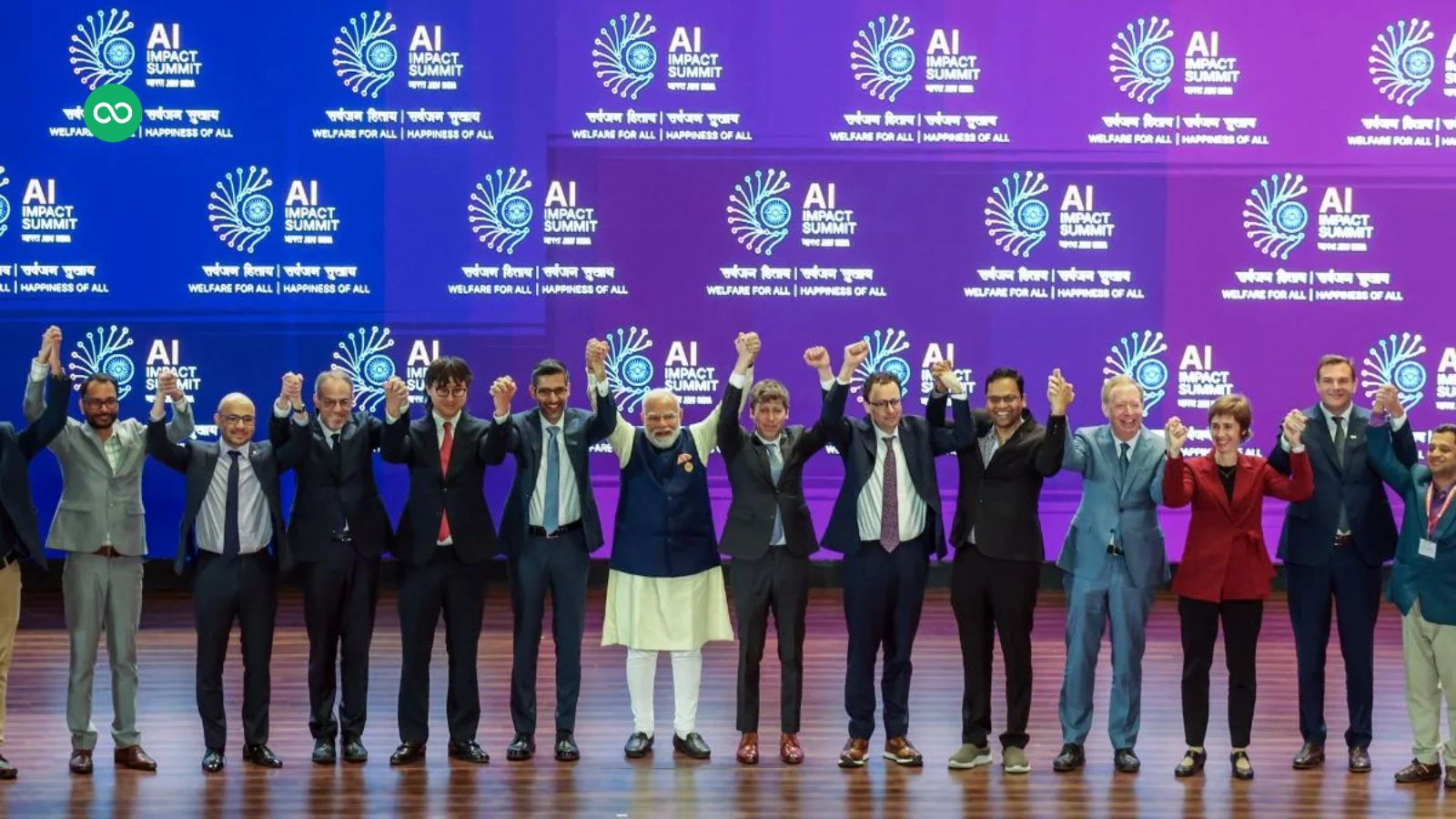
The AI Impact Summit India 2026 (February 16-20, 2026), at Bharat Mandapam in New Delhi, attracting exactly 251,000 visitors and marking a watershed moment for India’s tech ambitions. Prime Minister Narendra Modi described artificial intelligence as “humanity’s next leap after fire and wireless”. This wasn’t just another tech gathering. It represented the first global AI summit hosted in the Global South, signaling India’s serious bid for AI supremacy.
Tech giants like OpenAI CEO Sam Altman and Alphabet CEO Sundar Pichai flew to Delhi alongside 20 national leaders and 45 ministerial delegations. This massive convergence highlighted India’s growing role in shaping how AI will be developed, deployed, and governed worldwide. The AI transformation in India isn’t coming—it’s already here.
Key Takeaways
- $359-438 billion: Projected AI contribution to India’s GDP by 2029-30
- 1 million new AI jobs: Expected in India’s IT sector by 2025
- 38,000 GPUs: Being deployed under the IndiaAI Mission
- 7 guiding principles: Foundation of India’s AI governance framework
- ₹10,371.92 crore: Five-year budget for India AI Mission
Understanding India’s AI Mission and AI Transformation in India’s Economic Ambitions
Here’s what makes India’s approach different. The government isn’t just throwing money at AI and hoping for the best. The Cabinet approved the India AI Mission in March 2024 with a budget of ₹10,371.92 crore over five years. That’s roughly $1.25 billion—a serious commitment to building local AI capabilities.
Unlike countries chasing frontier AI models that gobble up massive capital, India’s taking a different path. The strategy focuses on job-aware, decentralized AI grounded in real-world use cases. Smart move.
The AI economic impact India could experience is staggering. EY’s Generative AI report estimates India can add $359–438 billion to GDP by 2029–30 through AI adoption. Even more optimistic forecasts suggest AI could contribute $500 billion to the economy by 2025-2030. These aren’t pie-in-the-sky numbers. They represent tangible opportunities across agriculture, healthcare, urban planning, and manufacturing.
The infrastructure backbone is already taking shape. As of October 2025, IndiaAI Mission deployed 38,000 GPUs and established 600 AI Data Labs. The government also created three Centres of Excellence focused on healthcare, agriculture, and sustainable cities. This infrastructure-first approach gives startups, researchers, and enterprises the tools to experiment and deploy AI solutions at scale.
Real-World Success Stories
Let me give you some examples of what’s actually working. Ninjacart, an agri-tech startup, uses AI to connect farmers directly with retailers, cutting out middlemen and reducing food waste by 20%. In healthcare, Qure.ai has deployed AI diagnostic tools across 2,000+ healthcare facilities, making quality diagnostics accessible in rural areas. These aren’t just feel-good stories—they’re proof that AI transformation in India is delivering real benefits.
India AI Policy Strategy: Balancing Innovation with Responsibility
The India AI policy strategy stands out globally. Rather than heavy-handed regulation, India follows a “hands-off” approach that encourages innovation while addressing harms through existing laws. This pragmatic stance reflects a crucial understanding: over-regulation could kill the very innovation needed to compete globally.
Days before the AI Impact Summit India 2026, India released its AI Governance Guidelines anchored in seven guiding “sutras.” The “AI for All” strategy seeks to democratize access across agriculture, healthcare, and education. These seven principles—Trust, People First, Innovation over Restraint, Fairness & Equity, Accountability, Understandable by Design, and Safety, Resilience and Sustainability—provide ethical guardrails without bureaucratic nightmares.
What makes India’s governance model distinctive? India regulates AI through existing laws and sector-specific rules from bodies like the Reserve Bank of India (RBI) and Securities and Exchange Board of India (SEBI), rather than a single AI statute. This sectoral approach lets different industries adapt AI governance to their contexts. Financial services can focus on fraud detection. Healthcare prioritizes patient data protection. Smart.
The framework emphasizes what officials call a “techno-legal” approach—using technology-enabled solutions for content authentication, privacy preservation, and bias mitigation. This moves beyond traditional regulatory frameworks to embrace technical safeguards built directly into AI systems.
How India Compares to Other Nations
Let’s be honest—India’s approach differs sharply from the EU’s heavy regulation or China’s state-controlled model. The EU AI Act creates multiple compliance layers that can slow innovation. China’s centralized control limits entrepreneurial experimentation. India’s trying to find a middle path that maximizes innovation while maintaining ethical standards. Whether this works remains to be seen, but it’s a bold experiment worth watching.
The Future of Jobs in India Due to AI: Opportunities and Disruptions
Here’s where things get real for you and your colleagues. Perhaps no aspect of AI transformation in India generates more anxiety than its impact on employment. Let me be straight with you: the picture is complex and far from uniformly negative.
Research reveals that AI hasn’t caused large-scale unemployment in India but has fundamentally altered job composition, employment quality, and income structures. Big difference. We’re not seeing mass job elimination. Rather, we’re experiencing a profound restructuring of how work gets done.
The creation of new opportunities is substantial. NASSCOM projects the Indian IT sector will add 1 million AI-related jobs by 2025. The McKinsey Global Institute suggests AI deployment could create up to 950,000 new jobs in India’s industrial sector by 2030. These aren’t just tweaks to existing roles—they represent entirely new categories: AI ethics auditors, machine learning engineers, data scientists, prompt engineers.
But here’s the thing—we’d be fooling ourselves to ignore the challenges. In July 2025, Tata Consultancy Services cut 12,200 jobs—roughly 2% of its workforce—as automation kicked in. Other major IT firms slowed campus hiring. The impact goes beyond headlines. India produces 1.5 million engineering graduates annually, but in 2024-25, major software exporters hired only 70,000 to 80,000 fresh engineers—the lowest intake in over two decades.
The future of jobs in India due to AI varies dramatically by sector. Customer service, accounting, sales, research, and retail face significant disruptions. McKinsey predicts that by 2030, 14% of employees may need career changes due to AI. Yet NVIDIA CEO Jensen Huang argues AI is simultaneously generating massive demand for skilled physical labor—electricians, plumbers, technicians, infrastructure workers.
What does this mean for you? The evidence points clearly toward reskilling and continuous learning. The government launched programs like FutureSkills PRIME covering emerging technologies including AI, and YUVAi, which familiarizes school students with AI technologies. The future of jobs in India due to AI demands adaptability.
How AI India Jobs Are Reshaping the Workforce
Beyond disruption, the AI India jobs landscape is creating professional categories that didn’t exist five years ago. These roles span technical, strategic, and ethical domains, offering diverse pathways for India’s young workforce.
Data scientists analyze complex patterns using various tools and algorithms to extract knowledge from data. They spot irregularities in time-series data, forecast trends, and offer strategic advice. Exciting stuff.
Business intelligence engineers represent another growing category. BI engineers analyze internal and external data to find patterns—monitoring stock market data for investment decisions or tracking sales patterns to guide distribution. These roles blend business acumen with technical capabilities.
AI research scientists tackle the highest-stakes positions. Research scientists pose original questions for AI to answer and specialize in statistics, machine learning, deep learning, and mathematics. These roles drive fundamental innovation.
The opportunity extends beyond purely technical positions. McKinsey suggests that by 2030, AI-driven technologies could create up to 133 million new roles globally. India, with its large English-speaking workforce and strong STEM tradition, is perfectly positioned to capture a hefty portion of these AI India jobs.
Practical Career Pathways
If you’re wondering how to break into AI India jobs, here’s a roadmap. Start with online courses from platforms like Coursera, edX, or India’s own NPTEL. Focus on Python programming, statistics, and machine learning fundamentals. Build a portfolio of projects—Kaggle competitions are great for this. Consider certifications like Google’s TensorFlow Developer Certificate or AWS Machine Learning Specialty. Network at local AI meetups and conferences. The barrier to entry is lower than you think.
India’s Strategic Positioning in Global AI Competition
India’s global influence in AI extends far beyond hosting summits. The country is emerging as a critical bridge between advanced economies and the Global South. India sees the AI Impact Summit India 2026 as a chance to project itself as this bridge, with officials noting India’s experience building large-scale digital public infrastructure offers a model for deploying AI at scale while keeping costs low.
This positioning isn’t accidental. India has implemented AI solutions across healthcare, agriculture, and public service delivery to over 1.4 billion citizens. During its G20 Presidency in 2023, India championed Digital Public Infrastructure (DPI) as a global public good. This track record gives India credibility when advocating for inclusive AI governance frameworks.
The talent advantage is mind-blowing. India’s demographic dividend as the world’s most populous country, with a median age of ~28 years, enables capitalizing on growing global demand for technology talent. Moreover, India’s AI talent base is expected to grow from 600,000 to 1.25 million by 2027.
India’s services export strength creates additional advantages. Services exports grew to ~$387 billion in 2024, at a compound annual growth rate of ~11% from 2005 to 2024—nearly double the global average. This infrastructure provides natural pathways for AI service deployment.
Global Capability Centers (GCCs) amplify this momentum. More than 60% of GCCs established in the last 2 years focus on AI, data, digital engineering, or product development. These centers aren’t just outsourcing hubs—they’re innovation laboratories where cutting-edge AI solutions get developed for global deployment.
Sectoral Transformation: Where AI Is Making Real Impact
The artificial intelligence India future isn’t uniform—some industries are transforming faster than others. Agriculture contributes more than 18% to India’s economy with more than 50% of the population engaged in farming. NITI Aayog’s National Strategy identifies five key sectors: healthcare, agriculture, education, smart cities, and mobility.
In healthcare, AI can empower India’s 490 million informal workers by expanding access to healthcare, education, and financial inclusion. Applications include diagnostic imaging analysis, predictive health analytics, telemedicine platforms, and drug discovery.
Manufacturing is undergoing revolution. Industry leaders emphasize India must move from service economy to product economy, moving up the value chain. AI enables this through smart factories, predictive maintenance, quality control, and supply chain optimization.
Financial services adopted AI early and aggressively. According to RBI and IMF, AI improves risk assessment and transaction monitoring, with PwC predicting 20% of traditional banking jobs will be automated by 2025. Yet this creates opportunities for enhanced fraud detection, personalized banking, and improved credit access for unbanked populations.
Challenges Facing AI Transformation in India
Despite enormous potential, significant obstacles remain. Infrastructure disparities present a fundamental challenge. Karnataka leads, while Bihar and Jharkhand lag. Without addressing these geographic inequalities, AI benefits risk concentrating in already-developed urban centers.
The skills gap presents another hurdle. Almost 75% of surveyed organizations acknowledge low to moderate readiness to harness Gen AI benefits. This gap impacts individual workers who lack training to adapt to AI-transformed workplaces.
Resource constraints matter too. Training frontier models requires enormous capital, scarce advanced chips, and energy-intensive data centers. India’s strategic choice to focus on application-layer AI rather than frontier model development reflects this reality.
But here’s what worries me most—ethical concerns. As AI algorithms influence employment decisions, policies need to be transparent, fair, and responsible. Issues of algorithmic bias, data privacy, and surveillance demand proactive governance.
The Road Ahead: 2026 and Beyond
Looking forward, India’s trajectory in AI transformation in India depends on executing several priorities simultaneously. The AI Impact Summit India 2026 provides an opportunity to establish India as a leading center that attracts AI professionals while developing infrastructure through investments and partnerships.
The government’s phased approach provides a roadmap. Phase 2 (2026–2027) focuses on establishing cross-sectoral governance structures and implementation blueprints, emphasizing infrastructure readiness while promoting domestic innovation.
International partnerships play a crucial role. Google announced a $15 billion investment to establish foundational AI infrastructure in India and the America-India Connect initiative for strategic fiber-optic routes. Similar commitments from other tech giants signal genuine global interest.
ServiceNow’s Chief Corporate Affairs Officer emphasized the need to consider ethical implications, noting that decisions based solely on profit could leave populations behind. This human-centric philosophy aligns with India’s developmental priorities.
Conclusion: India’s Moment in the AI Revolution
The AI Impact Summit India 2026 wasn’t just a conference. It was a declaration of intent. India is positioning itself not merely as a participant in the global AI revolution but as a shaper of how that revolution unfolds.
The AI economic impact India could experience over the next decade represents one of the most significant economic opportunities in the country’s history. Whether India capitalizes on this depends on continued execution: building infrastructure, developing talent, fostering innovation, ensuring ethical deployment, and maintaining inclusive growth.
The future of jobs in India due to AI will be neither dystopian nor utopian. It demands adaptive individuals, responsive institutions, and forward-thinking policies. The India AI policy strategy provides a framework, but implementation determines outcomes. The AI India jobs landscape will continue evolving rapidly.
Ultimately, the AI Impact Summit India 2026 marked a turning point—when India transitioned from being a destination for AI services to an origin of AI innovation. The journey ahead remains challenging, but the pathway is clear. India’s success will influence not just its economic trajectory but how AI gets developed across the Global South and beyond.
Frequently Asked Questions
What happened at the AI Impact Summit India 2026?
The AI Impact Summit India 2026 took place February 16-20, 2026, in New Delhi, attracting 251,000 visitors, 20 national leaders, and tech CEOs like Sam Altman and Sundar Pichai. It was the first global AI summit hosted in the Global South, showcasing India’s “AI for All” strategy and establishing the country as a bridge between advanced economies and developing nations in AI governance and innovation.
How much will AI contribute to India’s economy?
AI transformation in India could add $359-438 billion to GDP by 2029-30 according to EY’s report, with some projections suggesting up to $500 billion by 2030. McKinsey estimates AI could have a $15.7 trillion economic impact on India by 2035. These contributions will come from agriculture, healthcare, manufacturing, financial services, and retail sectors.
Will AI destroy jobs in India or create opportunities?
Research shows AI hasn’t caused large-scale unemployment but has altered job composition. While TCS cut 12,200 jobs in 2025, NASSCOM projects 1 million new AI-related jobs by 2025, and McKinsey estimates 950,000 new industrial sector jobs by 2030. The future of jobs in India due to AI requires reskilling for roles like data scientists, AI engineers, and business intelligence analysts.
What is India’s AI policy strategy?
The India AI policy strategy uses a “hands-off” approach encouraging innovation while addressing harms through existing laws. The AI Governance Guidelines released before the AI Impact Summit India 2026 outline seven principles: Trust, People First, Innovation over Restraint, Fairness & Equity, Accountability, Understandable by Design, and Safety. Unlike the EU’s heavy regulation, India uses sector-specific rules through RBI and SEBI.
Which sectors will AI transform most in India?
Five key sectors for AI transformation in India include: (1) Agriculture—improving yields for 50% of population engaged in farming; (2) Healthcare—expanding access for 490 million informal workers; (3) Manufacturing—enabling shift from service to product economy; (4) Financial Services—automating 20% of banking jobs by 2025 while creating new products; (5) Education—providing personalized learning and skill development.
How is India building AI infrastructure?
The IndiaAI Mission invested ₹10,371.92 crore over five years to deploy 38,000 GPUs, establish 600 AI Data Labs, and create three Centres of Excellence in healthcare, agriculture, and sustainable cities. Private partnerships are significant—Google announced $15 billion for AI infrastructure, while the America-India Connect initiative delivers strategic fiber-optic routes for enhanced connectivity.
What AI India jobs are being created?
AI India jobs include data scientists analyzing complex patterns, business intelligence engineers finding strategic insights, AI research scientists driving innovation, machine learning engineers, AI ethics auditors, and prompt engineers. McKinsey predicts 133 million new AI-driven roles globally by 2030. India’s English-speaking workforce and STEM tradition position it to capture a significant portion of these opportunities.