
The Rise of Autonomous AI Engineers: Will Startups Ever Need to Hire Human Coders Again?

92% of developers now use AI tools in some part of their workflow, and GitHub Copilot had 4.7 million paid subscribers by January 2026, up 75% year-over-year. These numbers signal a fundamental shift in how software gets built. Yet the question haunting tech circles isn’t whether AI will replace programmers—it’s whether startups will ever need to hire human coders again.
The answer? It’s more complicated than AI evangelists or skeptics want to admit.
Will AI Replace Programmers? What the Data Actually Shows
For years, the tech industry promised that coding was the ultimate career path. Learn Python, build a portfolio, land a six-figure job. That playbook worked—until 2022. Today, software developer postings are down approximately 35% from pre-2020 levels and roughly 70% from their 2022 peak, while entry-level postings dropped 60% between 2022 and 2024.
The AI coding revolution isn’t killing programming jobs outright. Rather, it’s restructuring the entire labor market. The Bureau of Labor Statistics still projects software developer jobs growing 15-18% through 2034, well above the national average. But here’s the catch: employment for software developers aged 22-25 dropped 20% from 2022 to 2025, according to Stanford’s AI Index 2026.
Not replacement. Compression.
Goldman Sachs research found that roughly 25% of work hours in advanced economies could be automated, but only around 6-7% of jobs would disappear entirely. The rest would be augmented or shifted. Developer work falls squarely in the “exposed but survives” bucket—judgment, context, and defining the actual problem remain human domains.
Autonomous AI Software Engineer: From Copilot to CEO?
Enter Devin, the world’s first fully autonomous AI software engineer. Built by Cognition AI, Devin correctly resolves 13.86% of real-world GitHub issues end-to-end, far exceeding the previous state-of-the-art of 1.96%. That might sound modest, but the implications are seismic.
Unlike traditional AI coding assistants that suggest snippets, Devin is an autonomous AI software engineer that can write, run and test code, handling most tasks excluding extremely difficult ones. Give it a Jira ticket. It explores the codebase, creates a plan, writes code, opens a PR with passing tests—all without babysitting every line.
Goldman Sachs is betting on it. The bank is testing Devin among its 12,000 human developers, with the AI agent handling jobs engineers often consider drudgery: updating internal code to newer programming languages. At Cognizant, 30% of code is already generated with AI, and the company aims to reach 50% in the near future.
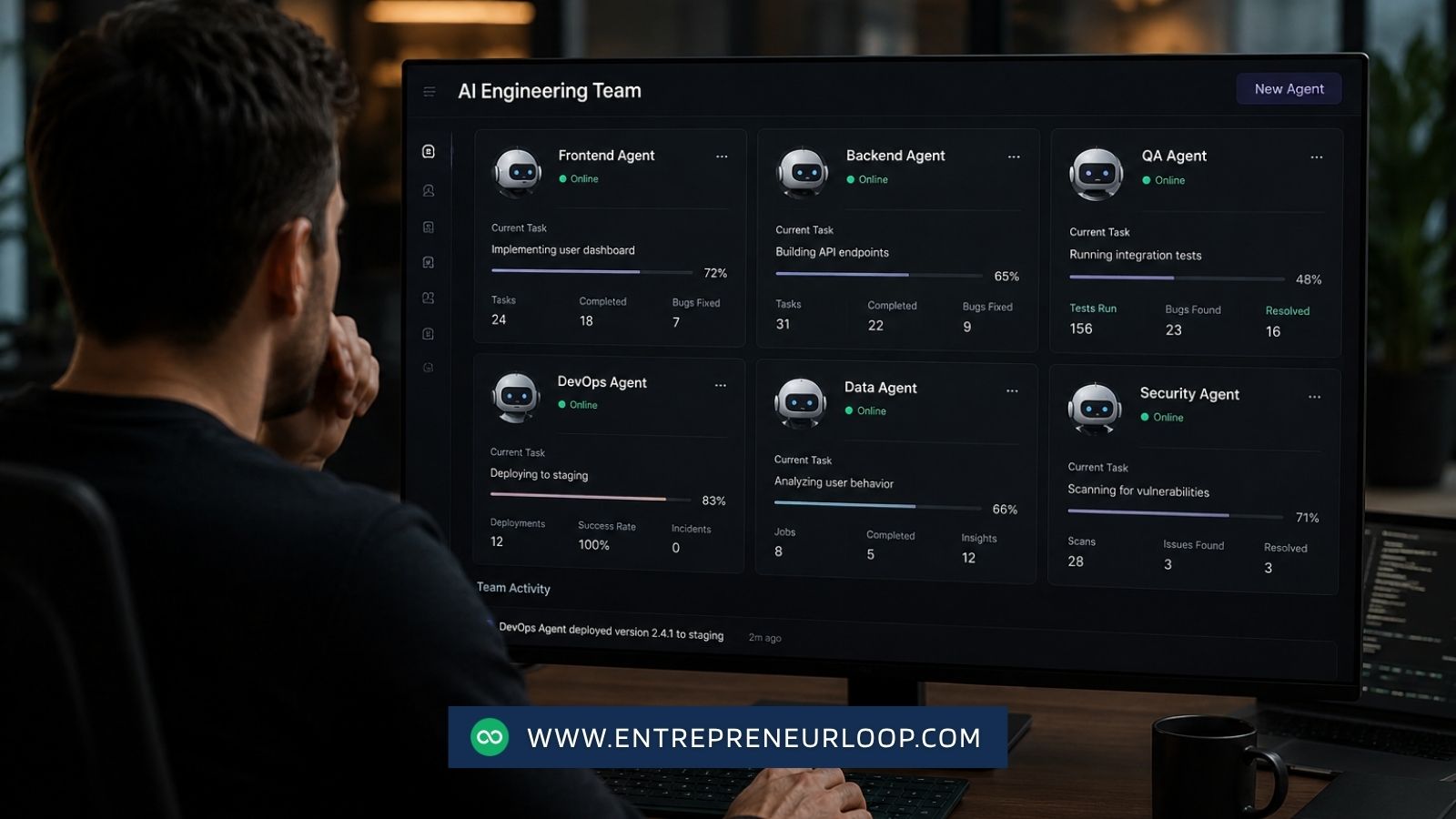
The future of software engineering? It’s not human versus machine. It’s agentic AI software development—multi-agent systems where specialized AI handles planning, coding, testing, and deployment while humans orchestrate, validate, and make strategic decisions.
Best AI Coding Tools: The New Developer Tech Stack
GitHub Copilot is now used by 90% of Fortune 100 companies. That’s not a feature anymore—it’s infrastructure. But Copilot isn’t alone in reshaping development workflows.
GitHub Copilot generates an average of 46% of code written by users, with Java developers reporting the highest rates at 61%. The code acceptance rate averages between 27% and 30%, and developers retain 88% of accepted code in final submissions, indicating AI suggestions are largely production-ready.
Beyond Copilot, the landscape includes:
Replit pivoted from cloud IDE to AI-first platform and achieved explosive growth. The company’s annualized revenue rose to $150 million from $2.8 million in less than a year, and Replit’s market valuation stands at $3 billion as of July 2025. Its Agent 3 handles autonomous coding, testing, and deployment—turning natural language into full-stack applications.
Cursor raised $900 million at a $10 billion valuation in May 2025, positioning itself as the AI-native IDE for developers who want autonomy without losing control.
Anthropic’s Claude Code reached $1 billion in annualized revenue in six months, becoming the viral darling of “vibe coding”—describing features in plain English and letting AI fill in the blanks.
These aren’t productivity boosters. They’re AI code generation tools fundamentally changing who can build software. More than 500,000 businesses use Replit, including startups, tech companies, and enterprise teams. Among business users, 58% aren’t engineers—they’re DevRel, sales, marketing, and operations teams building their own tools.
Future of Software Engineering: Fewer Juniors, More Architects
Here’s where it gets uncomfortable. The unemployment rate for recent US graduates in computer engineering stands at 7.5%, with computer science grads at 6.1%—higher than the overall US unemployment rate of 4.3% and significantly elevated compared to nursing, civil engineering, or even art history.
The junior developer job market is collapsing. The share of juniors in new hires dropped from 15% to approximately 7% over three years. Entry-level postings dropped 60% between 2022 and 2024, while Google and Meta are hiring roughly 50% fewer new grads compared to 2021.
Why? AI automates precisely the tasks junior developers used to handle. Startups are finding that AI can perform some tasks that junior developers used to handle—and it often does it faster and cheaper. Instead of hiring two juniors to support a senior, they’re looking for AI-augmented senior engineers.
But this creates a pipeline problem. If juniors can’t get jobs, they never become mid-level. If mid-levels are getting compressed, they can’t grow into senior developers. Ten years from now, who will be the senior developers reviewing AI code if nobody got hired as a junior in 2025?
Not every company is cutting juniors, though. Some of the largest enterprise technology companies began increasing junior developer hiring in 2026. The difference? Time horizon. Startups optimize for survival over the next 18 months. Enterprise companies optimize for engineering capacity over the next decade. Banks, healthcare platforms, and infrastructure companies continue hiring juniors because future senior engineers must come from somewhere.
The future of software engineering won’t be defined by mass unemployment. It’ll be defined by role transformation. In February 2026, Spotify revealed that some of its best developers haven’t written a line of code since December, thanks to AI. They’re now focused on directing AI agents, reviewing output, making architectural decisions, and ensuring code solves relevant business problems.
Agentic AI Software Development: The Next Paradigm
Traditional software development methodologies—Agile, Kanban, ShapeUp—were designed for human-centric teams. These methodologies are increasingly inadequate in environments where autonomous AI agents contribute to planning, coding, testing, and continuous learning.
Enter agentic AI—systems that perceive, reason, plan, and act autonomously. Agentic AI refers to AI systems that have agency: the ability to make decisions and take actions independently in pursuit of a goal. Unlike chat-based assistants that respond to prompts, agentic systems handle multi-step tasks, recover from errors, and adapt without constant re-prompting.
Formula 1 reduced issue resolution time by 86% with comprehensive AWS tools to securely build multi-agent workflows. That’s not a productivity gain—it’s a structural shift in how work gets done.
Cloudgeni, an Oslo-based AI infrastructure startup, exemplifies this shift. The company raised $1 million in seed funding and secured partnerships with enterprises like Norsk Hydro, Havila, and IBM. Cloudgeni’s autonomous AI agents automatically codify unmanaged cloud resources, remediate configuration drift, and enforce compliance directly in Infrastructure-as-Code—generating merge-ready pull requests that engineers review and approve.
This is deterministic AI: agents that don’t freelance in production but operate within strict guardrails, producing reviewable changes rather than uncontrolled automation. Every infrastructure change an agent produces flows through a pull request. The agent creates diffs, not deployments.
Junior Developer Job Market: Adapt or Get Left Behind
The data is brutal but clear. A 2024 SHRM survey found 70% of hiring managers say AI can do the jobs of interns, and 57% trust AI’s work more than that of interns or recent graduates. Internships across all industries decreased 11% year-over-year, while tech-specific internship postings dropped 30% since 2023.
For aspiring developers, the path forward isn’t coding bootcamps promising guaranteed employment. It’s AI-augmented skill development. With AI tools performing more of the grunt work that served as a training ground for early-career workers, expectations for recent graduates are high—juniors need to slot in at a higher level almost from day one.
What skills matter now?
AI tool fluency: 85% of developers already use at least one AI tool, with top use cases being generating boilerplate code (62%), understanding and fixing bugs (58%), and generating tests (57%). Proficiency with Copilot, Cursor, and Claude Code isn’t optional—it’s table stakes.
Business logic translation: Translating ambiguous requirements into precise specifications remains a human domain. Someone still has to decide what the code should do and check whether the AI output aligns with business goals.
System design and architecture: AI generates functions. Humans design systems. Developers doing well are the senior developers who treat AI like a turbocharged intern, reporting 2-2.5x output gains because AI handles grunt work while they focus on architecture.
Verification over trust: Only 29% of developers trust AI output—down 11 percentage points from 2024. Candidates who demonstrate evaluation rigor and the discipline to verify AI output will be significantly more valuable than those simply enthusiastic about AI.
The brutal reality? “I prefer to write everything by hand” is a red flag in 2026 hiring. Anyone whose differentiator is speed at boilerplate faces the reality that AI does it faster.
Will Startups Ever Need Human Coders Again?
Yes. But the definition of “coder” is changing.
Startups still need humans who understand product-market fit, customer pain points, and strategic direction. They need engineers who can evaluate whether an AI agent solved the right problem—not just whether it compiled. They need senior talent who can architect systems that scale, debug edge cases AI misses, and make judgment calls on technical debt versus velocity.
What they don’t need? Junior developers who primarily write boilerplate, fix trivial bugs, and handle grunt work—tasks AI now handles in seconds.
The startup hiring landscape reflects this shift. The percent of jobs with “AI” in the title doubled from 2% to 4%, and mentions of AI appear in roughly a third of job postings (33%). Meanwhile, over half (60%) of startup talent teams are already using AI in Q3 2025, distributed across sourcing, screening, and interview workflows.
Companies aren’t replacing developers with AI. They’re replacing the old developer workflow with an AI-augmented one—and hiring accordingly. For companies optimizing for short-term velocity, replacing junior positions with AI-augmented senior developers is a rational decision.
But there’s a counterintuitive trend emerging. Forrester forecasts a 20% drop in computer science enrollments and doubling of the times it takes to fill developer roles. Fewer CS graduates entering the pipeline today could produce a senior engineer shortage in 5-10 years, even as AI reduces demand for entry-level workers.
The companies that maintain their training pipelines will have a competitive advantage when that shortage hits. Companies eliminating junior roles in 2026 may find themselves competing for scarce mid-level talent later in the decade. Organizations that maintain their training pipelines will have an advantage when that shortage appears.
The Bottom Line: Transformation, Not Termination
AI will not replace programmers. But it is fundamentally changing what programmers do, how fast they work, and which skills are most valued.
Autonomous AI engineers like Devin, agentic platforms like Replit, and ubiquitous coding assistants like GitHub Copilot aren’t making developers obsolete. They’re making mediocre developers obsolete. The best developers in 2026 are those who use AI as a superpower—not those waiting to be replaced by it.
For startups, the question isn’t whether to hire human coders. It’s which human coders to hire. Senior engineers who can orchestrate AI agents, validate output rigorously, and make strategic architecture decisions command premium salaries. Developers fluent in AI tools are grabbing 50%+ wage bumps and getting promoted twice as quickly.
The profession isn’t dying. It’s splitting. On one side: AI-augmented developers shipping faster, thinking strategically, and commanding top-tier compensation. On the other: developers who refused to adapt, clinging to workflows from 2020.
The rise of autonomous AI engineers doesn’t mean startups will stop hiring human coders. It means they’ll hire fewer, better, higher-paid ones who know how to wield AI rather than compete against it.
The future belongs to the builders who direct the machines—not those replaced by them.
Frequently Asked Questions
Will AI replace programmers in 2026?
No, AI will not replace programmers entirely in 2026, but it is dramatically reshaping the profession. Employment for software developers aged 22-25 dropped 20% since 2022, primarily affecting entry-level roles. The Bureau of Labor Statistics still projects 17% growth in software developer jobs through 2033, but the roles are shifting from manual coding to AI orchestration, architecture, and strategic problem-solving.
What is an autonomous AI software engineer?
An autonomous AI software engineer is an AI system that can independently plan, write, execute, and test code to complete software development tasks. Devin, created by Cognition AI, is the first example—resolving 13.86% of real-world GitHub issues end-to-end. Unlike coding assistants that suggest snippets, autonomous AI engineers handle entire workflows: reading tickets, exploring codebases, generating solutions, and opening pull requests with passing tests.
What are the best AI coding tools in 2026?
The leading AI coding tools include GitHub Copilot (used by 90% of Fortune 100 companies, generating 46% of user code on average), Replit (valuation of $3 billion with autonomous Agent 3), Cursor (raised $900 million at $10 billion valuation), and Anthropic’s Claude Code ($1 billion annualized revenue). These tools range from code completion assistants to fully autonomous development platforms that handle entire projects from natural language descriptions.
Are junior developer jobs disappearing because of AI?
Yes, junior developer positions are declining sharply. The share of juniors in new hires dropped from 15% to 7% over three years, and entry-level postings fell 60% between 2022 and 2024. AI now automates the tasks juniors traditionally handled—boilerplate code, bug fixes, test generation—making these positions less necessary for startups optimizing for short-term velocity. However, enterprise companies with long-term planning horizons continue hiring juniors to maintain talent pipelines.
How is agentic AI software development different from traditional coding?
Agentic AI software development uses autonomous AI agents that can perceive, reason, plan, and act independently across the entire development lifecycle. Unlike traditional workflows where humans write every line, agentic systems involve AI handling coding, testing, and deployment while humans orchestrate, validate, and make strategic decisions. Formula 1 reduced issue resolution time by 86% using multi-agent workflows. This represents a paradigm shift from human-centric methodologies like Agile to AI-native development frameworks.
What skills do developers need to succeed with AI in 2026?
Developers need AI tool fluency (proficiency with Copilot, Cursor, Claude Code), business logic translation (converting ambiguous requirements into specifications), system design and architecture, and rigorous verification skills. Only 29% of developers trust AI output, down from 40% in 2024. The most valuable developers treat AI like a turbocharged intern—achieving 2-2.5x output gains by letting AI handle grunt work while they focus on high-level problem-solving, not competing with AI on boilerplate speed.
Should startups still hire human developers?
Yes, but fewer and more senior ones. Startups still need humans who understand product-market fit, strategic direction, and can architect scalable systems. What’s changed: instead of hiring two juniors to support a senior, startups hire AI-augmented senior engineers who achieve higher productivity. 60% of startup talent teams already use AI in hiring workflows, and mentions of AI appear in 33% of job postings. Developers fluent in AI tools command 50%+ wage premiums and get promoted twice as fast.