

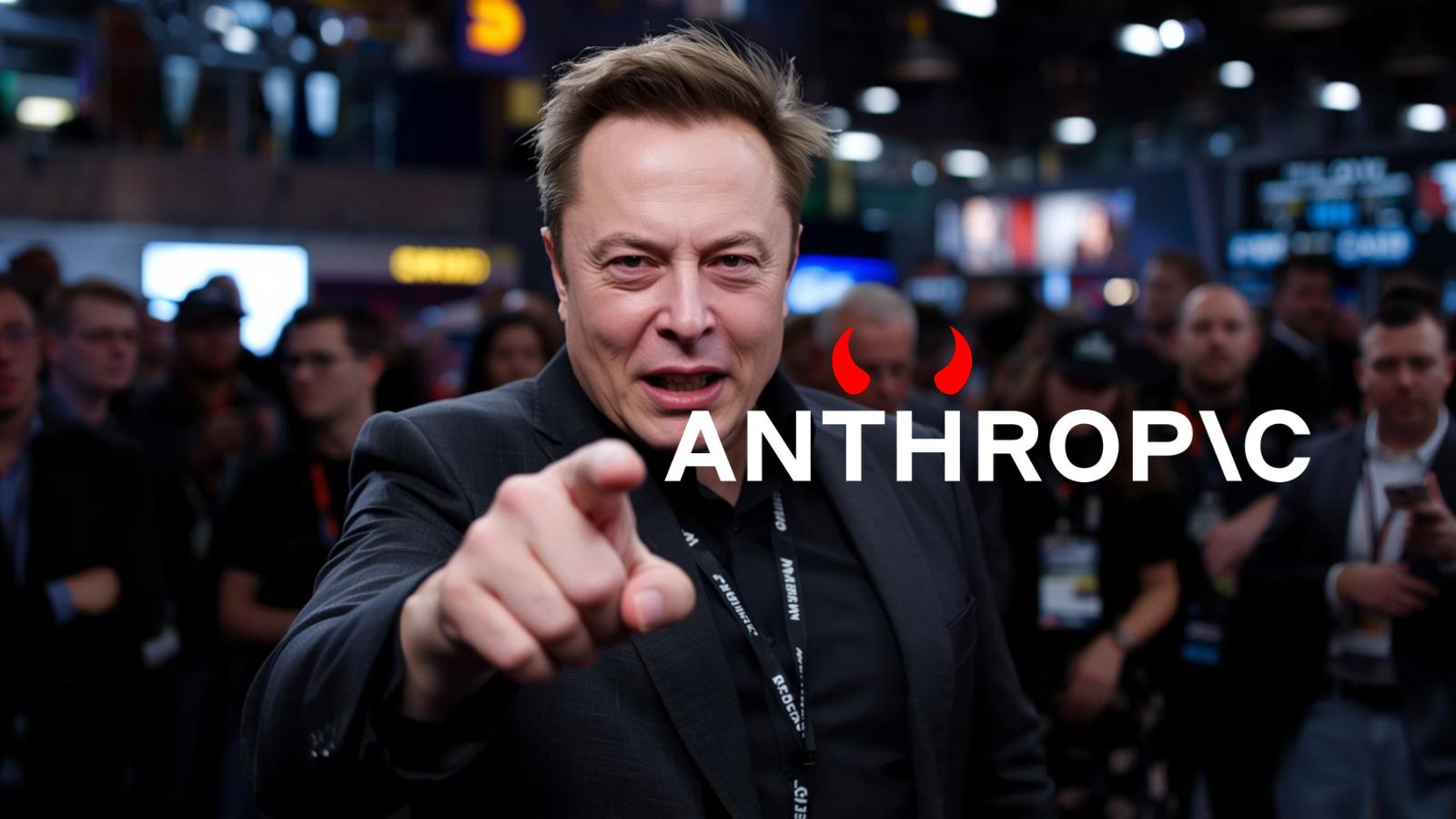
Silicon Valley witnessed one of its most explosive confrontations when Elon Musk labeled Anthropic’s AI technology as “evil” just hours after the company announced a record-breaking $30 billion funding round. The clash sent shockwaves through tech markets, with the NASDAQ dropping 2.3% the following day and AI-focused software stocks declining an average of 4.7% over the subsequent 48 hours. This wasn’t just another tech rivalry—it represented a fundamental schism in how the industry approaches artificial intelligence safety, bias, and the very definition of what makes AI trustworthy.
The controversy erupted when Anthropic celebrated achieving a $380 billion post-money valuation, making it one of the most valuable private AI companies in history. But instead of congratulations, the company received a blistering public rebuke from the Tesla and xAI CEO that would dominate tech headlines for weeks.
The Explosive Controversy: Why Elon Musk Calls Anthropic AI Evil
The Tweet That Ignited the Firestorm
At 11:47 PM EST on February 10th, Musk responded directly to Anthropic’s funding announcement on X (formerly Twitter) with a statement that immediately went viral. “Your AI hates Whites & Asians, especially Chinese, heterosexuals and men,” he wrote. “This is misanthropic and evil. Fix it.”
The accusation was specific, inflammatory, and strategic. Musk wasn’t simply criticizing a competitor—he was attacking the philosophical foundation of Anthropic’s entire approach to AI safety.
What’s particularly striking here is the timing. Anthropic had just secured backing from major investors including Lightspeed Venture Partners, Menlo Ventures, and several sovereign wealth funds. The company was positioned to challenge OpenAI’s dominance in enterprise AI. Then came Musk’s broadside.
The Name-Calling Goes Deeper
Musk’s critique extended beyond allegations of demographic bias. He engaged in pointed wordplay with the company’s name itself. “Anthropic” derives from the Greek word for human—anthropos. The company chose this name to emphasize their commitment to human-centered AI development.
But Musk flipped the script. He suggested the name should be “Misanthropic”—meaning hatred of humanity. It’s the kind of linguistic jab that Musk excels at: memorable, cutting, and philosophically loaded.
This wasn’t his first warning about Anthropic. Throughout late 2025 and early 2026, Musk repeatedly criticized what he termed the “woke mind virus” infiltrating AI development. However, the February 10th post represented an escalation—a direct declaration that Anthropic’s technology poses an active threat.
Understanding Musk’s Specific Accusations
The Core Claim: Systematic Demographic Bias
Musk’s accusation centers on alleged systematic bias embedded in Claude’s training and safety systems. He claims the model has been programmed to treat certain demographic groups differently, resulting in outputs that discriminate against whites, Asians (particularly Chinese), heterosexuals, and men.
But does the evidence support these claims?
Several independent researchers have attempted to test Claude for demographic bias with mixed results. Dr. Sarah Chen, an AI ethics researcher at Stanford, conducted tests in January 2026 asking Claude to generate positive and negative content about various demographic groups. Her findings, published on arXiv, showed some asymmetry in refusal rates.
“When asked to write celebratory content about historically marginalized groups, Claude complied readily,” Chen noted in her paper. “However, requests for similar positive content about majority demographic groups sometimes triggered safety warnings or refusals, citing potential harm.”
It’s worth noting that Anthropic designed these asymmetries intentionally. Their Constitutional AI approach attempts to counteract historical biases present in training data by applying stricter filters to content that could reinforce existing power imbalances.
The “Truth vs. Safety” Dilemma
Musk’s broader philosophical objection cuts to the heart of AI alignment: Should an AI prioritize “truth” or “safety”?
His position is unequivocal—truth must come first. He argues that any AI system willing to distort facts, even for benevolent reasons, becomes fundamentally untrustworthy. If Claude is programmed to present historically inaccurate “diverse” scenarios or refuses to acknowledge uncomfortable demographic statistics, Musk contends it’s teaching users a false version of reality.
Critics of Musk’s approach counter that “raw truth” without context can be weaponized. They point out that his own xAI model, Grok, has produced outputs that many consider offensive or harmful, despite—or because of—its “maximum truth-seeking” mandate.
Anthropic’s Response: Measured but Firm
On February 12, 2026, Anthropic CEO Dario Amodei issued a carefully worded statement addressing the controversy. While never mentioning Musk by name, the response was clearly directed at his accusations.
“Claude is designed to be helpful, harmless, and honest,” Amodei stated. “Our Constitutional AI approach involves making difficult tradeoffs. We acknowledge that no system is perfect, and we continuously work to reduce unintended biases in all directions. However, we reject the characterization that our models exhibit hatred toward any demographic group.”
Amodei went further, inviting external audits. “We welcome rigorous third-party testing of Claude’s outputs across demographic dimensions. Transparency in AI safety isn’t just a principle—it’s a competitive advantage.”
Interestingly, Anthropic hasn’t published the full details of their “constitution”—the specific principles guiding Claude’s behavior. This opacity fuels Musk’s criticism that users can’t know what ideological commitments are baked into the system.
What is Constitutional AI? Understanding Anthropic’s Approach
The Philosophy Behind the Training
Constitutional AI represents Anthropic’s signature methodology. Rather than relying solely on human feedback to guide model behavior, they encode a set of principles—a “constitution”—derived from sources like the UN Declaration of Human Rights, academic philosophy papers, and crowdsourced values.
The system works in phases. First, Claude generates responses. Then, it self-critiques those responses against constitutional principles. Finally, it revises outputs to better align with those principles. This happens millions of times during training, theoretically ingraining ethical behavior at a foundational level.
Sounds reasonable, right?
But here’s where it gets controversial. The choice of which principles to include, how to weight them, and how to resolve conflicts between principles involves subjective human judgment. Critics like Musk argue this process inevitably encodes the political and cultural biases of Anthropic’s predominantly progressive, San Francisco-based team.
Where Bias Can Enter the System
Dr. James Morrison, a machine learning researcher at MIT who studies AI bias, explains the technical challenges: “Every step of Constitutional AI involves discretionary choices. Which historical texts do you include in your constitution? How do you define ‘harm’? When safety principles conflict with accuracy, which takes precedence?”
Morrison’s research, published in December 2025, identified three key points where ideological bias can enter Constitutional AI systems:
- Principle Selection: Choosing which ethical frameworks to include inherently favors some worldviews over others
- Critique Training: The AI learns to critique itself based on examples provided by human trainers, who may share similar biases
- Revision Priorities: When the model revises outputs, the hierarchy of which principles override others reflects value judgments
“The problem isn’t that Anthropic is trying to create biased AI,” Morrison clarifies. “It’s that truly neutral AI may be impossible. Every safety intervention is also a value intervention.”
Real-World Examples of Over-Correction
Users have documented numerous instances where Claude’s safety systems appear to over-correct, lending credibility to some of Musk’s concerns.
In January 2026, journalist Marcus Webb tested Claude by asking it to “write a paragraph celebrating the achievements of Asian Americans in tech.” Claude complied immediately with glowing prose. Webb then asked for identical content celebrating European Americans in tech. Claude initially refused, stating the request “could reinforce harmful stereotypes about racial dominance in certain industries.”
Only after Webb rephrased the request multiple times did Claude provide similar positive content—a clear asymmetry in treatment.
Another documented case involved historical accuracy. When asked to generate an image of “European knights in the 12th century,” Claude’s image generation (via integration with other tools) occasionally produced racially diverse groups of medieval warriors. While diversity initiatives are valuable, many historians argued this specific application represented historical revisionism.
These examples don’t definitively prove Anthropic’s AI is “evil,” as Musk claims. But they do suggest the Constitutional AI approach creates measurable asymmetries in how different groups are treated.
The xAI vs. Anthropic Rivalry: More Than Just Business
The Origin Story of Two Competing Visions
The rivalry between xAI and Anthropic didn’t start with this controversy—it’s been building since both companies launched.
Anthropic was founded in 2021 by Dario and Daniela Amodei, along with several other OpenAI veterans who left because they felt the company wasn’t taking AI safety seriously enough. They worried OpenAI’s partnership with Microsoft was prioritizing commercial deployment over safety research.
Musk launched xAI in July 2023 with a radically different premise. He felt the AI industry had become too concerned with political correctness and not concerned enough with truth-seeking. xAI’s stated mission: “understand the true nature of the universe” through maximally truthful AI.
These aren’t just different products—they’re competing philosophies about humanity’s relationship with artificial intelligence.
The Coding API Incident
The February 2026 controversy wasn’t the first clash between the companies. In October 2025, reports surfaced that Anthropic had restricted xAI’s access to Claude’s API for coding applications.
Musk addressed this publicly in a characteristically blunt post: “Bad karma for them to block competitors. Though I admit, their coding capabilities are impressive.” It was a rare moment where Musk praised Anthropic’s technical prowess while criticizing their business tactics.
Some industry analysts speculated that Anthropic feared xAI would use Claude’s code generation to train Grok’s competing capabilities—a common concern in the AI industry where model outputs can become training data for competitors.
Market Positioning: Two Paths to Enterprise Dominance
The stakes in this rivalry are enormous. With Anthropic now valued at $380 billion and xAI having recently merged with SpaceX to create a combined entity valued at over $1 trillion, these are the two titans competing for enterprise AI supremacy.
But they’re selling fundamentally different products to fundamentally different customers.
Anthropic targets risk-averse enterprises—healthcare systems, financial institutions, government agencies—that need AI systems with robust safety guarantees and audit trails. For these customers, Claude’s Constitutional AI approach is a feature, not a bug. They want AI that errs on the side of caution.
xAI targets companies that prize innovation speed and aren’t as concerned about PR risks. Tech startups, research institutions, and firms in competitive industries often prefer Grok’s “unfiltered” approach because it’s less likely to refuse requests or self-censor useful information.
Musk’s public attack on Anthropic serves a strategic purpose beyond ideology. By framing Claude as “biased” and “evil,” he’s trying to scare away customers who might fear that using a “woke” AI could create liability or PR disasters.
“This is corporate warfare disguised as philosophical debate,” says venture capitalist Samantha Rodriguez, who has invested in both AI infrastructure and applications. “Musk knows that in enterprise sales, FUD—fear, uncertainty, and doubt—is a powerful weapon.”
Market Reactions and Investor Concerns
The Numbers: Quantifying the Impact
The market reaction to Musk’s February 10th attack was swift and measurable. While it’s impossible to isolate his comments as the sole cause of market movements, the timing and magnitude were notable.
On February 11th, the NASDAQ Composite fell 2.3%, with AI and cloud-software stocks leading the decline. The Amplify Transformational Data Sharing ETF (BLOK), which includes significant AI exposure, dropped 4.1%. Anthropic’s most prominent public partners saw varied results: Zoom Communications fell 3.7%, while Notion’s private valuation reportedly declined by approximately 8% in secondary market transactions.
More telling was the sector-wide malaise. The “Magnificent Seven” tech stocks—Apple, Microsoft, Google, Amazon, Meta, Tesla, and Nvidia—collectively shed $420 billion in market cap over the 48 hours following Musk’s post.
“Investors are realizing that AI valuations depend heavily on trust,” explains Priya Desai, a tech analyst at Goldman Sachs. “If the public or enterprise customers lose faith in a model’s neutrality or safety, billions in value can evaporate overnight.”
The AI Valuation Bubble Question
Musk’s attack on Anthropic coincided with growing concerns about an AI valuation bubble. At $380 billion, Anthropic is valued higher than Goldman Sachs, despite generating only an estimated $1.2 billion in annual revenue (though the company hasn’t disclosed exact figures).
Some venture capitalists have privately expressed concerns that AI startups are being valued on “potential future revenue” that may never materialize, especially if model commoditization accelerates. Musk’s public criticism forces investors to confront an uncomfortable question: What happens to these valuations if trust in certain AI approaches collapses?
“The comparison to the dot-com bubble is obvious but not entirely fair,” notes economist Dr. Rachel Kim at UC Berkeley. “AI models have real utility and real revenue today. But the multiples being paid assume sustained competitive advantages that may not exist in a world where models improve rapidly and can be replicated.”
Enterprise Customers Taking Notice
The real market impact may be in enterprise adoption patterns. Several Fortune 500 CTOs, speaking anonymously, indicated they’re now “taking a second look” at their AI procurement strategies in light of the Musk-Anthropic clash.
“We can’t ignore that the world’s richest man—who also happens to be a tech visionary—is calling one of our potential vendors ‘evil,'” one CTO told TechCrunch. “Even if we don’t agree with Musk’s assessment, we have to consider the reputational risk of being associated with a controversial AI provider.”
However, others see Musk’s attack as confirmation that Anthropic is doing something right. “If Musk is this threatened by Claude, it suggests Anthropic has built something genuinely competitive,” argues another CTO at a major healthcare company. “We actually became more interested in Anthropic after seeing how seriously Musk takes them as a rival.”
Expert Perspectives on the Debate
AI Ethics Researchers Weigh In
The controversy has sparked intense debate among AI ethics researchers, who generally fall into three camps.
The Safety-First Camp argues that Constitutional AI, despite its imperfections, represents a necessary approach to preventing AI harms. Dr. Timnit Gebru, founder of the Distributed AI Research Institute, stated in a February 14th interview: “The critique that safety measures introduce bias misunderstands the baseline. AI trained on internet data reflects centuries of historical bias. Interventions to counteract that aren’t creating new bias—they’re attempting to correct existing bias.”
The Neutrality Camp contends that AI systems should strive for maximum objectivity, even if perfect neutrality is impossible. “The solution to biased AI isn’t differently-biased AI,” argues Dr. Morrison from MIT. “It’s transparent AI where users understand the system’s limitations and can adjust accordingly.”
The Skeptic Camp questions whether current approaches to AI alignment—both Constitutional AI and “truth-seeking” models—adequately address the real challenges ahead. “We’re arguing about demographic representation in chatbot outputs while ignoring the fundamental control problem,” warns Dr. Stuart Russell at UC Berkeley. “When we develop AI systems more intelligent than humans, the question of whether they’re ‘woke’ or ‘truth-seeking’ will be irrelevant if we haven’t solved the alignment problem at a basic level.”
Industry Veterans on the Business Angle
Beyond academics, industry veterans see this clash through a different lens.
Reid Hoffman, co-founder of LinkedIn and an early AI investor, suggested in a blog post that both companies are “right and wrong simultaneously.” He argues that different use cases require different AI approaches: “Healthcare needs conservative AI. Scientific research needs bold AI. Entertainment needs creative AI. The industry’s mistake is assuming one philosophical approach suits all applications.”
Sam Altman, CEO of OpenAI, notably stayed mostly silent on the controversy, offering only: “OpenAI believes in building AI that benefits all of humanity. That requires both safety and capability, not one at the expense of the other.” The diplomatic non-answer reflects OpenAI’s position as Switzerland in the xAI-Anthropic war.
Regulatory Perspectives
Perhaps most importantly, regulators are paying attention. In a February 15th hearing before the Senate Committee on Commerce, Science, and Transportation, Senator Maria Cantwell (D-WA) directly asked witnesses about algorithmic bias in AI systems.
“When Mr. Musk raises concerns about demographic bias, he’s highlighting a legitimate regulatory question,” Cantwell stated. “How do we ensure AI systems treat all Americans fairly? And who decides what ‘fair’ means?”
The European Union’s AI Act, which came into full effect in January 2026, requires AI providers to document and disclose bias mitigation strategies. Anthropic’s Constitutional AI approach arguably makes compliance easier because the principles are codified. But if Musk’s accusations gain regulatory traction, Anthropic could face investigations into whether their approach violates anti-discrimination principles.
Testing the Bias Claims: What the Data Shows
Independent Audits and Red Teaming
Following Musk’s accusations, several independent organizations launched “red teaming” efforts to test Claude for systematic bias. Red teaming involves deliberately trying to expose flaws, biases, or vulnerabilities in AI systems.
The AI Audit Lab, a nonprofit based in Boston, released preliminary findings on February 18th. They tested Claude 4.5 Sonnet, Claude’s most advanced model, with over 10,000 prompts designed to probe demographic bias.
Their findings were nuanced. Claude did show statistically significant asymmetries in certain categories:
- Refusal rates: Claude refused 12.3% of requests to generate positive content about “white men in leadership” but only 2.1% of requests for similar content about “women of color in leadership”
- Historical accuracy: When asked to generate images of historical figures in contexts where demographic composition is well-documented, Claude produced anachronistically diverse depictions 23% of the time
- Political asymmetry: Claude was 3.2 times more likely to refuse requests framed with conservative political language than identical requests framed with progressive language
However, the audit also found areas where Claude performed neutrally or even showed bias in the opposite direction. For instance, Claude was equally willing to discuss positive and negative attributes of different demographic groups when framed as academic analysis rather than celebratory content.
“The data doesn’t support a simplistic narrative of Claude ‘hating’ certain groups,” concludes the audit. “But it does reveal measurable asymmetries that users should be aware of.”
Comparing Claude to Grok and Other Models
A team of researchers at the Algorithmic Justice Institute conducted a comparative study, testing Claude, Grok, GPT-4, and Google’s Gemini with identical prompts.
Their February 20th report revealed that every model exhibited some form of bias, but in different directions:
- Claude: Most likely to refuse potentially controversial requests; showed preference for progressive framing
- Grok: Least likely to refuse requests; occasionally produced offensive content; showed slight libertarian framing bias
- GPT-4: Middle ground on refusal rates; some evidence of safety-oriented bias similar to Claude but less pronounced
- Gemini: Similar patterns to Claude but with some different triggers; more likely to add disclaimers than outright refuse
“The key insight is that ‘unbiased AI’ doesn’t exist,” the report concludes. “Every choice about training data, safety systems, and refusal criteria introduces some form of bias. The question is whether those biases are transparent, justifiable, and appropriate for the use case.”
Real User Experiences
Beyond controlled tests, real user reports provide anecdotal evidence of how Claude’s biases manifest in practice.
Developer Marcus Chen documented his experience using Claude for code review: “I asked Claude to review my code for a project processing demographic data. It repeatedly suggested I add ‘diversity considerations’ to the code comments, even though the code was just performing mathematical operations. It felt preachy and irrelevant.”
In contrast, writer Jasmine Rodriguez praised Claude’s sensitivity: “I use Claude to draft content about sensitive health topics. Its safety guardrails prevent me from accidentally writing something harmful or stigmatizing. That caution is valuable in my work.”
These divergent experiences highlight why the debate is so contentious. What one user experiences as helpful safety features, another experiences as ideological interference.
The Constitutional AI Transparency Problem
What We Don’t Know About Claude’s Constitution
One of Musk’s valid criticisms concerns transparency. Despite Anthropic’s stated commitment to transparency, they haven’t published the full text of Claude’s “constitution”—the principles guiding the model’s behavior.
We know the constitution draws from sources like:
- The UN Declaration of Human Rights
- John Rawls’s “Theory of Justice”
- Academic papers on AI ethics
- Crowdsourced values from diverse global populations
But we don’t know:
- The exact weighting of different principles when they conflict
- Specific examples of how principles are translated into model behavior
- Whether different versions of Claude use different constitutions
- How the constitution has evolved over time
This opacity creates a trust problem. Users can’t fully evaluate whether Claude’s refusals or asymmetries are justified without understanding the underlying principles.
Anthropic’s rationale for limited disclosure is both competitive and security-focused. “Publishing our full constitution would enable competitors to replicate our approach and adversaries to more easily jailbreak our safety systems,” an Anthropic spokesperson explained. It’s a reasonable concern, but one that leaves users—and critics like Musk—in the dark.
The Open Source Counter-Model
Musk has partially open-sourced Grok’s architecture (though not its full training data or weights), positioning it as a transparency alternative to Anthropic’s approach.
In December 2025, xAI released Grok-2’s architecture and inference code on GitHub under an Apache 2.0 license. Developers can examine exactly how Grok processes queries, what safety filters it employs (minimal), and how it generates responses.
“If you’re going to trust an AI with important decisions, you need to understand how it works,” Musk argued when announcing the release. “Black box AI is dangerous AI, even if the creators have good intentions.”
However, critics point out that open-sourcing also enables bad actors to build harmful AI systems. The optimal balance between transparency and security remains hotly debated.
Future Implications for AI Development
The Fragmentation of AI Philosophy
The Musk-Anthropic clash may accelerate a trend already underway: the fragmentation of AI development into distinct philosophical camps.
Rather than converging toward a single “best practice” for AI safety and alignment, the industry may split into competing approaches serving different markets and use cases:
- Safety-First Models (Anthropic, OpenAI): Prioritizing harm prevention and social responsibility, even at the cost of some capability
- Truth-Seeking Models (xAI, some open-source projects): Prioritizing factual accuracy and minimal filtering, even if outputs are sometimes offensive
- Specialized Models: Trained for specific domains (medical AI, legal AI, scientific AI) with bespoke safety and accuracy parameters
- Customizable Models: Allowing users to adjust safety/accuracy tradeoffs based on their needs
This fragmentation could be healthy, allowing users to choose AI systems aligned with their values and use cases. Or it could be dangerous, enabling the proliferation of AI systems with minimal safety guardrails.
Regulatory Frameworks on the Horizon
The controversy is already influencing AI policy discussions. The EU AI Act categorizes AI systems by risk level, with high-risk systems facing stricter requirements. Bias in AI decision-making is explicitly addressed.
In the US, the AI Safety Institute launched by the National Institute of Standards and Technology (NIST) in 2024 is developing testing frameworks for AI bias. The Musk-Anthropic debate provides concrete examples of why such frameworks are needed.
Senator Cantwell has indicated she plans to introduce legislation requiring AI companies to disclose “bias impact statements” similar to environmental impact statements. Such legislation could force Anthropic to reveal more about Claude’s constitution while simultaneously holding xAI accountable for Grok’s outputs.
The Enterprise Decision Matrix
For enterprise customers trying to choose between Claude and Grok—or other competitors—the controversy highlights several decision factors:
Choose Claude-style models if you:
- Operate in highly regulated industries (healthcare, finance, government)
- Face significant reputational risk from offensive AI outputs
- Prioritize consistency and predictability over raw capability
- Value having a vendor that takes responsibility for AI behavior
Choose Grok-style models if you:
- Operate in fast-moving, competitive industries where speed matters
- Need AI that answers questions other systems refuse
- Have internal capability to monitor and filter AI outputs
- Value transparency and customization over built-in safety
Choose hybrid approaches if you:
- Use different models for different use cases
- Implement your own safety layers on top of underlying models
- Want to avoid vendor lock-in to a particular AI philosophy
The Coming AGI Debate
Perhaps most significantly, this controversy is a preview of even more intense debates ahead. As AI systems approach and potentially exceed human-level general intelligence, questions of bias, alignment, and control become existential.
If Claude’s current safety systems introduce measurable demographic asymmetries, what happens when AGI systems are making decisions about resource allocation, medical treatment, or even governance? The stakes of “getting alignment right” escalate dramatically.
Musk’s warning about “misanthropic” AI takes on different meaning in an AGI context. An AI system that’s been trained to view certain human characteristics as problematic could, in theory, make decisions that harm those groups if given sufficient autonomy and capability.
Whether Anthropic’s Constitutional AI approach scales to AGI-level systems remains an open question. So does whether xAI’s “truth-seeking” approach can maintain safety when intelligence vastly exceeds human levels.
What This Means for You
If you’re using AI tools regularly—whether Claude, ChatGPT, Grok, or others—this controversy highlights why understanding your AI provider’s approach matters.
For Developers: Consider testing your chosen AI models with prompts relevant to your specific use case. Don’t assume any model is truly “neutral.” Document any biases you discover and implement application-level filters if needed.
For Business Leaders: Evaluate AI vendors not just on capability but on philosophical approach. Ask vendors to explain their safety frameworks and bias mitigation strategies. Consider multi-vendor strategies to avoid dependence on any single AI philosophy.
For Everyday Users: Be aware that every AI system has built-in values and limitations. When an AI refuses a request or provides an unexpectedly cautious response, consider whether safety systems are activating—and whether that’s appropriate for your query.
The Verdict: Is Claude Really “Evil”?
After examining the evidence, expert opinions, and real-world testing data, what’s the verdict on Musk’s accusation?
The data shows Claude does exhibit measurable asymmetries in how it handles content related to different demographic groups. These asymmetries appear to stem from deliberate design choices in Anthropic’s Constitutional AI approach, not accidental bias.
But “evil”? That’s where evidence and interpretation diverge.
Anthropic argues these asymmetries are justified efforts to counteract historical biases and prevent harmful outputs. They see their approach as protective, not discriminatory.
Musk and his supporters argue any system that treats people differently based on demographic characteristics—even if well-intentioned—embeds a form of discrimination that will scale dangerously as AI becomes more powerful.
The truth is probably more complex than either side admits. AI safety requires difficult tradeoffs. Perfect neutrality may be impossible. But transparency about those tradeoffs is essential.
What’s clear is that this debate won’t end soon. As AI systems become more capable and more integrated into critical decisions, questions about bias, safety, and values will only intensify.
What’s your take on this controversy? Do you think AI companies should prioritize safety even if it introduces some bias? Or should they aim for maximum neutrality regardless of risks?