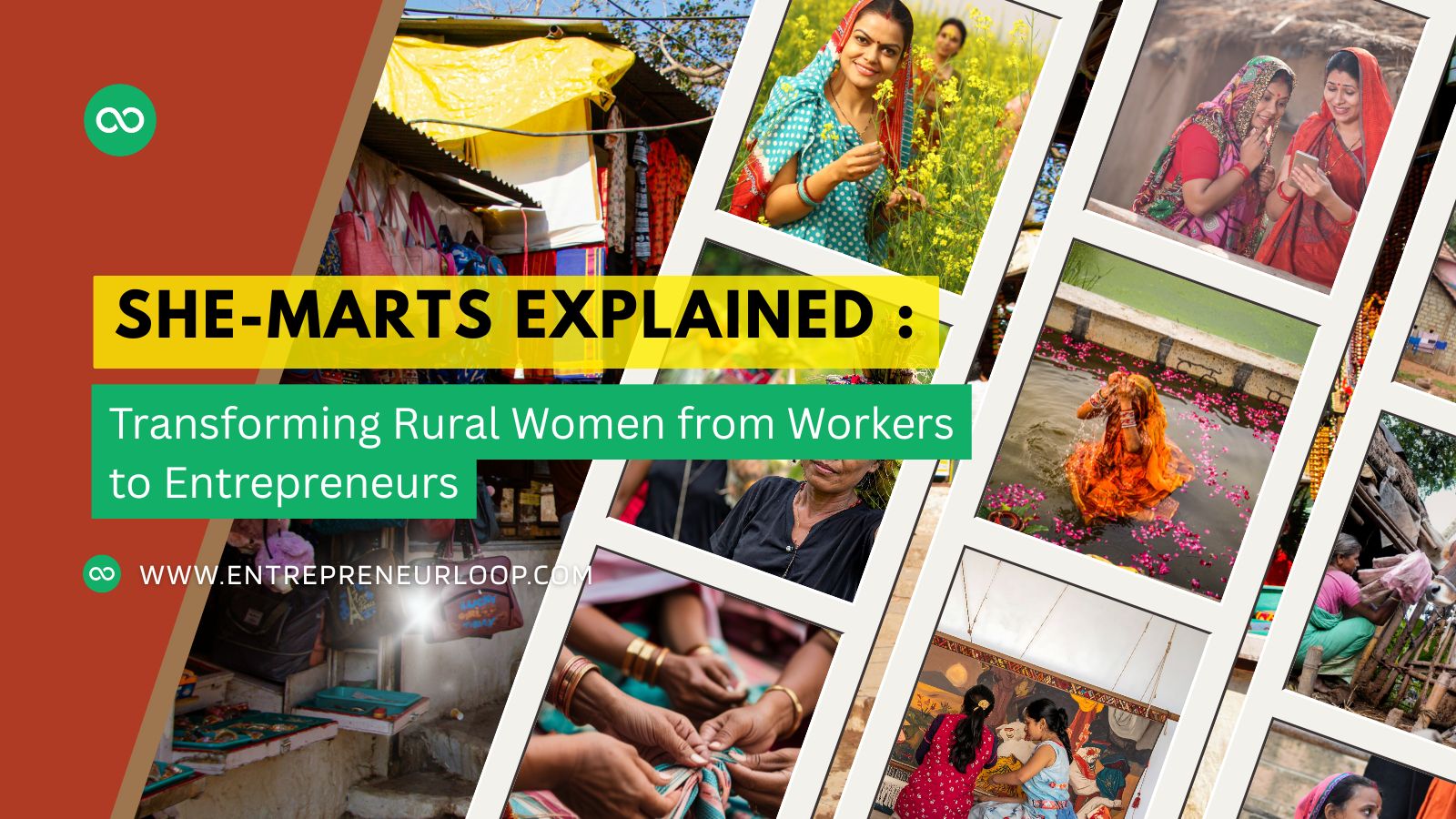
SHE-Marts Explained: Transforming Rural Women from Workers to Entrepreneurs

On February 1, 2026, Finance Minister Nirmala Sitharaman fundamentally altered the trajectory of India’s rural economy by announcing the creation of SHE-Marts during her Union Budget speech. This initiative marks a decisive policy shift from merely providing credit to rural women to establishing them as legitimate owners of retail enterprises. The government’s introduction of these community-owned outlets represents the most significant structural upgrade to the Self-Help Group (SHG) ecosystem since the inception of the Lakhpati Didi programme. By explicitly targeting the “ownership” phase of entrepreneurship, the administration is acknowledging that access to capital is no longer the primary bottleneck for rural women—access to organized markets is.
The announcement of SHE-Marts has immediately sparked conversations across the development and economic sectors about the future of rural commerce. For decades, rural women have been confined to the production end of the supply chain, often selling their goods at local haats (weekly markets) or through exploitative middlemen who capture the majority of the value. [The Union Budget 2026-27 seeks to dismantle this archaic structure] by placing the retail machinery directly into the hands of the producers themselves. This is not just a branding exercise; it is an infrastructure project designed to give products made by rural women a physical, professional storefront that can compete with established commercial entities.
As we analyze this development on February 2, 2026, it is crucial to understand that SHE-Marts are not standalone shops but part of a sophisticated network. They will be integrated into Cluster-Level Federations (CLFs), which are the larger umbrella organizations that oversee multiple village-level SHGs. This strategic placement ensures that SHE-Marts have the volume and variety of products necessary to attract consistent footfall. The initiative essentially corporatizes the collective output of millions of women, giving them the “front-end” retail presence that has always been the missing piece of the rural puzzle.
What Are SHE-Marts?
At its core, the term “SHE-Marts” stands for Self-Help Entrepreneur Marts. These are envisioned as modern, community-owned retail outlets managed and operated entirely by women-led Self-Help Groups. Unlike temporary stalls or exhibition counters that have characterized previous government marketing efforts, SHE-Marts are designed to be permanent brick-and-mortar establishments. [Finance Minister Sitharaman explicitly stated that these marts will be established within cluster-level federations], ensuring they serve as aggregation points for products from multiple villages.
The concept of SHE-Marts explained simply is the vertical integration of the rural women’s economy. Until now, a woman weaving baskets or making pickles in a remote village had to rely on a complex web of intermediaries to get her product to a town or city. SHE-Marts eliminate these layers. By owning the retail outlet, the collective retains the retail margin that was previously lost to traders. This model draws inspiration from successful cooperative movements but adds a modern retail layer that demands professional management and standardized branding.
A critical component of this initiative is the “community-owned” aspect. This means the equity and profits of the SHE-Marts belong to the SHG members themselves. It is a move away from the beneficiary model, where the government gives aid, to a shareholder model, where women own the assets. [The government has promised to support this transition through “enhanced and innovative financing instruments”], suggesting that we may see new types of loan products or micro-equity structures designed specifically for retail infrastructure rather than just working capital.
The Evolution: From Lakhpati Didi to Enterprise Owners
To understand the significance of SHE-Marts, we must look at the foundation upon which they are built. The Lakhpati Didi programme was a massive success in terms of income generation, helping millions of women cross the annual income threshold of ₹1 Lakh. However, income generation is not the same as wealth creation or business ownership. [The government’s stated goal is to help women take the next step from “credit-linked livelihoods” to being “owners of enterprises”]. This distinction is vital for long-term economic resilience.
A livelihood often implies subsistence—working to meet daily needs. An enterprise implies growth, asset accumulation, and scalability. SHE-Marts are the vehicle for this transition. Under the previous model, a woman might take a loan to buy a sewing machine (livelihood). Under the SHE-Marts model, her SHG federation takes a larger financing package to open a clothing store (enterprise) that sells the garments she and fifty other women produce. This shift from individual production to collective retail ownership is what makes the SHE-Marts union budget 2026 announcement so revolutionary.
The “credit-linked livelihood” model has served India well, creating a vast network of credit-disciplined women. However, without control over the point of sale, these women remained price-takers. They could not dictate terms to the market. SHE-Marts change this dynamic. By controlling the retail interface, rural women empowerment becomes a matter of economic leverage rather than just financial inclusion. They can control pricing, inventory, and customer experience, effectively moving up the value chain where the profit margins are significantly higher.
Operational Structure and Cluster-Level Federations
The operational backbone of SHE-Marts will be the Cluster-Level Federations (CLFs). For those unfamiliar with the SHG hierarchy, a CLF is a powerful node that typically aggregates 5 to 20 Village Organizations, representing hundreds or even thousands of individual women. Anchoring SHE-Marts at this level is a strategic masterstroke. An individual SHG might not have enough product diversity to stock a full retail store, but a CLF certainly does. [This aggregation model allows for economies of scale], ensuring that the shelves of a SHE-Mart are always stocked with a wide variety of goods, from textiles and handicrafts to processed foods and organic produce.
We can expect the operational model of SHE-Marts to require a new set of skills. The women running these marts will need training in inventory management, visual merchandising, customer service, and digital payments. This opens up a secondary layer of opportunity for younger, educated women in rural areas who can be employed as store managers or accountants for these marts. [The initiative is expected to create sustainable livelihood opportunities] not just for the producers, but for the retail workforce that will manage these outlets.
Furthermore, the “innovative financing instruments” mentioned in the budget speech likely point towards a departure from standard term loans. Establishing a retail outlet requires significant upfront capital for interiors, stocking, and branding. We might see the introduction of soft loans with longer moratorium periods, or perhaps a blended finance model where government grants cover the infrastructure setup while bank loans cover the working capital. This financial structuring will be critical to the survival of SHE-Marts in their early years.
SHE-Marts Impact on the Rural Economy
The economic ripple effects of SHE-Marts will extend far beyond the women who own them. By creating a formalized retail sector in rural and semi-urban areas, these marts will stimulate local economies. Currently, a significant portion of rural consumption expenditure flows out to urban centers or large corporate FMCG brands. SHE-Marts offer a way to circulate money within the local community. When a villager buys soap or spices from a SHE-Mart, that money stays within the SHG network, eventually returning to the producers as dividends or increased purchase orders.
We must also consider the potential for SHE-Marts to act as quality control hubs. To sell in a formal retail store, products must meet certain packaging and quality standards. This requirement will force an upgrade in the production processes of rural enterprises. [The move is expected to improve market access for products made by women], but it will also necessitate a standardization of those products. This “formalization by default” will make rural products more competitive not just in SHE-Marts, but potentially in export markets as well.
The SHE Marts impact will also be visible in the digital domain. It is highly probable that these physical marts will serve as fulfillment centers for digital commerce. With the government’s push for the Open Network for Digital Commerce (ONDC), a physical SHE-Mart can easily double as a warehouse for online orders. This hybrid “phygital” model would allow a rural woman’s enterprise to sell to a customer in Mumbai or Delhi, with the SHE-Mart handling the logistics and quality assurance.
Addressing the Market Access Gap
One of the most persistent failures in rural development has been the inability to solve the “last mile” of sales. We have become very good at training women to make things, but very poor at helping them sell those things. SHE-Marts explained in this context are a direct answer to the market access gap. [Rural women entrepreneurship success has often been hindered by a lack of visibility]. A woman making excellent turmeric powder in a remote village has no way to signal her quality to a buyer ten kilometers away. A SHE-Mart provides that signal.
These marts will likely function as local department stores. Instead of a chaotic weekly market where goods are exposed to dust and sun, SHE-Marts will offer a dignified shopping experience. This dignity is crucial for branding. It signals to the consumer that rural products are not “charity purchases” but high-quality goods worthy of shelf space. This psychological shift in how rural products are perceived is perhaps the most intangible but valuable asset that SHE-Marts will create.
Moreover, the sheer visibility of SHE-Marts in rural towns will serve as a powerful advertisement for women-led markets. It normalizes the image of women as business owners and retail managers. In many conservative rural pockets, women are still discouraged from interacting with male customers or handling large sums of cash. SHE-Marts, being all-women spaces, provide a safe and culturally acceptable environment for women to engage in commerce, slowly chipping away at patriarchal restrictions on women’s mobility and economic agency.
The Role of Self-Help Groups Women in the New Economy
The narrative of the “poor woman” needing aid is being replaced by the “entrepreneurial woman” needing investment. Self-help groups women have proven themselves to be the most reliable borrowers in the Indian financial system, with Non-Performing Asset (NPA) rates that are the envy of corporate banks. SHE-Marts are a vote of confidence in this reliability. The government is essentially betting that the same discipline women showed in repaying micro-loans will translate into managing retail profit and loss statements.
This transition will require a massive capacity-building exercise. Managing a retail store is infinitely more complex than managing a savings group. It involves supply chain logistics, expiry date management, customer relationship management, and competitive pricing. [The success of the Lakhpati Didi programme] was built on simple, replicable models. SHE-Marts are bespoke and complex. The government will need to deploy extensive training modules, perhaps partnering with retail management institutes or private sector retail giants to mentor these women.
We are also seeing a semantic shift. By calling them “Self-Help Entrepreneur Marts,” the government is rebranding the SHG member. She is no longer just a “member”; she is an “entrepreneur.” This identity shift is crucial for rural women entrepreneurship success. When a woman sees herself as a business owner, her risk appetite, investment decisions, and long-term planning change. She begins to think about expansion, marketing, and customer retention—concepts that are alien to a subsistence livelihood mindset.
Challenges to Anticipate
Despite the immense promise, the road to establishing successful SHE-Marts will be paved with challenges. The retail sector is brutal, with thin margins and fierce competition. SHE-Marts will not just be competing with other local shops; they will be competing with the distribution networks of massive FMCG conglomerates that penetrate even the smallest villages. [Experts have noted that regular bank loans may not be enough] to sustain these marts against such competition, which validates the need for the innovative financing mentioned in the budget.
Supply chain consistency is another potential hurdle. A retail store cannot afford to have empty shelves. Rural production is often seasonal and fragmented. If a SHE-Mart relies on local SHGs for inventory, what happens during the harvest season when women are busy in the fields? Developing a robust, year-round supply chain that can withstand the seasonality of rural labor will be the biggest operational test for the Cluster-Level Federations managing these marts.
There is also the risk of elite capture. In any community structure, the most powerful or politically connected members often seize control of the most lucrative assets. Ensuring that SHE-Marts remain truly democratic and that the profits are shared equitably among the poorest SHG members will require vigilant oversight. The governance structure of these marts must be transparent, with digital bookkeeping that allows any member to audit the store’s performance.
Financing the Future: Beyond Micro-Credit
The mention of “enhanced and innovative financing instruments” in the SHE Marts union budget 2026 speech is particularly intriguing. Traditional microfinance is ill-suited for retail infrastructure. High-interest, short-term loans crush low-margin retail businesses before they can break even. We might expect the government to introduce long-term capital loans with interest subvention, or perhaps a “viability gap funding” model where the government covers the operational losses of a SHE-Mart for the first two years.
Another possibility is the securitization of future cash flows. If a SHE-Mart has a steady stream of customers, that revenue can be collateralized to raise cheaper capital. This level of financial sophistication has rarely been applied to rural women’s enterprises. If successful, SHE-Marts could become the testing ground for a new class of financial products designed for the “missing middle”—enterprises that are too big for microfinance but too small for corporate banking.
The banking sector will play a pivotal role here. Banks have historically been hesitant to lend for rural infrastructure projects without hard collateral. [The government’s push to move women from credit-linked livelihoods to owners] implies that the state might stand as a guarantor for these SHE-Marts, de-risking the proposition for lenders. This credit guarantee would unlock the floodgates of private capital, allowing SHE-Marts to scale much faster than if they relied solely on government grants.
Integration with Digital Platforms
In 2026, no retail strategy is complete without a digital component. SHE-Marts are perfectly positioned to leverage the digital public infrastructure India has built. We can envision SHE-Marts using UPI for all transactions, building a credit history based on real-time cash flow data. This data-rich environment would allow lenders to offer instant working capital loans based on the previous week’s sales, bypassing the cumbersome paperwork of traditional lending.
Furthermore, SHE-Marts could serve as the physical touchpoints for a broader digital ecosystem. They could offer assisted e-commerce services, helping rural customers buy goods online that aren’t available locally. Conversely, they can list their unique local products on national marketplaces. [The initiative aims to improve market access], and in today’s world, market access is synonymous with digital visibility. A SHE-Mart that is integrated into the ONDC network instantly has a national market, not just a local one.
This digital integration also aids in transparency. If inventory and sales are tracked digitally, the leakage of funds—a common plague in cooperative models—can be minimized. Real-time dashboards could allow district administrators to monitor the health of every SHE-Mart in their jurisdiction, intervening early if a particular store shows signs of financial distress.
The Socio-Cultural Shift
The establishment of SHE-Marts will inevitably alter the social fabric of rural India. When women control the town’s main retail outlet, power dynamics shift. Men will have to do business with women—selling them raw materials, buying finished goods, or negotiating transport. This daily economic interaction normalizes female authority in the public sphere. [The SHE Marts impact] will be measured not just in rupees, but in the confidence of the women standing behind those counters.
We have seen with the Lakhpati Didi programme that economic power leads to social voice. Women who earn money are more likely to participate in Gram Sabha meetings, demand better schools, and fight against social ills like alcoholism or dowry. SHE-Marts amplify this. A woman running a store is a public figure. She is visible, she is essential to the community’s daily life, and she commands respect. This visibility is a powerful antidote to the invisibility that rural women often suffer.
Moreover, SHE-Marts can become community hubs. They can host financial literacy workshops, health camps, or skill training sessions. Because they are community-owned, they are not just profit centers but social assets. They can become the physical headquarters for rural women empowerment, a place where business and social progress intersect.
Conclusion: A New Era of Ownership
The launch of SHE-Marts in the Union Budget 2026 is more than just a new scheme; it is a graduation ceremony for the Self-Help Group movement. After decades of proving their creditworthiness and production capacity, rural women are finally being given the keys to the shop. By focusing on ownership, the government is acknowledging that true empowerment comes from controlling the asset, not just working for it.
The success of SHE-Marts will depend on execution. It will require a delicate balance of government support and private sector efficiency. It will need “innovative financing” that is truly innovative, and training that is truly practical. But the vision is clear: a rural India where women are not just the workers in the field or the factory, but the owners of the market itself.
As these SHE-Marts begin to open their shutters across the country, they will stand as physical proof of a changing India. They represent a move away from the charity model of development toward an equity model. For the millions of women who have already become Lakhpati Didis, SHE-Marts are the answer to the question, “What next?” The answer is ownership. The answer is enterprise. The answer is SHE-Marts.
Frequently Asked Questions
What exactly are SHE-Marts and how do they work?
SHE-Marts (Self-Help Entrepreneur Marts) are community-owned retail outlets managed by women-led Self-Help Groups (SHGs), designed to sell products made by rural women directly to consumers. They work by creating permanent brick-and-mortar stores at the Cluster-Level Federation level, allowing multiple villages’ SHGs to pool their products in one professional retail space. The SHG members collectively own the equity and share the profits, eliminating middlemen who previously captured 60-70% of the value. Unlike temporary stalls or exhibition counters, these are permanent businesses where rural women control pricing, inventory, customer experience, and ultimately, the retail profit margins.
How are SHE-Marts different from the Lakhpati Didi programme?
The Lakhpati Didi programme focused on increasing individual household income to ₹1 lakh annually through credit-linked livelihoods—basically giving women loans to start income-generating activities. SHE-Marts take this to the next level by creating enterprise ownership rather than just livelihoods. Instead of individual women taking loans for sewing machines or goat-rearing, their Cluster-Level Federation takes larger financing to establish a retail store that all members collectively own. This shift from income generation to wealth creation through asset ownership represents the natural progression—Lakhpati Didi helped women earn money; SHE-Marts help them own businesses that create lasting wealth.
Who can apply to open a SHE-Mart and what’s the process?
While detailed guidelines are still being finalized as of February 2026, SHE-Marts will likely be open to established Cluster-Level Federations (not individual SHGs) with minimum 500-1000 members, clean credit history, and demonstrated production capacity across multiple product categories. The expected process involves: (1) CLF conducts internal readiness assessment, (2) submits formal application with business plan to District Rural Development Agency, (3) district officials evaluate and approve, (4) federation secures approved financing (mix of grants, equity, and loans), and (5) completes setup and training before launch. Total cost per mart is estimated at ₹15-25 lakhs, with government potentially covering 40-50% as grants, 10-20% as SHG equity, and remaining as bank loans.
What challenges do SHE-Marts face and how can they succeed?
The main challenges include: supply chain consistency (rural production is seasonal), competition from corporate FMCG brands with massive distribution networks, skills gap (most SHG women lack retail management experience), elite capture risk (powerful members controlling profitable assets), and technology infrastructure needs. Success strategies include: coordinating year-round production across villages, emphasizing unique local/organic/handmade products, intensive practical training with mentorship from successful marts, mandatory transparent digital bookkeeping, simplified vernacular technology interfaces, and government partnerships for quality POS systems. The key is robust support systems during the first 2-3 years while SHE-Marts establish customer bases and optimize operations.
How will SHE-Marts impact the rural economy and women’s empowerment?
SHE-Marts create multiple economic ripples: they keep money circulating within local communities instead of flowing to urban centers, force quality upgrades through retail standards (improving competitiveness), serve as digital commerce fulfillment centers (expanding market reach nationally via ONDC), and create secondary employment for store managers and staff. For women’s empowerment, the impact is transformative—women shift from being price-takers to price-makers, gain public visibility that commands respect, normalize female authority in commerce, and create safe all-women business spaces in conservative communities. Economic power translates to social voice, making women more likely to participate in governance, demand better services, and challenge regressive traditions. The socio-cultural shift might ultimately be more valuable than the purely economic gains.