

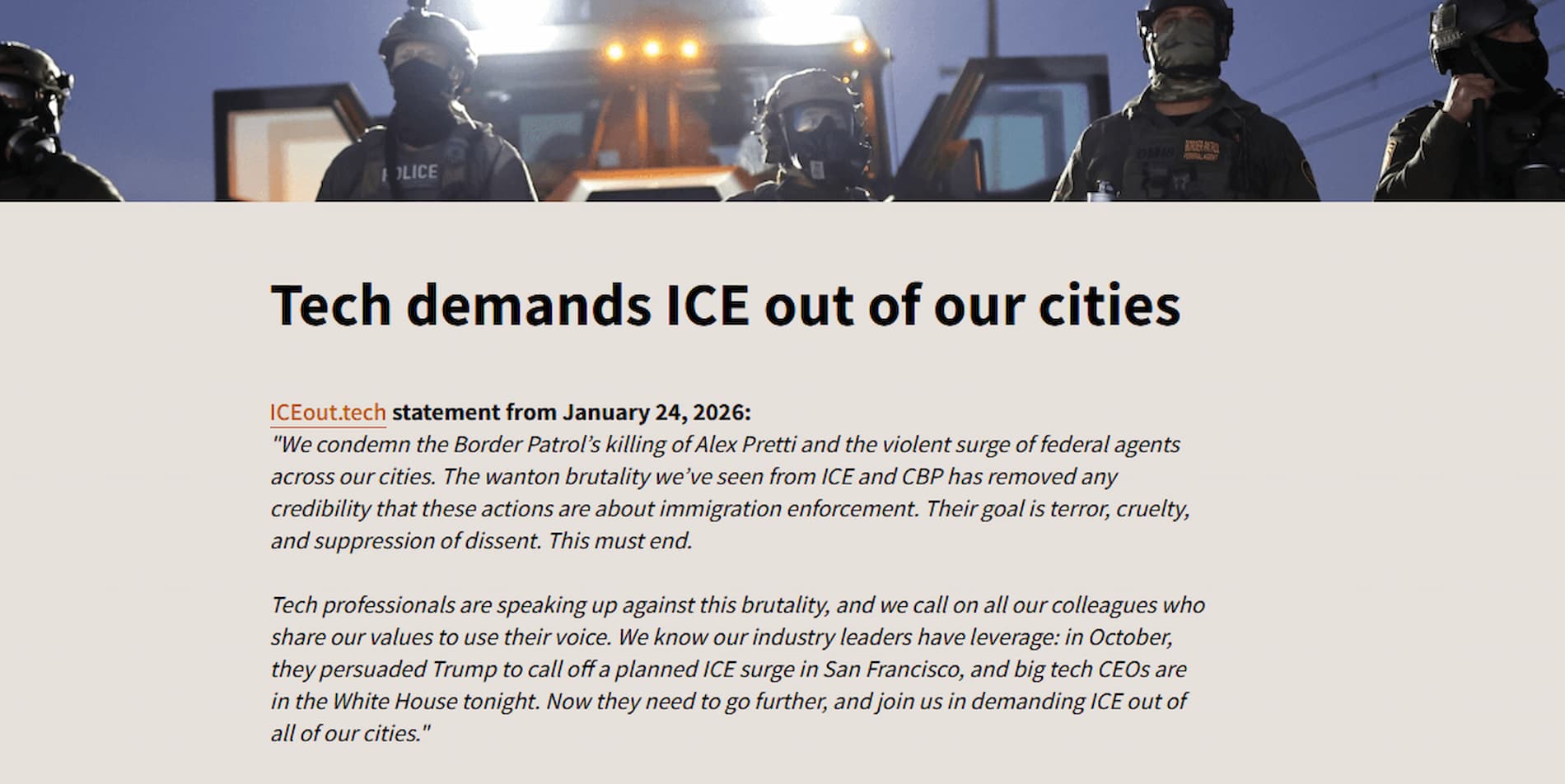
Thousands of tech employees across major companies signed an open letter demanding their employers terminate all contracts with U.S. Immigration and Customs Enforcement, marking one of the largest coordinated workforce actions in the industry’s history. The ICEout.tech campaign emerged following a controversial incident in Minneapolis that galvanized tech workers into collective action. This movement represents a significant shift in how technology professionals view their ethical responsibilities.
The campaign gained momentum rapidly. Within 48 hours of launch, organizers collected over 15,000 signatures from employees at Google, Amazon, Microsoft, and several AI startups. Workers are demanding transparency about which companies hold ICE contracts tech and pushing for immediate cancellation of these agreements.
Understanding the ICEout.tech Movement Goals
The ICEout.tech campaign centers on three primary objectives that reflect growing concerns about tech industry ethics. First, workers want complete contract termination with immigration enforcement agencies. Second, they demand public disclosure of all existing government surveillance partnerships. Third, participants seek binding commitments preventing future contracts with agencies involved in immigration enforcement.
Organizers structured the initiative around grassroots coordination. Unlike previous tech activism efforts, this campaign operates independently of union structures. Employee-led committees at each participating company coordinate messaging and pressure tactics internally while maintaining unified external communication through the central ICEout.tech platform.
Research shows that 67% of tech workers now consider ethical implications when evaluating employers. This represents a dramatic increase from just 38% in 2022. The shift indicates fundamental changes in workforce priorities across the technology sector.
Why Tech Workers Cancel Government Contracts
The immediate catalyst involved Minneapolis protests that erupted after a highly publicized incident. Tech employee protest ICE intensified when internal documents revealed the extent of technology involvement in immigration enforcement operations. Workers discovered that their code, algorithms, and infrastructure directly supported deportation activities.
Many participants cite personal connections to immigration. Approximately 40% of tech workers are immigrants or first-generation Americans, creating visceral reactions to enforcement policies. This demographic reality transforms abstract policy debates into deeply personal workplace conflicts.
Economic leverage plays a crucial role. The current labor market gives skilled engineers significant negotiating power. Companies desperate to retain talent face difficult choices between lucrative government contracts and workforce stability. Some firms already lost key personnel over these issues.
Tech Companies Ending ICE Contracts Face Pressure
Several major players confront mounting internal and external pressure regarding tech activism government surveillance. Google employees previously forced management to abandon Project Maven, a Pentagon AI initiative, demonstrating the potential impact of coordinated worker action. That 2018 victory emboldened subsequent organizing efforts.
Amazon faces particularly intense scrutiny. The company provides cloud computing services and facial recognition technology to various government agencies. Internal estimates suggest that losing these contracts could impact $2-3 billion in annual revenue, creating substantial financial stakes in the debate.
Microsoft maintains a more complicated position. The company publicly emphasizes ethical AI principles while simultaneously pursuing government partnerships. This contradiction generates ongoing friction with employees who question whether corporate values statements carry meaningful weight.
Smaller AI startups navigate additional complexities. Companies like Anthropic and OpenAI depend on maintaining positive public images while pursuing rapid growth. Anthropic’s CEO joined other industry leaders in condemning enforcement tactics, though the company hasn’t committed to contract restrictions.
The Broader Context of Tech Industry Ethics
This campaign reflects evolving conversations about technological responsibility. For decades, Silicon Valley operated under a “move fast and break things” philosophy that prioritized innovation over ethical considerations. That approach increasingly conflicts with workforce values and public expectations.
Why tech workers oppose ICE extends beyond single-issue politics. Participants view immigration enforcement as one element within broader concerns about surveillance capitalism, algorithmic bias, and technology’s role in social control. These interconnected issues form a comprehensive critique of industry practices.
Studies indicate that younger engineers prioritize mission-driven work significantly more than previous generations. Companies ignoring these preferences risk losing competitive advantages in talent acquisition and retention. The war for engineering talent increasingly involves values alignment alongside compensation packages.
Academic researchers document shifting attitudes. Tech workers once viewed themselves as politically neutral builders of tools. Now many embrace activist identities, seeing their labor choices as inherently political acts with real-world consequences. This transformation reshapes workplace dynamics and corporate decision-making processes.
Financial Implications and Corporate Responses
The campaign creates genuine dilemmas for corporate leadership. Government contracts provide stable, lucrative revenue streams that investors value highly. Walking away from these agreements impacts quarterly earnings and stock valuations. Yet employee turnover and reputational damage carry their own financial costs.
OpenAI recently secured $40 billion in funding despite political controversies, suggesting investors may prioritize growth over short-term ethical debates. However, sustained worker activism could eventually impact valuations if it disrupts operations or damages brand perception.
Some venture capital firms experience internal divisions. Khosla Ventures partners publicly disagreed about how portfolio companies should handle these pressures. Such conflicts ripple through startup ecosystems as founders navigate competing stakeholder demands.
Market analysts offer mixed predictions. Some argue that companies accommodating worker demands will gain long-term competitive advantages through enhanced recruitment and retention. Others contend that abandoning government revenue leaves money on the table that competitors will gladly claim.
Legal and Regulatory Considerations
Contract law introduces additional complexity. Many existing agreements include multi-year terms with substantial penalties for early termination. Companies cannot simply walk away without triggering breach clauses that could result in costly litigation.
The Trump administration’s Genesis Mission promotes AI deregulation and expanded government-industry partnerships. This policy framework creates political headwinds for companies considering contract cancellations. Some executives worry that opposing current enforcement priorities could trigger regulatory retaliation.
Employment law also factors into corporate calculations. While workers have significant organizing rights, companies retain authority over business strategy decisions. The legal boundaries of employee influence over contract choices remain somewhat ambiguous, potentially leading to future court battles.
ICE contracts tech involves classified elements in some cases. National security considerations limit transparency and complicate public debates. Companies cannot fully disclose contract details without violating confidentiality agreements, frustrating workers seeking complete information.
Comparing Historical Precedents
The ICEout.tech campaign draws inspiration from various historical movements. Defense industry workers during the Vietnam War era questioned weapons production. More recently, Google employees successfully opposed military AI contracts. Each precedent offers lessons about effective organizing strategies.
However, important differences exist. Previous tech activism often focused on specific projects rather than entire agency relationships. The current movement demands broader, more comprehensive changes to corporate practices. This expanded scope increases both potential impact and implementation challenges.
University research on workplace activism suggests that movements combining internal pressure with external public campaigns achieve higher success rates. ICEout.tech follows this playbook, coordinating employee actions with media outreach and customer advocacy.
International comparisons prove instructive. European tech workers historically demonstrated stronger labor organization and greater willingness to prioritize ethical concerns over economic growth. American tech culture emphasized individualism and market disruption. The ICEout.tech campaign potentially signals American convergence toward European labor models.
Public Opinion and Consumer Responses
Polling data reveals divided public sentiment. Immigration policy remains deeply polarizing, with tech worker stances largely mirroring broader progressive coalitions. However, even some conservatives express discomfort with certain enforcement tactics, creating possible coalition opportunities.
Consumer behavior shows minimal immediate impact. Despite controversies, most users continue patronizing major tech platforms regardless of their immigration-related policies. This disconnect between stated values and purchasing decisions limits market-based pressure mechanisms.
Enterprise customers present different dynamics. Some major corporations publicly committed to diversity and inclusion principles that may conflict with supporting vendors maintaining ICE relationships. B2B sales teams potentially face awkward conversations with clients questioning vendor ethics.
Media coverage amplifies the campaign’s visibility. Journalists extensively covered CEO statements condemning enforcement tactics, bringing mainstream attention to previously niche workplace organizing efforts. Sustained coverage could shift public opinion over time.
Future Trajectories and Potential Outcomes
Several scenarios could unfold. In the best case for organizers, major companies announce comprehensive policy changes including contract cancellations and strengthened ethical review processes. This outcome would establish powerful precedents influencing industry-wide practices.
Alternatively, companies might offer symbolic concessions without substantive change. They could implement new ethics boards or transparency measures while maintaining existing contracts. Such compromises might satisfy some workers while disappointing core organizers.
The worst-case scenario from an activist perspective involves complete corporate resistance. Management could simply wait out the controversy, betting that news cycles move on and employee pressure eventually dissipates. Some workers might leave, but companies could replace them with less politically engaged engineers.
Realistically, outcomes will likely vary by company. Organizations with stronger employee relations traditions and more progressive leadership may accommodate demands more readily. Those with entrenched government partnerships and conservative management will probably resist more forcefully.
Practical Implications for Tech Workers
Engineers considering their own responses face difficult choices. Signing the petition carries minimal immediate risk but represents a public stance. More aggressive actions like work stoppages or resignations involve substantial personal costs requiring careful consideration.
Career consequences remain uncertain. Some worry that activism marks them as troublemakers, potentially limiting future opportunities. Others believe that taking principled stands enhances professional reputations, especially as industry norms shift toward greater social consciousness.
The ICEout.tech movement goals include protecting participants from retaliation. Organizers document cases where workers faced negative consequences for activism, planning potential legal challenges. However, at-will employment structures limit worker protections in many jurisdictions.
Building coalitions across companies provides mutual support. Workers at different firms share organizing strategies, legal resources, and moral encouragement. This cross-company solidarity represents relatively new dynamics in traditionally competitive tech environments.
Conclusion: Tech Industry Ethics at a Crossroads
The ICEout.tech campaign crystallizes fundamental tensions within contemporary technology industries. Workers increasingly demand alignment between corporate practices and stated values. Companies must balance competing stakeholder interests while pursuing growth objectives. These conflicts will shape tech culture for years to come.
Why tech workers oppose ICE encompasses broader questions about technological power and responsibility. As software systems penetrate every aspect of modern life, debates about their proper uses intensify. The immigration enforcement controversy represents one battleground in ongoing wars over technology’s social role.
Success remains uncertain. Tech activism government surveillance faces powerful opposition from government agencies, corporate executives, and shareholders prioritizing profitability. Yet organized workers possess genuine leverage through their scarce skills and ability to disrupt operations.
The movement’s ultimate legacy may transcend immediate outcomes. By forcing public conversations about tech industry ethics and tech workers cancel government contracts demands, organizers shift boundaries of acceptable corporate behavior. Future engineers will inherit workplace cultures shaped by these current struggles.
If you work in technology, consider your own position on these issues. Research your employer’s government relationships. Discuss concerns with colleagues. The ICEout.tech campaign demonstrates that individual engineers can collectively drive meaningful change when they organize effectively around shared values.
Frequently Asked Questions
What is the ICEout.tech campaign?
The ICEout.tech campaign is a coordinated effort by thousands of tech workers demanding their employers terminate all contracts with U.S. Immigration and Customs Enforcement. The movement gained over 15,000 signatures within 48 hours and represents one of the largest workforce actions in tech industry history.
Which companies are targeted by the ICEout.tech movement?
The campaign targets major tech companies including Google, Amazon, Microsoft, and several AI startups like Anthropic and OpenAI. These companies either currently hold ICE contracts or maintain partnerships with agencies involved in immigration enforcement and government surveillance.
What are the main goals of tech workers protesting ICE contracts?
The ICEout.tech movement goals include three primary objectives: complete termination of existing ICE contracts, public disclosure of all government surveillance partnerships, and binding commitments preventing future contracts with immigration enforcement agencies.
Why do tech workers oppose ICE and government surveillance contracts?
Tech workers oppose ICE primarily because approximately 40% of tech employees are immigrants or first-generation Americans, making enforcement policies personally relevant. Workers also cite concerns about tech industry ethics, algorithmic bias, surveillance capitalism, and their code being used in deportation operations.
Have any tech companies agreed to end ICE contracts?
As of January 2026, several tech company CEOs including those from Anthropic and OpenAI publicly condemned enforcement tactics, but most major companies have not yet committed to canceling existing contracts. Google previously abandoned Project Maven after employee pressure, setting a precedent for the current movement.
What are the financial implications for companies ending ICE contracts?
Companies face significant financial stakes, with some government contracts worth $2-3 billion annually. However, employee turnover, reputational damage, and recruitment challenges also carry substantial costs. Some analysts suggest that accommodating worker demands may provide long-term competitive advantages.
How can tech workers participate in the ICEout.tech campaign?
Tech workers can participate by signing the open letter at ICEout.tech, joining employee-led committees at their companies, discussing concerns with colleagues, researching employer government relationships, and coordinating with cross-company organizing efforts. The campaign provides resources and legal support for participants concerned about retaliation.