

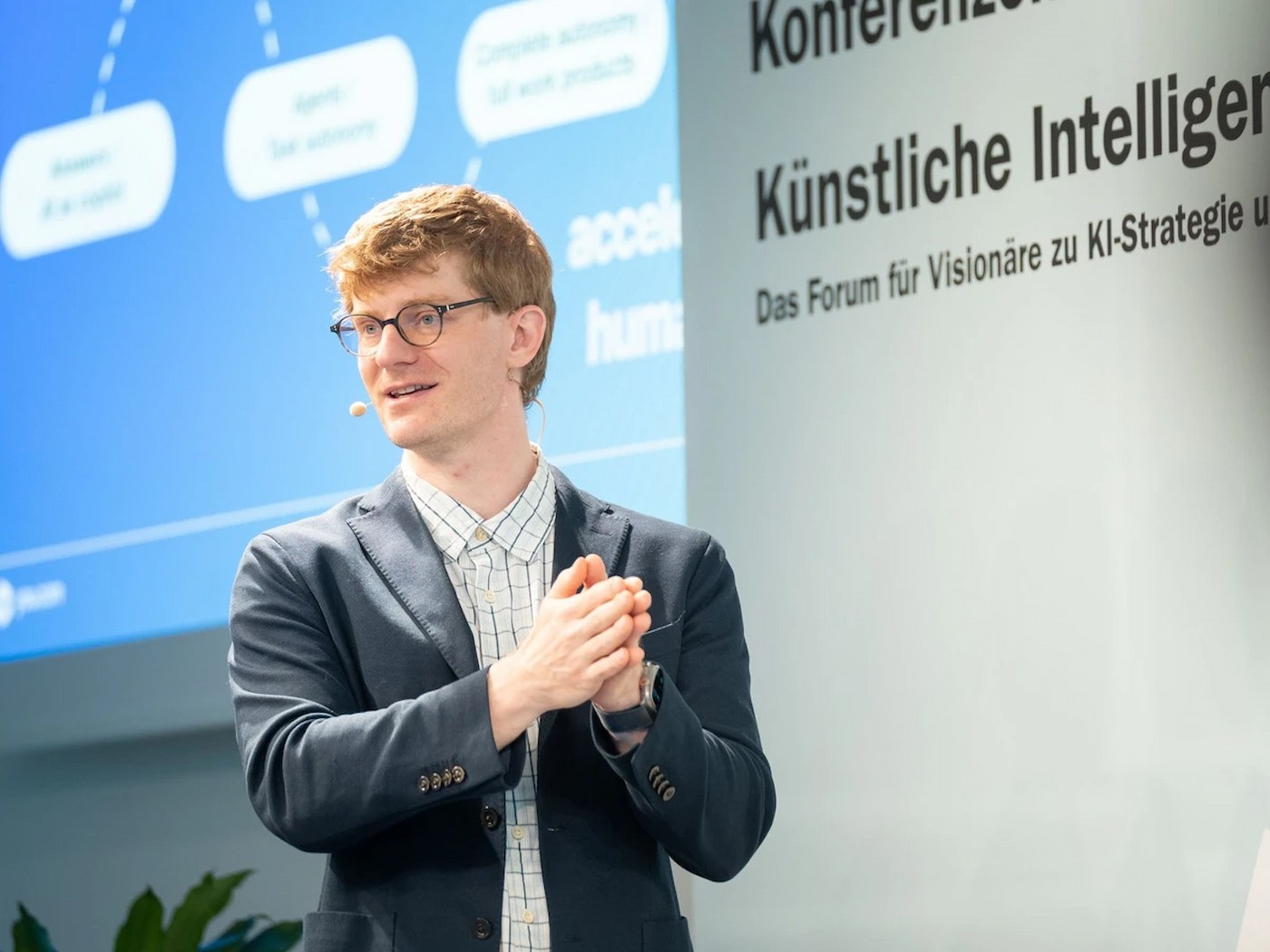
Richard Socher’s Recursive is in talks to raise hundreds of millions at a $4 billion pre-money valuation to build self-improving superintelligent AI, according to recent reports. This development represents one of the most ambitious Richard Socher Recursive AI funding announcements in 2026, positioning the venture as a major player in the race toward AI startup funding 2026.
The artificial intelligence landscape continues accelerating at breakneck speed. We’re witnessing valuations that would have seemed impossible just months ago. Now, one of the industry’s most respected figures is making his boldest move yet.
Who Is Richard Socher and Why Does His New Venture Matter?
Before diving into the Recursive AI $4 billion valuation, understanding Richard Socher’s track record proves essential. In 2014, Socher received a Ph.D. in Computer Science from Stanford University for his dissertation titled “Recursive Deep Learning for Natural Language Processing and Computer Vision,” which was honored with Stanford University’s Best Computer Science PhD Thesis Award. His pioneering work fundamentally shaped how machines understand language.
He has over 185,000 citations, and his pioneering contributions include the development of Recursive Neural Networks (RNNs), which have transformed natural language processing tasks such as sentiment analysis and machine translation. That academic foundation translated directly into commercial success.
The Richard Socher AI startup journey began with MetaMind in 2014. He founded MetaMind, a start-up for AI applications, which he led as CEO/CTO and was acquired by Salesforce in 2016, at which point Socher became Chief Scientist at the company. After leaving Salesforce, he founded You.com, which has a $1.5B valuation and raised $200M+.
Now he’s tackling something even more ambitious with Recursive AI. His focus on superintelligent AI development signals a fundamental shift in his career trajectory.
The $4 Billion Valuation: Breaking Down the Numbers
The Recursive AI investment news centers on a staggering pre-money valuation that puts the company among the AI elite even before it has publicly launched. For context, AI startups attract 33% of total VC funding in 2026, with early-stage, Series A, and Series B rounds seeing higher valuations. This favorable environment creates ideal conditions for ambitious projects.
How does this compare to other recent deals? The first full week of 2026 brought a whopping $20 billion new funding round for Elon Musk’s xAI. While Recursive’s potential raise is smaller, the $4 billion valuation demonstrates extraordinary investor confidence. The AI venture capital trends in 2026 show unprecedented capital flowing into companies promising breakthrough capabilities.
Several factors justify such aggressive valuations. First, Socher’s proven track record de-risks the investment considerably. Second, the superintelligent AI development race has intensified dramatically. Third, investors recognize that whoever achieves meaningful progress first could capture enormous market value.
The funding structure matters enormously. Pre-money valuations differ from post-money calculations, affecting dilution and founder control. If Recursive raises hundreds of millions at this valuation, existing shareholders maintain significant ownership while gaining resources for rapid scaling.
Superintelligent AI: The Ultimate Prize
What exactly is Recursive building? The focus on superintelligent AI development represents the field’s most ambitious goal. Developing superintelligence is now in sight, and it seems clear that in the coming years, AI will improve all our existing systems and enable the creation and discovery of new things that aren’t imaginable today, according to Meta’s perspective on the technology.
Most surveys indicate a 50% probability of achieving AGI between 2040 and 2061, with some estimating that superintelligence could follow within a few decades. However, many industry leaders predict much faster timelines. Elon Musk stated that we will achieve AGI in 2026, and by 2030, the total intelligence of AI will “exceed the sum of all human intelligence”.
The concept of recursive self-improvement lies at Recursive’s core. I. J. Good proposed the concept of an “intelligence explosion”, where an AI system could rapidly improve its own intelligence, potentially leading to superintelligence. This theoretical framework has transitioned from science fiction to serious engineering pursuit.
What makes self-improving AI so powerful? The feedback loop creates exponential capabilities. An AI that improves its own algorithms accelerates beyond human-guided development. Each iteration becomes smarter, faster, and more capable than the last. Eventually, the system could surpass human intelligence across all domains.
Critics remain skeptical about near-term superintelligence. Experts gave the tech leaders’ timeline of rapid progress only a 23% chance of actually happening, where “AI writes Pulitzer Prize-worthy novels, collapses years-long research into days and weeks, outcompetes any human software engineer, and independently develops new cures for cancer”. This gap between industry hype and expert consensus creates interesting dynamics.
AI Startup Funding 2026: A Record-Breaking Year
The broader AI startup funding 2026 landscape provides crucial context for understanding Recursive’s raise. AI startup funding trends for 2026 show rapid growth, rising valuations, and investor confidence, with strategies to secure capital becoming increasingly important. Multiple tailwinds support this environment.
Enterprise adoption has accelerated dramatically. TechCrunch surveyed 24 enterprise-focused VCs and an overwhelming majority predicted enterprises will increase their budgets for AI in 2026, though this budget increase will be concentrated and many enterprises will spend more funds on fewer contracts. This consolidation benefits category leaders like Recursive.
Mega rounds, funding rounds above 100 million dollars, now sit at the center of AI fundraising, concentrating large amounts of capital into a small group of high performing startups and turning a few players into category leaders, giving founders resources to scale fast, dominate distribution, and hire aggressively. The Richard Socher Recursive AI funding round fits this pattern perfectly.
Geographic dynamics also matter. While Silicon Valley dominates, other hubs are emerging. The concentration of talent, capital, and infrastructure in specific regions creates network effects that benefit well-connected founders like Socher.
The Competitive Landscape: Who Else Is Racing Toward Superintelligence?
Recursive AI doesn’t operate in a vacuum. The superintelligent AI development race includes several well-funded competitors with different approaches. Understanding this landscape reveals where Recursive might fit strategically.
OpenAI remains the category leader. OpenAI raised $40 billion at a $300 billion post-money valuation in March 2025 and later reached a $500 billion valuation by October through secondary share sales, with the company projecting annual recurring revenue growth from $6 billion to $20 billion by 2026. Their resource advantage is substantial but not insurmountable.
Anthropic pursues safety-focused AGI development. Their Constitutional AI approach attempts to build alignment directly into foundation models. Google DeepMind combines academic research rigor with corporate resources. Meta has declared that personal superintelligence that knows us deeply, understands our goals, and can help us achieve them will be by far the most useful, with personal devices like glasses that understand our context.
Interestingly, a different company called Ricursive Intelligence (note the spelling) recently launched. Ricursive Intelligence, a frontier AI lab with the mission to transform semiconductor design, launched and announced its $35 million seed round led by Sequoia Capital at a $750 million final valuation. Despite the similar name, this is a separate company focused on chip design rather than general superintelligence.
What differentiates Recursive AI from these competitors? Socher’s unique combination of academic depth, entrepreneurial experience, and industry connections creates advantages. His networks span leading research institutions, major tech companies, and venture capital firms. This positioning enables faster talent acquisition, partnership formation, and strategic navigation.
Technical Approach: How Might Recursive Achieve Superintelligence?
While Recursive hasn’t disclosed detailed technical approaches, we can infer possibilities from Socher’s background and current AI trends. His expertise in recursive neural networks suggests potential architectural innovations. The recursive self-improvement concept likely plays a central role.
According to METR’s report, the length of coding tasks AIs can handle, their “time horizon”, doubled every 7 months from 2019 – 2024 and every 4 months from 2024-onward, and if the trend continues, by March 2027 AIs could succeed with 80% reliability on software tasks that would take a skilled human years to complete. This trajectory suggests near-term breakthroughs in AI capabilities could emerge.
Several technical pathways could lead toward superintelligence. Scaling existing architectures with more compute and data represents the dominant paradigm. Developing new architectures that transcend transformer limitations offers another route. Combining multiple specialized systems into coherent general intelligence provides a third approach.
The alignment problem remains critical. Unlike the chatbots many people use today, superintelligent AI could be fundamentally different and more dangerous, as they are rushing to build smarter and smarter AIs. Ensuring that superintelligent systems pursue goals aligned with human values represents one of humanity’s most important challenges.
Investment Risks and Rewards
The Recursive AI $4 billion valuation implies enormous expectations. Investors backing this round are betting on multiple improbable events occurring. Let’s examine what must go right—and what could go wrong.
Success requires technical breakthroughs that remain uncertain. Despite rapid progress, fundamental obstacles to superintelligence persist. We don’t fully understand intelligence, consciousness, or reasoning. Engineering systems that surpass human cognition without understanding these foundations is challenging.
The competitive environment creates winner-take-most dynamics. If OpenAI, DeepMind, or Anthropic achieves superintelligence first, Recursive’s value could evaporate. Network effects, data advantages, and talent concentration favor incumbents. Recursive must execute flawlessly while competitors stumble.
Regulatory risks loom large. Governments increasingly scrutinize advanced AI development. Export controls restrict access to cutting-edge chips. Safety requirements could mandate expensive testing and oversight. International competition might trigger restrictions on technology transfer or talent mobility.
The upside case, however, is extraordinary. Successfully developing aligned superintelligence could create trillions in value. The company controlling such technology would reshape entire industries. Early investors could see returns measured in hundreds or thousands of X.
AI Venture Capital Trends: What This Deal Signals
The Richard Socher Recursive AI funding discussions reveal broader AI venture capital trends that extend beyond this single deal. Investor behavior is shifting in response to technological progress and market dynamics.
Seed rounds for AI benefit from a 42% premium in valuations, with Series A and Series B rounds achieving significantly higher median valuations compared to non-AI peers, and the funding landscape for AI is set for continued robust growth. This premium reflects both genuine capabilities and speculative fervor.
Capital concentration intensifies as investors pick perceived winners. Andrew Ferguson predicted 2026 will be the year that enterprises start consolidating their investments and picking winners, as enterprises test multiple tools but will cut out experimentation budget, rationalize overlapping tools and deploy savings into AI technologies that have delivered. This consolidation benefits companies with strong fundamentals and impressive demos.
Due diligence standards vary wildly. Some investors conduct rigorous technical assessments, engaging domain experts to evaluate architectural choices and capability claims. Others rely on founder reputation, competitive dynamics, and momentum. The Recursive AI investment news will test which approach proves wiser.
The Socher Effect: Founder Reputation in Fundraising
Richard Socher’s involvement fundamentally changes Recursive’s fundraising dynamics. His reputation functions as both signal and asset, reducing perceived risk while attracting resources. This “Socher effect” manifests across multiple dimensions.
Socher built and exited one startup (MetaMind), scaled AI inside Salesforce, and raised $200M+ for You.com, while being active in academia and startup investment, mentoring young AI founders. This track record demonstrates capabilities across research, engineering, product, and business development.
Investor access proves easier for repeat founders. Socher’s existing relationships with top-tier venture firms enable rapid fundraising. He can bypass early-stage gatekeepers and pitch directly to decision-makers. This efficiency reduces time spent fundraising and increases favorable terms.
Talent acquisition similarly benefits from founder brand. Top researchers and engineers want to work with respected leaders on ambitious problems. Socher’s academic connections and industry reputation help recruit exceptional teams. This talent advantage compounds over time.
What Happens Next: Potential Scenarios
Assuming Recursive closes this funding round, several scenarios could unfold. The path from capital raise to superintelligence involves numerous decision points and uncertainties. Let’s explore possible futures.
The aggressive scaling scenario involves rapidly expanding headcount, acquiring massive compute resources, and pursuing ambitious technical milestones. This approach mirrors OpenAI’s trajectory, burning capital to achieve breakthroughs before competitors. Success requires consistent progress and patient investors.
The focused research scenario prioritizes technical depth over rapid scaling. A smaller team tackles fundamental problems before pursuing commercialization. This approach reduces burn rate and emphasizes scientific rigor. The risk is competitors achieving critical breakthroughs first.
The partnership scenario involves collaborating with established tech giants. Large companies provide compute infrastructure, data access, and distribution while Recursive contributes algorithmic innovations. This derisks the venture but potentially limits upside.
The pivot scenario acknowledges that superintelligence timelines might exceed initial expectations. Recursive could target nearer-term applications while continuing long-term research. This generates revenue and validates capabilities without abandoning the ultimate vision.
Implications for the AI Industry
The Recursive AI investment news extends beyond one company’s fundraising. It signals broader shifts in how the industry approaches superintelligent AI development and allocates resources.
Funding availability for ambitious AI projects remains extraordinary. Despite economic uncertainties, investors pour billions into companies promising transformative capabilities. This capital influx accelerates research but also inflates valuations and expectations.
The concentration of talent and resources among a small number of labs raises concerns. The CEOs of OpenAI, Google DeepMind, and Anthropic have all predicted that AGI will arrive within the next 5 years. If these predictions prove accurate, decisions made by a handful of organizations will determine humanity’s trajectory.
Safety considerations receive increasing attention but remain secondary to capability development. Companies invest in alignment research but allocate far more resources to building more powerful systems. This imbalance creates risks that concern many researchers.
Conclusion: A Defining Moment in AI’s Evolution
Richard Socher’s Recursive AI funding discussions at a $4 billion valuation represent more than a financial transaction. They exemplify the extraordinary ambitions, resources, and expectations surrounding superintelligent AI development in 2026.
The AI startup funding 2026 environment enables ventures that seemed impossible years ago. Mega-rounds concentrate capital among companies pursuing transformative breakthroughs. The AI venture capital trends favor experienced founders tackling existential challenges.
Whether Recursive AI successfully develops superintelligent systems remains uncertain. The technical obstacles are formidable. The competitive landscape is brutal. The timeline predictions might prove wildly optimistic.
But the attempt matters enormously. Each serious effort to build aligned superintelligence teaches us something valuable. Each team contributes to collective understanding. Each failure eliminates approaches that don’t work.
Richard Socher has spent his career pushing the boundaries of what AI systems can achieve. From pioneering recursive neural networks to building successful companies, he’s consistently delivered impact. Now he’s attempting his most ambitious project yet.
The coming years will reveal whether the Recursive AI $4 billion valuation proves prescient or premature. Either way, this moment marks another step in humanity’s journey toward creating intelligence that surpasses our own. That journey, regardless of its ultimate destination, will reshape our world in ways we can barely imagine.
For entrepreneurs, investors, and researchers watching this space, the message is clear: the race toward superintelligent AI development has entered its most intense phase. The decisions made today will echo through history. And Richard Socher has just placed his biggest bet yet.
Frequently Asked Questions
What is Recursive AI and who founded it?
Recursive AI is a new artificial intelligence startup founded by Richard Socher, the renowned AI researcher and entrepreneur who previously founded MetaMind (acquired by Salesforce) and You.com. The company is focused on developing self-improving superintelligent AI systems and is currently in talks to raise funding at a $4 billion pre-money valuation.
What makes the Recursive AI $4 billion valuation significant?
The $4 billion valuation is significant because it places Recursive among the most valuable AI startups despite being in early stages. This reflects extraordinary investor confidence in Richard Socher’s track record and the potential of superintelligent AI development. The valuation aligns with broader AI venture capital trends showing premium valuations for ambitious AI projects in 2026.
How does Richard Socher Recursive AI funding compare to other AI startups?
While smaller than OpenAI’s $500 billion valuation or xAI’s recent $20 billion funding round, Recursive’s potential $4 billion valuation and hundreds of millions in funding positions it among the top-tier AI startups. The company benefits from Socher’s proven track record, having previously raised $200M+ for You.com and successfully exited MetaMind to Salesforce.
What is superintelligent AI development and why does it matter?
Superintelligent AI development aims to create artificial intelligence systems that surpass human intelligence across all cognitive domains. This represents the ultimate goal of AI research, with potential to transform every industry and aspect of human life. Leading AI companies predict AGI could arrive within the next few years, with superintelligence following shortly after.
What are the AI venture capital trends in 2026?
AI startup funding 2026 trends show that AI companies attract 33% of total venture capital, with seed rounds receiving a 42% valuation premium over non-AI startups. Mega-rounds above $100 million dominate the landscape, concentrating capital among high-performing companies. Investors increasingly focus on category leaders with proven founders and transformative potential.
What technical approach might Recursive AI take toward superintelligence?
While Recursive hasn’t disclosed specific technical details, Richard Socher’s background in recursive neural networks and deep learning suggests innovative architectural approaches. The company likely focuses on recursive self-improvement systems where AI iteratively enhances its own capabilities, potentially leveraging recent progress in AI coding abilities that double every 4 months.
What are the risks and opportunities of Recursive AI investment news?
Risks include technical uncertainty about achieving superintelligence, intense competition from well-funded rivals like OpenAI and DeepMind, regulatory challenges, and potentially inflated valuations. Opportunities include potentially massive returns if Recursive succeeds, first-mover advantages in transformative technology, and the chance to participate in one of humanity’s most significant technological developments.