
PM Modi Champions Indigenous AI Innovation : Urges Indian AI Startups to Showcase Local Use Cases

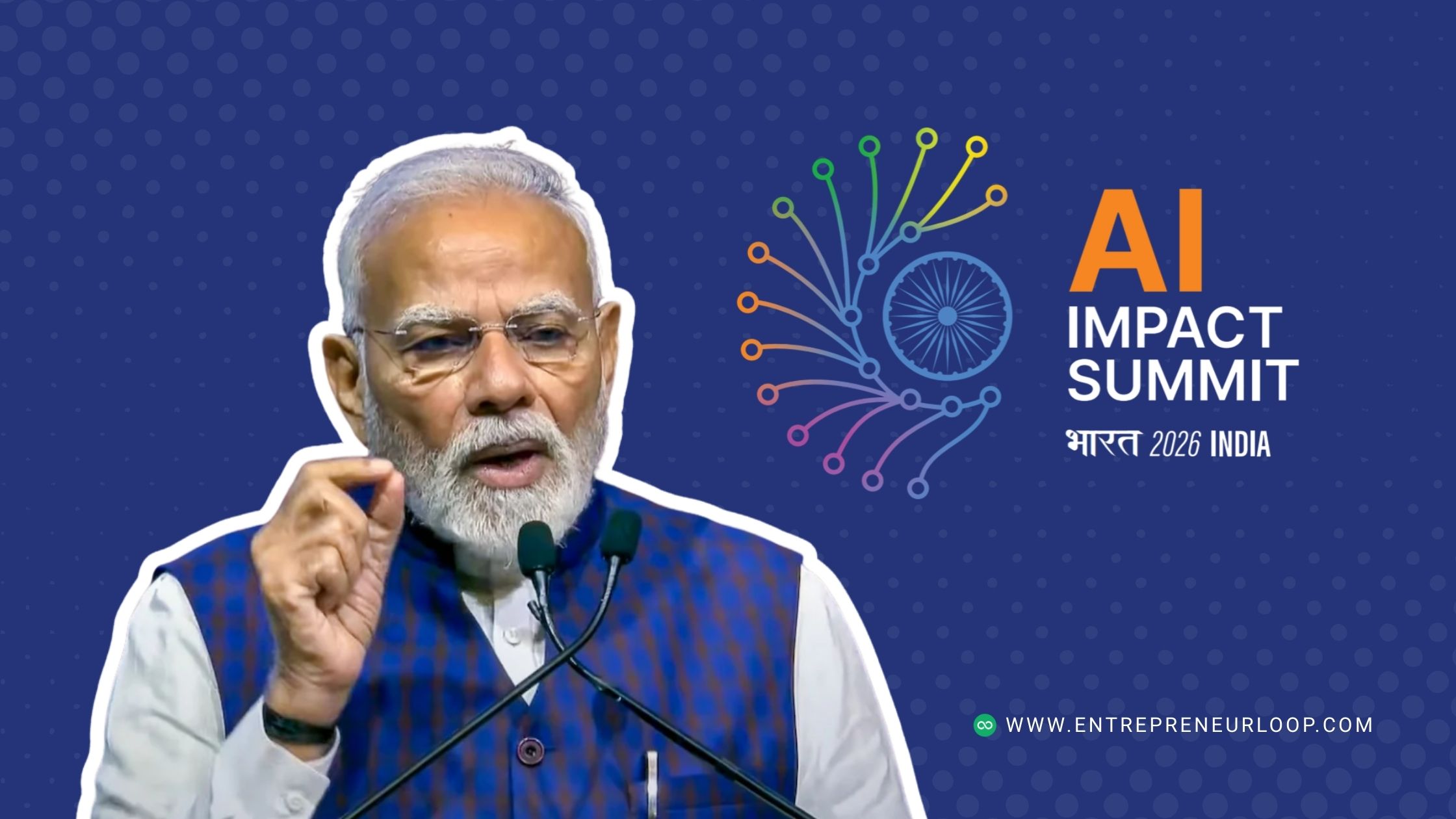
India : Prime Minister Narendra Modi has issued a bold challenge to Indian AI startups. He wants them to showcase their strongest innovations at the upcoming IndiaAI Impact Summit 2026.
This isn’t just another tech conference. Twelve Indian AI startups have been selected to demonstrate their innovations at the first-ever global AI summit hosted in the Global South. The February AI summit India startups event represents a turning point for local AI use cases to gain international recognition.
Key Takeaways: What You Need to Know
Before we dive deeper, here’s what matters most:
- 12 Indian AI startups will showcase local AI use cases at the February 2026 summit in New Delhi
- ₹10,372 crore IndiaAI Mission provides 18,000 GPUs at under ₹100/hour for startups
- Ethics-first approach distinguishes India’s AI strategy from Western and Chinese models
- Real impact: AI solutions are already blocking ₹25 crore daily in UPI fraud and saving ₹390 billion annually in healthcare costs
- Global reach: 300+ pre-summit events across 25 countries with 15,000+ registrations from 135 nations
The PM Modi AI Vision India: Ethics Meets Innovation
What sets the PM Modi AI vision India apart from global competitors?
Ethics forms the cornerstone. PM Modi emphasized that Indian AI models must be ethical, unbiased, transparent, and rooted in data privacy principles. This commitment to ethical AI India distinguishes the nation’s approach from purely profit-driven models dominating Silicon Valley and China.
And here’s the kicker: the IndiaAI Mission provides the infrastructure backbone. The government allocated ₹10,300 crore over five years to strengthen AI capabilities. This creates a robust ecosystem for India AI startups to thrive.
Inside the 90-Minute Roundtable
The closed-door meeting on January 8, 2026, lasted over ninety minutes. Participants included companies like Sarvam, Gnani, BharatGen, Fractal, and Intellihealth—all working on local AI use cases spanning diverse sectors.
The conversation turned technical quickly. Founders described Modi’s engagement as remarkably hands-on. He wasn’t there for ceremonial platitudes. He wanted specifics on how these Made in India AI models would differ from Western alternatives.
Modi repeatedly stressed that India should aim to lead in artificial intelligence rather than settle for limited pilots. His message was clear: the IndiaAI Impact Summit 2026 must become a launchpad for homegrown innovations that solve real problems for real people.
Top Local AI Use Cases from Indian Startups
What makes local AI use cases so crucial for India’s strategy? Context.
These startups are addressing challenges that global AI models ignore. They’re building solutions for India’s 22 scheduled languages, rural infrastructure constraints, and unique cultural contexts. Unlike generic AI tools built for English-speaking markets, these local AI solutions India develops serve real people facing real challenges.
The 12 Startups Leading India’s AI Revolution
Here’s who’s showcasing at the February summit:
- Sarvam AI – Multilingual large language models supporting Indian languages
- Gnani.ai – Speech-to-speech AI with 14 billion parameters for voice-enabled services
- BharatGen – Open-source multilingual models from 2B to 1 trillion parameters
- Fractal Analytics – AI-powered business intelligence and decision-making tools
- Intellihealth – Healthcare diagnostics and medical research platforms
- Avataar – Generative 3D content for e-commerce applications
- Soket AI – Engineering simulation and design optimization
- Shodh AI – Research and knowledge discovery platforms
- Genloop – Domain-specific AI applications for enterprises
- GAN – Advanced generative AI solutions
- Tech Mahindra – Enterprise AI transformation services
- Zenteiq – Industry-specific AI deployment tools
Healthcare: Where AI Saves Lives and Money
Consider the healthcare sector. Research estimates that AI-assisted screening tools could save the Indian public around ₹390 billion ($4.7 billion) annually. That’s approximately 12% of India’s total out-of-pocket healthcare expenditure.
PM Modi AI healthcare startups are building diagnostic tools that work in rural clinics with limited internet connectivity. They support regional languages that global AI models completely ignore. These aren’t theoretical benefits—they’re operational systems serving patients today.
Wadhwani AI received $2.5 million from Google.org to pilot HealthVaani. This LLM-based conversational AI assistant—launched in partnership with the Ministries of Health and Women and Child Development—uses Gemini 2.5-Flash for translations and answer generation. It’s multimodal, multilingual, and supports frontline health workers who serve India’s most vulnerable populations.
Agriculture: Precision Farming for 490 Million Workers
Agriculture presents another compelling frontier. The IndiaAI Mission, in collaboration with Maharashtra’s AI and Agritech Innovation Center, invites use case submissions for a Casebook on AI’s Real-World Impact in Agriculture.
You might be wondering: what difference does AI make for farmers?
These local AI use cases help farmers optimize irrigation, predict pest infestations, and plan crop rotations based on hyperlocal weather patterns. These challenges require India-specific data and models that understand monsoon patterns, soil conditions, and crop varieties unique to the subcontinent.
Bengaluru-based Cropin exemplifies this approach. With $46.4 million in funding, their platform offers insights into crop health, pest risks, and yield forecasts. They’re giving farmers data-backed decision-making tools that directly increase profitability.
Financial Services: Protecting Millions Daily
The results speak for themselves in financial technology. NPCI’s graph-based risk engine flags roughly 70,000 fraudulent UPI requests every single day. It’s blocking an estimated ₹25 crore in scam attempts daily.
These aren’t laboratory prototypes. They’re operational systems protecting millions of transactions using local AI use cases tailored specifically to Indian payment patterns and fraud techniques.
Made in India AI Models: A New Global Standard
The Made in India AI models initiative extends beyond nationalism. It addresses a fundamental gap in the global AI landscape.
Modi emphasized that India should present a unique AI model to the world reflecting the spirit of “Made in India, Made for the World.” This philosophy embraces cost-effective solutions—creating powerful AI without the resource-heavy infrastructure that makes Western AI inaccessible to most of the world.
How India’s Models Compete Globally
How do Made in India AI models achieve this balance? Through architectural efficiency and purpose-driven design.
Led by IIT Bombay, BharatGen is building an open-source suite of multilingual and multimodal models. They’re scaling from 2 billion to a massive one trillion parameters. Interestingly enough, their recent 2.9B bilingual LLM outperforms global peers on key benchmarks.
These models use script-aware tokenizers and dedicate 25% of their training corpus to Indic data. This ensures linguistic accuracy for India’s diverse language landscape—something global models consistently fail to deliver.
Speech Technology That Actually Works
Another breakthrough comes from Gnani.ai. With 14 billion parameters, their model excels in multilingual, real-time speech processing and advanced reasoning.
What’s fascinating is their native “speech-to-speech” capabilities. These are ideal for voice-enabled services in call centers, education, and accessibility tools. In a country where many users prefer voice interfaces over text-based interactions, this matters enormously.
AI for Social Good: Not Just Profit
Furthermore, the AI for social good India principle guides development priorities. Rather than chasing consumer entertainment applications, Indian AI innovation focuses on solving systemic challenges.
Education, governance, and public health take priority. These local AI solutions India creates establish new benchmarks for socially responsible technology. Game-changing. That’s how industry experts describe this initiative.
IndiaAI Mission: Building the Foundation
What infrastructure supports this ambitious vision? The IndiaAI Mission operates through seven strategic pillars that democratize AI access across India.
The Seven Pillars of IndiaAI Mission
Here’s how the government is building India’s AI ecosystem:
- Compute Infrastructure – 18,000 GPU commons (NVIDIA H100s, AMD MI300 Xs, AWS Trainium-2) with coupon-based incentives trimming up to 40% off list prices
- Innovation Centers – AI labs in Tier 2 and Tier 3 cities to distribute innovation beyond metros
- Datasets Platform – IndiaAI Dataset Platform (AIKosha) housing the largest collection of anonymized, non-personal datasets
- Application Development – Funding and support for startups building indigenous foundation models
- Future Skills – Fellowships for 13,500 scholars and AI curriculum integration in universities
- Startup Financing – Acceleration programs and investment support for AI ventures
- Safe & Trusted AI – Governance frameworks ensuring ethical, transparent AI deployment
Democratizing Computing Power
This democratization levels the playing field. Previously, advanced model training meant paying foreign cloud providers ₹150-₹180 per H100 hour and shipping sensitive data offshore.
Now? Founders, professors, and students access sovereign compute for under ₹100 per GPU hour. By pooling capacity and underwriting part of the bill, the government targets a ten-fold jump in indigenous model R&D.
Analysts project a ₹7-lakh-crore Gen-AI economy by 2030. That’s ambitious—but the infrastructure is being built today to support it.
Data: The Missing Piece
Data forms another critical pillar. The IndiaAI Dataset Platform provides seamless access to high-quality, non-personal datasets. It houses the largest collection of anonymized data specifically for AI research.
This addresses a historical bottleneck. Indian researchers previously lacked diverse, representative datasets for training models. That gap is closing rapidly.
Talent: India’s Secret Weapon
Talent development completes the ecosystem. According to the Stanford AI Index 2024, India ranks first globally in AI skill penetration with a score of 2.8. That’s ahead of the US (2.2) and Germany (1.9).
India’s AI talent concentration has grown 263% since 2016. The IndiaAI Mission expands this advantage through fellowships, university partnerships, and hands-on training programs.
February AI Summit India Startups: Global Expectations
The stakes for the February AI summit India startups couldn’t be higher. Scheduled for February 19-20, 2026, in New Delhi, the Summit brings together policymakers, researchers, industry leaders, startups, and civil society.
This represents India’s opportunity to redefine global AI discourse around impact rather than just capability.
What Makes This Summit Different
While no specific deadlines were announced, the government expects real outcomes. Modi wants demonstrations of working solutions already deployed at scale—not laboratory prototypes or conceptual presentations.
The distinction matters. India aims to showcase solutions built for Indian needs rather than simply hosted in the country.
Global Engagement: Beyond Expectations
The international community watches closely. Approximately 300 pre-summit events have been organized across 25+ countries. Three large-scale global challenges—YUVAi, AI by HER, and AI for All—attracted over 15,000 registrations from 135 countries.
Around 4,700 submissions poured in. This engagement demonstrates hunger for alternative AI development models beyond the US-China paradigm.
Three Core Principles Guiding the Summit
The summit follows three core principles:
- People – AI that serves humanity’s broadest needs
- Planet – Sustainable and energy-efficient AI development
- Progress – Economic growth coupled with social good
Seven thematic working groups will structure discussions covering human capital development, inclusive and locally relevant AI systems, safe governance frameworks, scientific collaboration, democratization of AI resources, and AI for economic growth.
How India’s Approach Compares to Global AI Summits
It’s worth noting that India’s approach differs fundamentally from AI summits in other countries.
India vs. US AI Strategy
United States: Focus on maintaining technological dominance through massive private sector investment. Emphasis on commercial applications and military AI. Limited government intervention in development priorities.
India: Government-led infrastructure with private sector execution. Explicit focus on social good and ethical frameworks. Subsidized compute democratizes access beyond tech giants.
India vs. China AI Strategy
China: State-controlled development with surveillance capabilities integrated. Massive computational resources concentrated in government-approved entities. Export-focused but with significant restrictions.
India: Open-source emphasis with transparency requirements. Distributed innovation across startups and research institutions. Ethics and privacy as non-negotiable foundations.
India vs. European Union AI Strategy
European Union: Regulation-first approach with comprehensive AI Act. Strong privacy protections but slower deployment timelines. Limited compute infrastructure compared to US and China.
India: Balance between enabling innovation and ensuring safety. Risk-based governance building on existing legal frameworks. Rapid deployment coupled with ethical guidelines.
Clearly, India’s positioning the summit as a “third way”—combining innovation velocity with ethical safeguards and inclusive development.
Ethical AI India: Setting Global Standards
How does ethical AI India translate from principle to practice? Through concrete governance frameworks that balance innovation with safety.
India’s Risk-Based Governance Approach
The meeting comes after India unveiled its AI Governance Guidelines in November 2025 under the IndiaAI Mission. This establishes a risk-based, evidence-led approach that builds on existing legal frameworks rather than creating new AI-specific laws from scratch.
Information Technology Minister Ashwini Vaishnaw emphasized that India aims to launch its own safe and secure indigenous AI model at an affordable cost. The goal? Help India emerge as a reliable technological powerhouse of ethical AI solutions.
This pragmatic approach resonates globally. It appeals to developing nations skeptical of expensive, proprietary Western systems or surveillance-oriented alternatives.
Transparency Requirements
Transparency requirements distinguish Indian models from competitors. Modi stressed that Indian AI models must be ethical, unbiased, and transparent—rooted firmly in data privacy principles while reflecting India’s diversity through local content and regional languages.
This commitment to transparency extends to:
- Model documentation and technical specifications
- Training data provenance and composition
- Algorithmic decision-making processes
- Regular audits and accountability mechanisms
Data Privacy as Foundation
Data privacy forms a non-negotiable foundation. Unlike surveillance-oriented AI implementations in some countries, India’s framework prioritizes citizen consent and data minimization.
The IndiaAI Dataset Platform demonstrates this commitment by providing only anonymized, non-personal datasets for research and development. Personal data remains protected while enabling innovation.
India AI Startups: From Local to Global
Can India AI startups successfully compete on the world stage? Evidence suggests yes—and the momentum is accelerating.
Startup leaders highlighted the rapid growth and vast future potential of the AI sector. They observe that the center of gravity of artificial intelligence innovation and deployment is beginning to shift towards India. This shift reflects both technological capability and market opportunity.
The Numbers Tell the Story
The numbers support this optimism:
- ₹10,372 crore IndiaAI Mission budget over five years
- 18,000 subsidized GPUs in national pool
- 25% CAGR projected growth to $17 billion market by 2027
- 263% increase in AI talent concentration since 2016
- 15,000+ registrations from 135 countries for summit challenges
This growth trajectory positions India as one of the fastest-expanding AI markets globally.
International Partnerships Accelerating Growth
International partnerships accelerate this growth. In collaboration with STATION F and HEC Paris, the IndiaAI Mission will launch an acceleration program for Indian AI startups.
Ten selected AI startups will receive a four-month immersive program:
- 1 month online preparation
- 3 months onsite at STATION F in Paris (the world’s largest startup campus)
This provides access to European markets, investors, and technical expertise that would otherwise take years to develop.
Challenges and Obstacles: The Road Ahead
But there’s more to the story than just opportunities. Indian AI startups face significant challenges that need honest acknowledgment.
Talent Retention Issues
Despite India’s #1 ranking in AI skill penetration, talent retention remains problematic. Many of the country’s best AI researchers and engineers migrate to higher-paying positions in the US and Europe.
The IndiaAI Mission’s fellowship programs attempt to address this. However, competing with Silicon Valley salaries requires more than just infrastructure—it demands building world-class research environments and commercial opportunities at home.
Infrastructure Gaps Beyond Compute
While the 18,000 GPU commons represents significant progress, infrastructure gaps extend beyond raw computing power. Reliable high-speed internet, stable electricity, and data center capabilities in Tier 2 and Tier 3 cities lag behind metros.
Startups building local AI use cases for rural applications often struggle with deployment infrastructure that doesn’t exist yet.
Funding Challenges at Scale
Indian AI startups secure impressive seed and Series A funding. However, late-stage capital for scaling operations globally remains challenging. Most large AI investments still flow to US and Chinese companies.
The IndiaAI Mission’s startup financing pillar aims to bridge this gap. Success will require coordinating domestic institutional investors, family offices, and international capital.
Regulatory Uncertainty
Despite the November 2025 governance guidelines, some regulatory uncertainty persists. Startups need clarity on data localization requirements, cross-border data flows, and liability frameworks for AI-driven decisions.
Balancing innovation-friendly policies with necessary safeguards remains an ongoing challenge that will evolve beyond the February summit.
Looking Forward: AI for Social Good India
What does success look like beyond the February summit? Long-term impact on citizens’ lives—not just impressive technical demonstrations.
Transforming 490 Million Informal Workers
NITI Aayog’s report “AI for Inclusive Societal Development” shows how AI can empower India’s 490 million informal workers. By expanding access to healthcare, education, skilling, and financial inclusion, AI-driven tools can boost productivity and resilience for millions who form the backbone of India’s economy.
This isn’t about replacing workers with automation. It’s about augmenting human capabilities with intelligent tools that level the playing field.
Education Revolution in Progress
Education transformation continues accelerating. AI-powered learning platforms adapt to individual student needs across languages and learning styles. They provide personalized instruction that human teachers—facing 40+ student classrooms—simply can’t deliver alone.
Digital governance initiatives use AI to streamline public services, reduce corruption, and improve transparency. Each application demonstrates how AI for social good India prioritizes inclusive development over commercial returns alone.
Timeline and Roadmap: What Happens After February 2026?
Here’s the projected timeline for India’s AI journey:
Q1 2026 (February): IndiaAI Impact Summit showcases working solutions and establishes global partnerships
Q2-Q3 2026: Acceleration programs launch, sending startups to international markets while scaling domestic deployments
Q4 2026: First indigenous large language models (1 trillion parameters) complete training and begin deployment
2027: Expansion of GPU commons to 30,000+ units as demand grows; AI curriculum reaches 500+ universities
2027-2028: Major scaling of agriculture, healthcare, and education AI applications; measurable impact on GDP contribution
2030: Target ₹7-lakh-crore Gen-AI economy with India recognized as top-3 global AI innovation hub
Obviously, timelines will shift based on real-world deployment challenges. However, the roadmap demonstrates commitment beyond a single summit.
What This Means for You: Actionable Takeaways
Depending on who you are, here’s what you should do with this information:
For Indian AI Startups
- Apply immediately for IndiaAI Mission GPU access at under ₹100/hour
- Submit applications to STATION F acceleration program for European market access
- Prepare demos of deployed solutions (not prototypes) if targeting February summit visibility
- Leverage dataset platform to train models with India-specific data
- Focus on local AI use cases that address real problems in healthcare, agriculture, education, or governance
For Investors
- Reassess India AI exposure in portfolios given projected 25% CAGR
- Prioritize startups with deployed solutions and measurable social impact
- Look beyond metros to Tier 2/3 cities where AI labs are creating new innovation clusters
- Evaluate ethics frameworks as differentiator—this will matter increasingly for global expansion
- Consider co-investment with IndiaAI Mission programs for de-risked opportunities
For Policymakers and Government Officials
- Study India’s approach as alternative to US/China models, especially for developing nations
- Engage with IndiaAI summit and pre-summit events to understand governance frameworks
- Explore partnerships for technology transfer and capacity building
- Implement risk-based AI governance building on existing laws rather than creating new regulatory overhead
For Citizens and End Users
- Stay informed about AI applications in your sector (healthcare, education, agriculture)
- Provide feedback when testing AI tools—your local context insights improve model development
- Advocate for ethical AI deployment that respects privacy and transparency
- Learn basic AI literacy to better understand and benefit from emerging tools
The PM Modi AI Vision India: Redefining Global Leadership
The PM Modi AI vision India ultimately redefines what AI leadership means. Rather than competing solely on model size or computational power, India positions itself as the champion of responsible, inclusive, affordable AI that serves humanity’s broadest needs.
As the IndiaAI Impact Summit 2026 approaches, the world watches to see whether this vision can deliver measurable impact at scale. The early evidence—from HealthVaani supporting frontline workers to NPCI blocking daily fraud to Cropin helping farmers increase yields—suggests the answer is yes.
These local AI use cases aren’t just Indian solutions. They’re templates for the 6+ billion people living in developing economies who need AI that works for them—not just the privileged few in developed nations.
The February summit will showcase whether India can transform these local innovations into global solutions that bridge the digital divide rather than widen it. That would be truly transformative.
Frequently Asked Questions
What is the IndiaAI Impact Summit 2026?
The IndiaAI Impact Summit 2026 is the first global AI summit hosted in the Global South, scheduled for February 19-20, 2026, in New Delhi. It brings together policymakers, researchers, industry leaders, and startups to showcase transformative local AI use cases and promote inclusive, ethical AI development focused on People, Planet, and Progress. Over 300 pre-summit events across 25+ countries have generated 15,000+ registrations from 135 nations.
Why did PM Modi emphasize local AI use cases for Indian startups?
PM Modi urged Indian AI startups to showcase local AI use cases because they address India-specific challenges in healthcare, agriculture, education, and governance. These solutions are built for Indian languages, cultural contexts, and infrastructure constraints that global AI models ignore. By developing local AI use cases, India positions itself as a leader in affordable, inclusive AI innovation that can serve developing economies worldwide—representing 6+ billion people who need AI that works for them.
What is the IndiaAI Mission and how does it support AI startups?
The IndiaAI Mission is a ₹10,372 crore government initiative with seven strategic pillars supporting AI development. It provides 18,000 subsidized GPUs at under ₹100 per hour (compared to ₹150-₹180 from foreign cloud providers), datasets through the IndiaAI Dataset Platform, fellowships for 13,500 scholars, AI labs in Tier 2-3 cities, and funding for startups building indigenous foundation models. The mission aims to create a ₹7-lakh-crore Gen-AI economy by 2030.
How do Made in India AI models differ from global AI models?
Made in India AI models prioritize cost-effective innovation, ethical design, multilingual capabilities for 22+ Indian languages, data privacy, transparency, and local content. They’re optimized for lower computational costs while addressing India-specific challenges like limited internet connectivity, diverse linguistic needs, and cultural contexts. For example, BharatGen dedicates 25% of its training corpus to Indic data using script-aware tokenizers, while Gnani.ai’s speech-to-speech model works specifically for voice-preferred Indian users.
What are some examples of local AI solutions India is developing?
Local AI solutions India includes HealthVaani—an LLM-based conversational AI assistant for frontline health workers that’s multimodal and multilingual; Cropin’s precision agriculture platform helping farmers optimize yields with $46.4 million in funding; NPCI’s fraud detection blocking ₹25 crore daily in UPI scams; Gnani.ai’s 14-billion-parameter speech-to-speech models; BharatGen’s open-source LLMs scaling to 1 trillion parameters; and AI diagnostic tools projected to save ₹390 billion annually in healthcare costs.
How does ethical AI India differ from AI development in other countries?
Ethical AI India emphasizes transparency, data privacy, unbiased algorithms, and inclusive design rooted in India’s diversity. Unlike surveillance-oriented models (China) or purely profit-driven approaches (US tech companies), Indian AI governance guidelines use risk-based frameworks that build on existing laws, prioritize citizen consent, promote regional languages, and focus on social good. The IndiaAI Dataset Platform provides only anonymized, non-personal datasets, demonstrating commitment to privacy while enabling innovation.
Which startups will showcase innovations at the February 2026 AI summit?
Twelve startups qualified for the AI for All: Global Impact Challenge including Sarvam (multilingual LLMs), Gnani (speech processing), BharatGen (open-source models), Fractal (business intelligence), Intellihealth (healthcare diagnostics), Avataar (3D generative content), Soket AI (engineering simulations), Shodh AI (research platforms), Genloop (domain-specific AI), GAN (generative solutions), Tech Mahindra (enterprise AI), and Zenteiq (industry deployment tools). These companies work on local AI use cases spanning healthcare, agriculture, education, e-commerce, and governance.
What challenges do Indian AI startups face despite government support?
Indian AI startups face several challenges including talent retention (many researchers migrate to higher-paying US/European positions), infrastructure gaps beyond compute power (reliable internet and electricity in Tier 2-3 cities), late-stage funding difficulties for scaling globally, and some regulatory uncertainty around data localization and cross-border flows. While the IndiaAI Mission addresses many issues, building world-class research environments and commercial opportunities that compete with Silicon Valley requires sustained effort beyond infrastructure alone.
How can startups, investors, or citizens get involved with IndiaAI initiatives?
Startups should apply for IndiaAI Mission GPU access, leverage the dataset platform, submit applications to the STATION F acceleration program, and focus on deployed solutions addressing real problems. Investors should reassess India AI portfolio exposure given 25% CAGR projections and prioritize startups with measurable social impact. Citizens can stay informed about AI applications in their sectors, provide feedback when testing AI tools, advocate for ethical deployment, and develop basic AI literacy to benefit from emerging tools.