

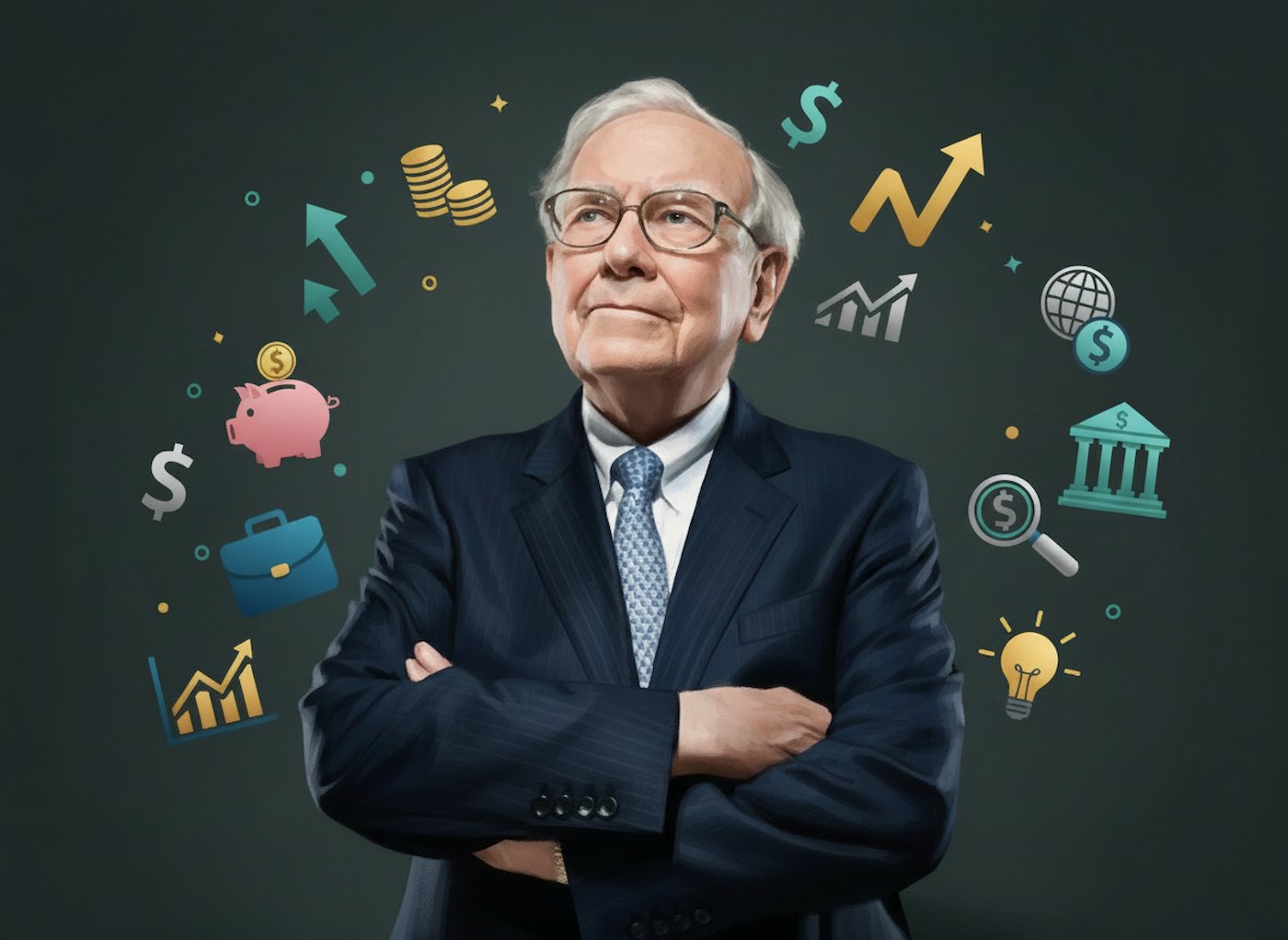
Legendary investor Warren Buffett, widely known as the “Oracle of Omaha,” steps down as Chief Executive Officer of Berkshire Hathaway today, marking one of the most significant transitions in corporate history. At 95 years old, he’s transforming a struggling New England textile manufacturer into a diversified global powerhouse valued at over $1 trillion—a journey that shows how patient investing creates extraordinary wealth.
And here’s the thing: the Warren Buffett retirement isn’t just about one man leaving a corner office. It’s about whether an entire investment philosophy can survive without its architect.
Timeline: Key Dates in the Buffett-to-Abel Transition
Let’s be clear about what’s happening and when:
1965: Buffett takes control of Berkshire Hathaway at $19/share May 2025: Announces retirement at annual shareholder meeting December 31, 2025: Warren Buffett steps down as CEO (today) January 1, 2026: Greg Abel officially becomes CEO
This planned handover has been years in the making, giving investors time to prepare. Or has it?
The Historic Leadership Transition Begins
Berkshire Hathaway announced that Greg Abel, vice chairman overseeing non-insurance operations, will succeed Buffett as CEO effective January 1, 2026. Abel brings extensive experience managing complex operations across energy and infrastructure sectors.
The Berkshire Hathaway CEO change caught many by surprise when announced at the May 2025 annual shareholder meeting. “I think the time has arrived where Greg should become the chief executive of the company at year end,” Buffett said at the gathering in Omaha. Even Abel himself seemed caught off guard.
But here’s what matters for your portfolio: Buffett will remain chairman of Berkshire Hathaway. This ensures continuity in the company’s unique culture. The culture emphasizes hands-off management style, conservative capital allocation, and long-term value creation. Plus, he plans to come into the office daily—the man still drives himself to work in a modest sedan and grabs McDonald’s for breakfast on the way.
Warren Buffett’s Remarkable Journey from $19 to $750,000
Buffett took control of Berkshire Hathaway in 1965, initially seeking to salvage the textile business. Then came the pivot. He gradually redirected capital into insurance, railroads, utilities, consumer brands, and equities. What many considered a failing investment became a trillion-dollar empire.
The numbers? Astonishing.
Buffett took the stock from $19/share in 1965 to $750,000/share today—up 3,950,000%—according to market analysis published today. Few investors in history have achieved such spectacular long-term returns. Actually, scratch that. No one has matched this record over six decades.
His disciplined value-investing philosophy delivered unparalleled returns for shareholders. It earned him global recognition as one of the greatest investors of all time. His annual shareholder letters became essential reading for investors worldwide, offering wisdom that transcended markets and touched on ethics, management, and human behavior.
The Buffett 60-year tenure witnessed countless market cycles, economic crises, and technological revolutions. Berkshire owns wholly owned subsidiaries including BNSF Railway, Geico, Berkshire Hathaway Energy, Dairy Queen, and numerous manufacturing and retail businesses. This diversification provided stability through tumultuous times—a lesson in not putting all your eggs in one basket.
How This Compares to Other Legendary CEO Transitions
Warren Buffett steps down after 60 years. How does that stack up?
Jack Welch ran GE for 20 years before handing off to Jeff Immelt—a transition that, frankly, didn’t go well. Steve Jobs left Apple twice, with Tim Cook eventually taking permanent control. Both companies struggled initially without their visionary founders. The difference? Buffett’s been preparing Abel for years, not months.
Greg Abel: The Chosen Successor
Abel, a longtime Berkshire executive, has been widely viewed as Buffett’s chosen successor. He’s played a key role in expanding the company’s energy and infrastructure businesses over the past two decades. His track record demonstrates competence and alignment with Berkshire’s values.
As Greg Abel takes the helm, he inherits world-class businesses like GEICO and BNSF Railway. But that’s not all. He also gets a record-shattering $382 billion cash pile, according to financial reports from today.
What will he do with all that cash? That’s the $382 billion question.
Finding attractive investments in today’s elevated market poses significant challenges. The pressure to deploy capital will intensify as the pile grows. So here’s what investors should watch: Abel’s first major acquisition. It’ll signal his investment philosophy and whether he’s willing to be as patient as Buffett.
Abel’s Investment Style: How It Differs from Buffett’s Approach
Abel (who, by the way, has been preparing for this role since 2018 when Buffett publicly endorsed him) brings a more hands-on management style. While Buffett famously gave executives complete autonomy, Abel asks tough questions. He holds company leaders accountable for their performance, recent reports indicate.
This approach balances oversight with entrepreneurial freedom. It’s also more aggressive on technology investments—Abel pushed for the Amazon and Alphabet stakes that Buffett initially resisted.
Organizational Shake-Up: Key Leadership Changes
The Berkshire Hathaway leadership transition includes several organizational changes. Warren Buffett announced Monday that the leadership ranks were being reshuffled as the 95-year-old prepares to end his tenure.
Todd Combs—head of Geico, the insurance company owned by Berkshire Hathaway—is leaving for an “interesting and important job” at JPMorgan Chase. This creates new dynamics within the executive team. Nancy L. Pierce has been appointed CEO of GEICO, effective immediately. Ms. Pierce currently serves as Chief Operating Officer of GEICO and has held leadership roles across claims, underwriting, product management and regional operations since joining in 1986.
Chief Financial Officer Marc Hamburg is retiring after 40 years with the company. Charles Chang, the CFO of Berkshire Hathaway Energy, takes over the role next year. Adam M. Johnson, CEO of NetJets, has been appointed President of the Consumer Products, Service and Retailing businesses while continuing at NetJets. These moves signal the Warren Buffett retirement brings broader organizational evolution.
These promotions from within demonstrate Berkshire’s commitment to continuity. It’s a vote of confidence in the existing culture.
The Cultural Challenge: Can Berkshire Survive Without Buffett?
Here’s what really matters: Will Berkshire’s unique culture survive?
Industry observers expect Buffett’s continued presence to provide stability and reassurance to shareholders during the transition. His guidance will prove invaluable as Abel navigates early challenges. Nevertheless, the transition tests whether Berkshire’s culture can survive without its architect at the helm.
Berkshire’s core investment philosophy should remain unchanged under Abel’s leadership. Abel has been deeply involved in strategic decision-making and has earned the trust of Buffett and the board. This continuity should comfort shareholders worried about dramatic shifts.
Still, recent analysis suggests challenges await. Berkshire is sitting on a cash and Treasury bill pile exceeding $380 billion. This raises questions about how effectively that capital can be deployed in an environment of elevated asset valuations and limited large-scale acquisition opportunities.
Can Abel allocate capital as effectively as his predecessor? We’re about to find out.
What Makes This Transition Historic
Unprecedented. Historic. The end of an era.
Buffett’s retirement as CEO marks the end of an era not only for Berkshire Hathaway but for American investing as a whole. His emphasis on patience, integrity, and rational decision-making reshaped how generations of investors view markets and corporate leadership. His influence extended far beyond financial returns.
“What I’ve always admired about Warren Buffett, and (his late business partner) Charlie Munger for that matter, is their use of plain English and plain language to explain difficult concepts,” Steve Hafner, the CEO of Kayak, said. This clarity made investing accessible to millions—you didn’t need an MBA to understand Buffett’s annual letters.
The latest business coverage highlights lessons from his career. “From Warren Buffett, I’ve learned that excellence really is a discipline,” said Larry Restieri, CEO at wealth management firm Hightower. “Set a clear direction, stay true to your principles and execute patiently.”
These principles transcend investing. They apply to life, business, relationships—anything requiring long-term thinking in a short-term world.
Market Implications: What Warren Buffett Steps Down Means for Your Portfolio
So what should Berkshire shareholders do? Hold, buy, or sell?
Buffett will remain chairman and plans to continue coming into the office each day to help spot new investments and offer Abel advice, according to reporting from today. This arrangement provides a safety net during the transition period. Frankly, having the Oracle of Omaha as your backup isn’t a bad position to be in.
For decades, Berkshire’s stock has traded with a “Buffett Premium”—a valuation boost attributed to his unique genius for capital allocation and his status as a moral compass for the investing public. Whether this premium persists under new leadership remains an open question.
Market psychology plays a significant role in valuations. Some analysts expect a 5-10% discount to develop as the market adjusts to life without Buffett at the helm.
Berkshire Stock Reaction: What Happened Today
Berkshire Hathaway shares traded relatively flat in early trading today, suggesting investors had already priced in the transition. The Class A shares hovered around $750,000, while Class B shares traded near $500. Trading volume was elevated but orderly—no panic selling, no euphoric buying.
This measured response reflects confidence in the succession plan. It also shows that Abel has already earned investors’ trust through years of strong operational performance.
The Cash Deployment Challenge: $382 Billion Question
One of Abel’s most pressing challenges involves the massive cash position.
As Warren Buffett steps down, he leaves his successor with a $381.7 billion question: What will the company do with all that cash? The pressure to take action will rise as the cash continues to accumulate, investment analysts note.
Finding value in today’s market won’t be easy. Berkshire has struggled to find significant acquisitions. Even this fall’s $9.7 billion acquisition of OxyChem probably isn’t big enough to move the needle. Scale has become both blessing and curse—when you’re managing $1 trillion, a $10 billion deal barely registers.
Some experts believe a dividend may be inevitable. Buffett has consistently expressed his affinity for dividend stocks throughout his career. He’s also been equally vocal about his disdain for the idea of Berkshire Hathaway paying one. Instead, Buffett has long preferred to retain Berkshire’s profits and invest them in acquisitions or other opportunities.
Abel may need to reconsider this long-standing policy. If he can’t find attractive investments, returning cash to shareholders makes sense. It’s basic capital allocation.
Buffett’s Enduring Philosophy and The Giving Pledge
The jump from $19 to $750,000 is really a story about patience, discipline, and the power of compounding. It’s not about any single brilliant trade. Buffett avoided overpaying, shunned complex derivatives and high leverage, stuck to businesses he understood, and let time do the heavy lifting.
This simplicity belied profound wisdom. As Buffett himself said, “It’s far better to buy a wonderful company at a fair price than a fair price at a wonderful price.”
His approach to Warren Buffett retirement reflects characteristic thoughtfulness. He has no plans to sell his shares in Berkshire Hathaway, which are expected to be donated after his death. “I would add this, the decision to keep every share is an economic decision because I think the prospects of Berkshire will be better under Greg’s management than mine,” he said.
Buffett’s Philanthropic Legacy and The Giving Pledge
Beyond investing, Buffett’s impact on philanthropy rivals his financial achievements. He co-founded The Giving Pledge with Bill Gates in 2010, convincing over 200 billionaires to commit at least half their wealth to charitable causes.
What happens to The Giving Pledge now? Buffett remains committed—his entire Berkshire stake will eventually go to the Gates Foundation and his family foundations. This transition doesn’t change that. If anything, it ensures his philanthropic vision outlives his CEO tenure.
Looking Ahead: The Post-Buffett Era
Investor Chris Ballard, who is managing director at Check Capital, said most of Berkshire’s businesses “can almost take care of themselves.” He sees a bright future for Berkshire under Abel. The company’s operational excellence provides a strong foundation for continued success.
“As a long-term shareholder, we aren’t too concerned with Todd’s departure and don’t think this is the tip of some sort of iceberg,” said Ballard, whose firm counts Berkshire as its largest holding. “Todd’s situation is unique. It’s just a reminder that Warren’s pending departure is imminent and they’re preparing for a new phase—one that we’re still excited to see unfold.”
The transition raises questions about potential strategic shifts. Berkshire Hathaway’s tech investments have increased as Buffett has given more authority to his staff in recent years. When Berkshire finally invested in Amazon in 2019, Buffett noted that it wasn’t he who bought the stock but one of his fund managers. More recently, the company opened a nearly $5 billion stake in Alphabet.
Abel may accelerate technology investments. He’s more comfortable with tech than Buffett ever was. Expect to see Berkshire deploy more capital into software, cloud computing, and artificial intelligence over the next decade.
The Legacy of the Oracle of Omaha
As we mark this historic day, we recognize that Warren Buffett steps down having fundamentally changed how people think about investing, business, and wealth creation. His emphasis on long-term thinking over short-term gains influenced countless investors and business leaders.
60 years of success is an unprecedented run in the up-today, down-tomorrow world of investing, NPR reported today. His consistency defied market volatility and economic cycles. His ability to maintain discipline during manias and panics set him apart.
The Oracle of Omaha’s impact extends beyond financial metrics. Buffett wrote in 2025: “Kindness is costless but also priceless.” This perspective on wealth and giving shaped philanthropic efforts worldwide.
He famously plays bridge with Bill Gates at his Omaha office—the same modest building on Farnam Street he’s occupied for decades. No corporate jet. No sprawling campus. Just discipline, focus, and an unshakeable belief in value investing.
What Investors Should Watch in 2026
Shareholders and market observers should monitor several key factors in the coming months:
Capital Allocation Decisions: Abel’s ability to find attractive investments in an expensive market will determine Berkshire’s returns. Watch for his first major acquisition—it’ll set the tone for his entire tenure.
Communication Style: Will Abel maintain Buffett’s folksy, transparent communication style? His first annual letter will be scrutinized intensely.
Insurance Operations Stability: The head of the insurance unit, Vice Chairman Ajit Jain, is now 74. Many of the CEOs of the various companies have continued working long after retirement age because they like working for Buffett. Future leadership changes could create additional uncertainty.
Decentralized Structure: Berkshire operates under an extremely decentralized structure that trusts its executives with significant decisions. Everyone associated with the company has said there are no plans to change that. This autonomy has been central to Berkshire’s success.
Dividend Policy: Will Abel break with tradition and institute Berkshire’s first-ever dividend? If the cash pile hits $500 billion with no attractive investments, the pressure will intensify.
Technology Investments: How aggressively will Abel pursue tech companies compared to Buffett’s cautious approach? This could reshape Berkshire’s portfolio over the next decade.
Should You Hold, Buy, or Sell Berkshire Stock?
Let’s be real: This is the question every Berkshire shareholder is asking.
For long-term holders, the answer is simple: Hold. Buffett himself is keeping every share. The fundamentals remain strong—world-class businesses, fortress balance sheet, proven management team. The culture of value investing and patient capital allocation isn’t going anywhere.
For new investors, this transition creates opportunity. If the stock dips on sentiment concerns, it may offer an attractive entry point. You’re getting a $1 trillion conglomerate with $382 billion in cash at what could be a temporary discount.
For traders, caution is warranted. Short-term volatility is possible as the market adjusts to Abel’s leadership style and first major decisions.
Bottom line? Berkshire remains one of the best-managed companies in the world. Warren Buffett steps down, but his investment philosophy lives on.
Today marks the end of one of the greatest chapters in business history. Warren Buffett steps down from a role he’s held for six extraordinary decades, leaving behind a legacy that will influence investors and business leaders for generations. As Greg Abel assumes leadership of this trillion-dollar conglomerate, the world watches to see whether Berkshire Hathaway can maintain its exceptional culture and performance in the post-Buffett era.
Frequently Asked Questions
When did Warren Buffett step down as Berkshire Hathaway CEO?
Warren Buffett officially stepped down as CEO of Berkshire Hathaway on December 31, 2025, after serving in the role for 60 years. He announced his intention to retire at the company’s annual shareholder meeting in May 2025, giving the organization several months to prepare for the transition. This deliberate timeline allowed for a smooth handover of responsibilities to his successor, Greg Abel.
Who is replacing Warren Buffett as Berkshire Hathaway CEO?
Greg Abel, the 62-year-old vice chairman who has been overseeing Berkshire’s non-insurance operations, became CEO on January 1, 2026. Abel has been with Berkshire for over two decades and was publicly identified as Buffett’s successor in 2021, giving him years to prepare for the role. He brings extensive experience from Berkshire Hathaway Energy, where he successfully managed complex acquisitions and operations.
How much is Berkshire Hathaway worth after Warren Buffett’s 60-year tenure?
Under Warren Buffett’s leadership, Berkshire Hathaway grew from a struggling textile manufacturer into a diversified conglomerate valued at over $1 trillion. The company’s stock price increased from $19 per share in 1965 to approximately $750,000 per share by the end of 2025, representing a gain of nearly 4 million percent—the greatest wealth creation in investment history.
Will Warren Buffett remain involved with Berkshire Hathaway after retirement?
Yes, Warren Buffett will remain as chairman of Berkshire Hathaway’s board of directors. He plans to continue coming into the office daily to help identify investment opportunities and provide advice to Greg Abel when requested, though Abel will have final decision-making authority on operations, capital deployment, and acquisitions. This arrangement provides continuity during the critical transition period.
What is Berkshire Hathaway’s biggest challenge during this leadership transition?
The biggest challenge facing new CEO Greg Abel is deploying Berkshire’s record-breaking $382 billion cash reserve in an environment of elevated asset valuations and limited large-scale acquisition opportunities. How effectively Abel allocates this capital will significantly impact the company’s future returns and define his early legacy as CEO. The pressure to act will intensify as the cash pile continues growing.
Should I sell my Berkshire Hathaway stock now that Warren Buffett steps down?
Most analysts recommend holding Berkshire stock for long-term investors. Buffett himself is keeping every share, and the fundamentals remain strong with world-class businesses, a fortress balance sheet, and a proven management team. While short-term volatility is possible, the company’s culture of value investing and patient capital allocation should persist under Abel’s leadership. For new investors, any sentiment-driven dip could offer an attractive entry point.
How has the Berkshire Hathaway leadership team changed alongside Buffett’s retirement?
Several significant leadership changes accompanied Buffett’s retirement. Todd Combs, who led GEICO, departed for JPMorgan Chase, with Nancy Pierce becoming GEICO’s new CEO. CFO Marc Hamburg announced retirement plans, with Charles Chang set to succeed him in 2027. Adam Johnson was appointed president of consumer products, service, and retailing businesses. These moves create a new organizational layer while maintaining Berkshire’s commitment to promoting from within and preserving its unique decentralized culture.